Archive · 8 Aug 2026
Saudi Arabia, Turkey and Pakistan sign Mecca Joint Defence Agreement
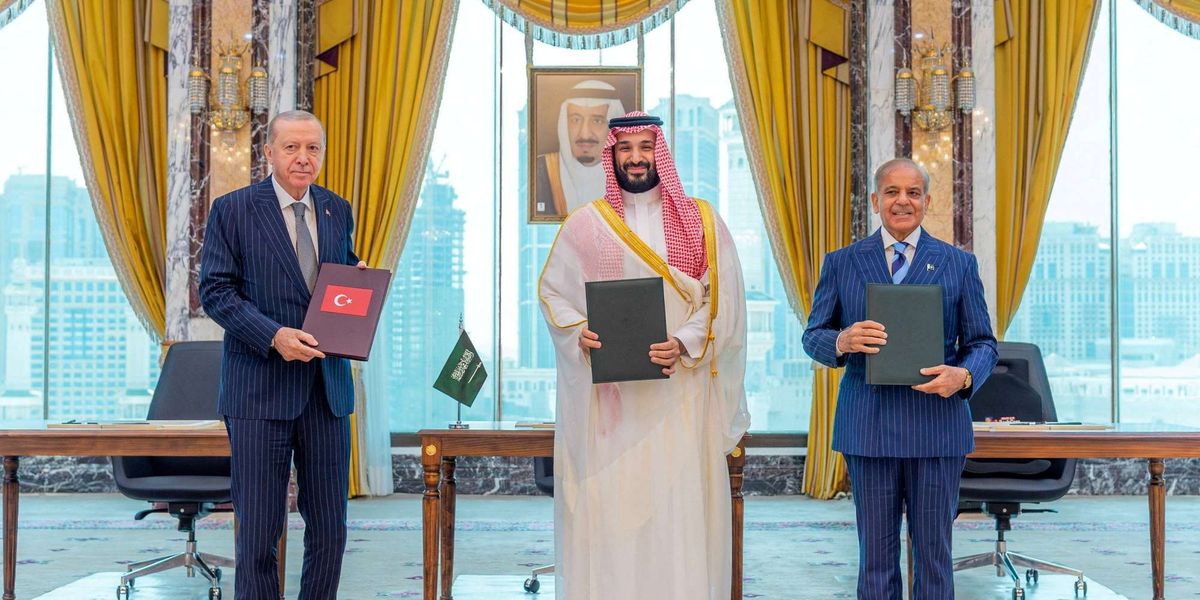
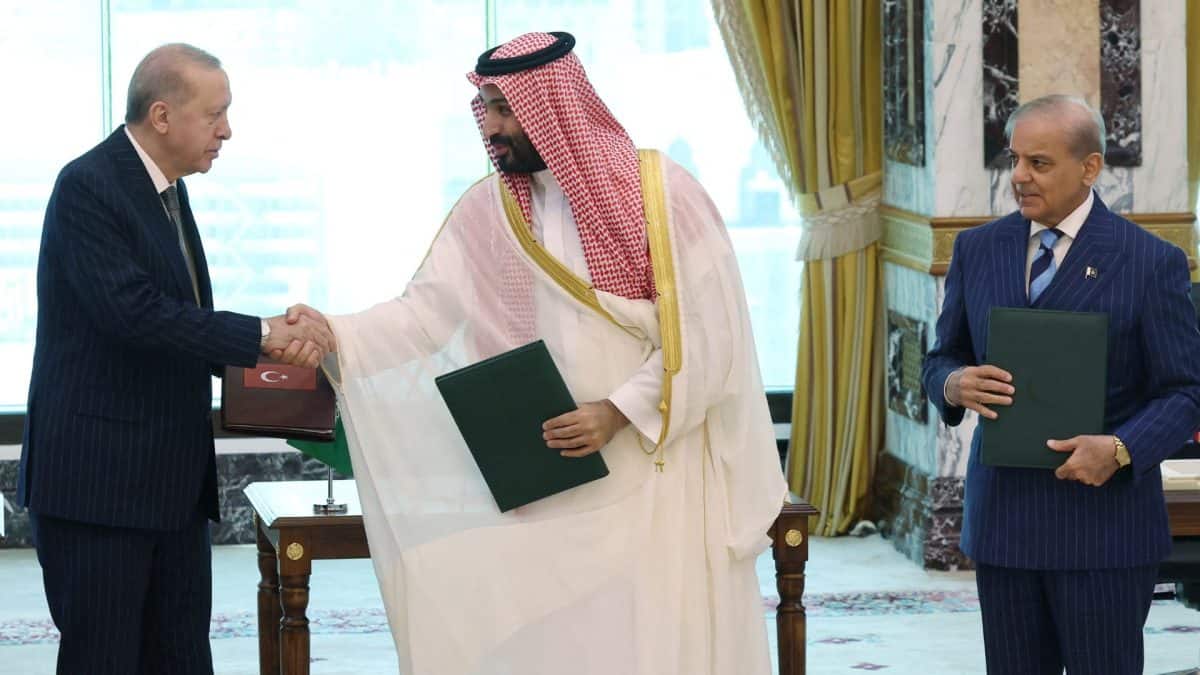
The leaders of three countries — Saudi Arabia, Turkey, and Pakistan — met at a palace in Mecca, a holy city in Saudi Arabia, and signed a special agreement called the Mecca Joint Defence Agreement.
This agreement promises that if one of the countries is attacked, the other two will help defend it.
It is like a big promise between friends to protect each other.
The agreement also lets the three countries share safety secrets and build things like drones and ships together.
They decided to do this because there has been a lot of fighting in the Middle East, and some places have been hit by rockets and drones.
A few days before the signing, rockets fired by Yemen's Houthi group killed many soldiers in southern Saudi Arabia.
The three leaders say the agreement is only for defence, not to start new fights or to target any other country.
Other countries, like India and Iran, are watching closely to see what this new team will mean for the region.

Saudi Arabia, Turkey and Pakistan signed the Mecca Joint Defence Agreement (MJDA) at the Al-Safa Palace overlooking the Grand Mosque in Mecca.
The trilateral pact commits the three nations to treating an armed attack on any one signatory as an attack on all three, citing Article 51 of the UN Charter.
It covers mutual defence, intelligence sharing, joint military exercises, and co-production of UAVs, naval systems, air defence and electronic warfare hardware.
The signing followed an August 6, 2026 Houthi missile and drone strike that killed at least 58 Yemeni government troops and injured 11 civilians in southern Saudi Arabia.
India said it is 'closely following' the pact, while Iranian lawmakers criticised it and Israel and the United States responded with cautious scrutiny.
- Who
- Saudi Crown Prince and Prime Minister Mohammed bin Salman Al Saud, Turkish President Recep Tayyip Erdogan and Pakistani Prime Minister Shehbaz Sharif signed the pact.
- What
- The signing of the Mecca Joint Defence Agreement, a trilateral collective defence and military cooperation pact.
- When
- Friday, August 7, 2026, days after the August 6 Houthi attack on southern Saudi Arabia.
- Where
- Al-Safa Palace overlooking the Grand Mosque in Mecca, Saudi Arabia.
- Why
- To respond to escalating West Asian hostilities — including missile and drone strikes on Gulf energy sites and threats to shipping through the Strait of Hormuz, Bab-el-Mandeb and the Red Sea — and to build local deterrence beyond reliance on US security guarantees.
Supporters of the pact
Critics and cautious observers
Purpose of the agreement
Supporters of the pact
Saudi and Turkish officials say the agreement is strictly defensive, targets no specific non-signatory state, and does not supersede existing commitments such as Turkey's NATO obligations.
Critics and cautious observers
Iranian figures say the pact 'alters the rules of the peripheral war' and enables strategic encirclement; analysts such as Umar Karim say the alignment is 'clearly oriented towards Iran', and some compare it to an 'Islamic Nato'.
Effectiveness as an alliance
Supporters of the pact
The pact combines Gulf financial capital, Turkish NATO-grade defence technology and Pakistan's nuclear-armed military into a binding mutual deterrence framework.
Critics and cautious observers
Unlike NATO, the MJDA lacks a unified command structure, standing joint forces and an integrated headquarters, so its operational effectiveness remains unproven.
Impact on regional stability
Supporters of the pact
Officials say the pact strengthens local deterrence and protects Gulf energy infrastructure; analysts like Andreas Krieg see it as diversifying security rather than replacing the United States.
Critics and cautious observers
Israel is wary of Turkey's prominent leadership role, while India worries the pact shields Pakistan and could affect South Asian deterrence and Western Indian Ocean maritime security.
- Agreement
- Mecca Joint Defence Agreement (MJDA)
- Signatories
- Saudi Arabia, Turkey and Pakistan
- Legal basis
- Article 51 of the UN Charter (collective self-defence)
- Core commitment
- An armed attack on one signatory is treated as an attack on all three
- Signing location
- Al-Safa Palace overlooking the Grand Mosque, Mecca, Saudi Arabia
- Predecessor pact
- Saudi-Pakistan Strategic Mutual Defence Agreement (September 2025)
- Triggering context
- August 6, 2026 Houthi strike killed at least 58 Yemeni troops and injured 11 civilians in southern Saudi Arabia
- India's response
- MEA spokesperson Randhir Jaiswal said the development is 'closely following' and updates will follow