

Archive · 26 Dec 2025
Hubble Telescope Captures Dracula's Chivito
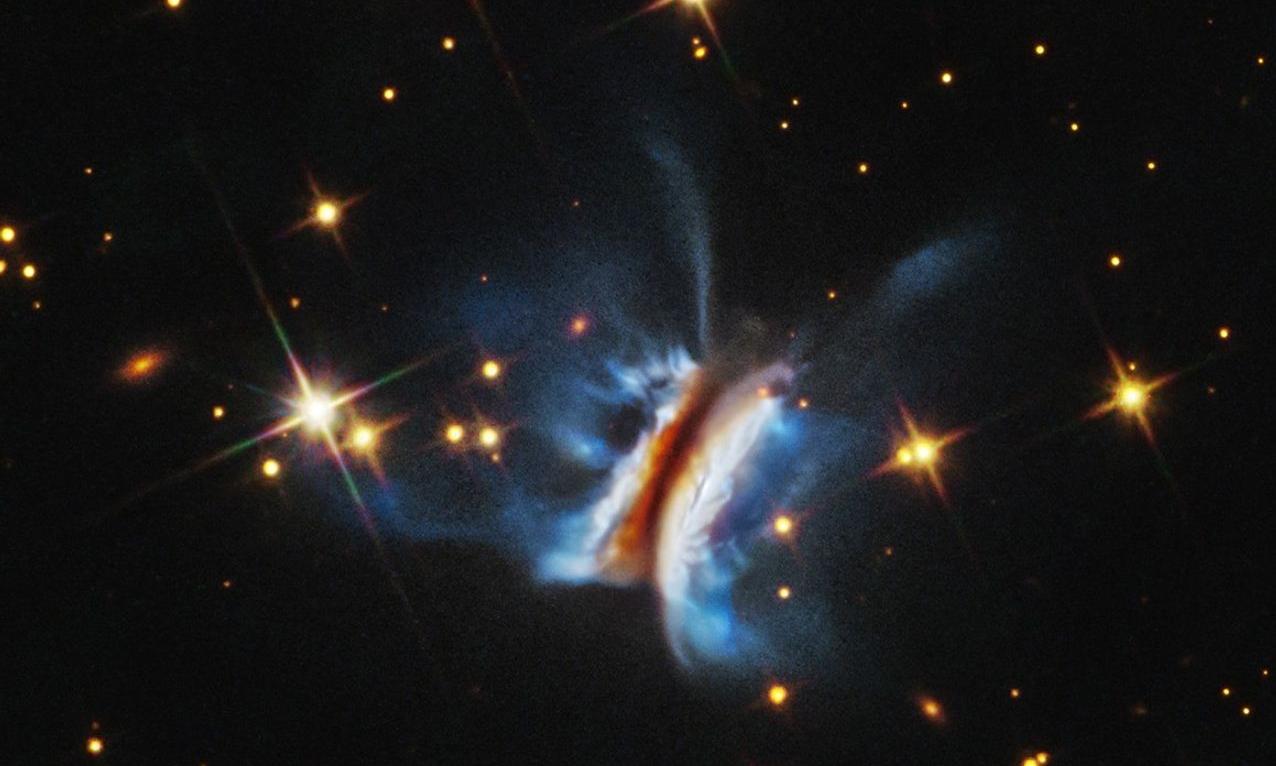
Scientists using the Hubble Telescope found a huge, messy disk of dust and gas around a young star.
They nicknamed it Dracula's Chivito because of the researchers' backgrounds.
The disk looks like a hamburger from the side and helps scientists understand how planets form.
It's the biggest disk of its kind ever seen and is very far away, about 1,000 light-years from Earth.

Hubble Telescope captured the largest planet-forming disk ever observed.
The disk is located 1,000 light-years away and is named Dracula's Chivito.
The disk is described as chaotic, turbulent, and resembles a hamburger.
The nickname reflects the heritage of researchers from Transylvania and Uruguay.
The findings provide new insights into planet formation in extreme environments.
- Who
- NASA scientists
- What
- Largest planet-forming disk observed, named Dracula's Chivito
- When
- Not specified
- Where
- 1,000 light-years away
- Why
- To study planet formation in extreme environments
- Object Name
- IRAS 23077+6707 (Dracula's Chivito)
- Distance
- 1,000 light-years away
- Observation Tool
- Hubble Space Telescope
- Researchers' Heritage
- Transylvania and Uruguay
- Disk Characteristics
- Chaotic, turbulent, edge-on, hamburger-like appearance