

Archive · 14 Jan 2026
James Webb Telescope Reveals Galaxy Death by Black Hole
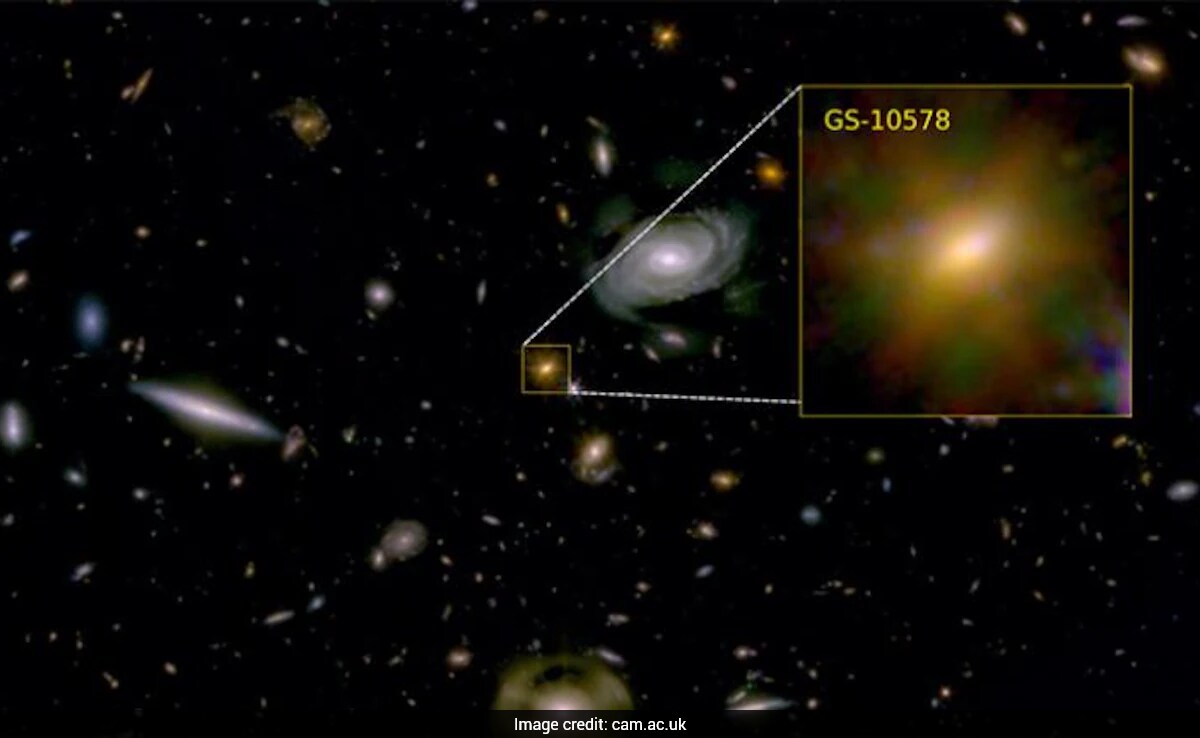
Scientists using powerful telescopes found a galaxy called Pablo's Galaxy that is dying because of its central black hole.
This galaxy was once full of stars but is now running out of gas needed to make new stars.
The black hole is pushing the gas away at very high speeds, causing the galaxy to slowly starve.
Even though the galaxy looks calm, it hasn't formed new stars in a long time.
This discovery helps explain why some galaxies in the early universe look old.
It shows that black holes can slowly kill galaxies by taking away their star-making fuel.

Researchers used the James Webb Space Telescope (JWST) and ALMA to study a galaxy nicknamed Pablo's Galaxy.
The galaxy's central supermassive black hole is pushing gas outward at high speeds, depleting its star-forming fuel.
ALMA detected no carbon monoxide, indicating a severe lack of cold, star-forming gas.
The galaxy loses about 60 solar masses of gas annually and could exhaust its fuel in 16-220 million years.
Despite its demise, Pablo's Galaxy remains a calm, rotating disc with no major mergers, suggesting repeated black hole activity caused the starvation.
- Who
- Researchers using the James Webb Space Telescope (JWST) and the Atacama Large Millimeter Array (ALMA)
- What
- Discovered that a galaxy, GS-10578 (Pablo's Galaxy), is being starved to death by its central supermassive black hole
- When
- Around three billion years after the Big Bang
- Where
- 11 billion light-years away from Earth
- Why
- The black hole is pushing gas outward at high speeds, depleting the galaxy's fuel reserves for star formation
- Galaxy Name
- GS-10578 (Pablo's Galaxy)
- Distance from Earth
- 11 billion light-years
- Galaxy Mass
- 200 billion suns
- Gas Loss Rate
- 60 solar masses annually
- Time Until Fuel Exhaustion
- 16-220 million years
- Black Hole Gas Ejection Speed
- 2.2 million miles per hour
- Time Since Star Formation Stopped
- 400 million years