Archive · 4 Oct 2026
Telangana Leads India’s Race for Data Centre Investment
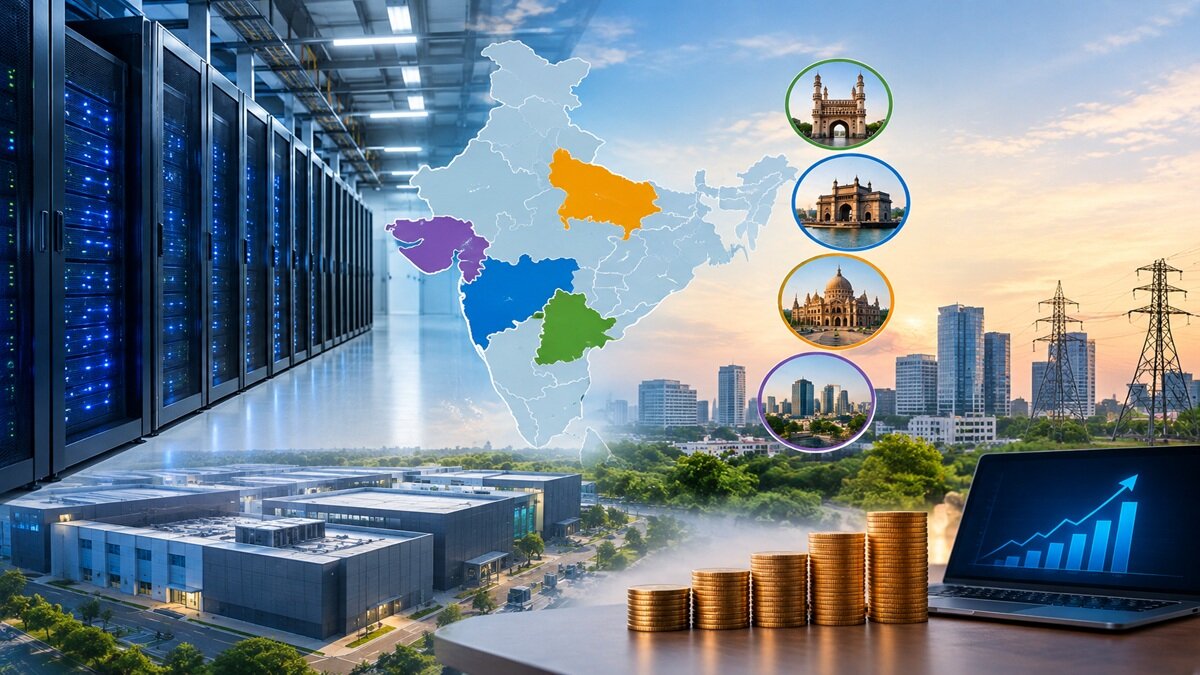
A report compared how Indian states are trying to attract data centres.
Data centres are buildings full of computers that store and handle information.
Telangana ranked first for its overall support, including electricity and regulatory incentives.
Maharashtra and Uttar Pradesh also offered broad support, while Gujarat stood out for power incentives and easier business processes.
Andhra Pradesh was especially strong in land and capital support, and Karnataka offered measures intended to protect operations.
India has about 1.5 gigawatts of data centre capacity now.
The report says capacity could reach 26.3 gigawatts by FY2031–32.
Data centres will need much more electricity, with demand expected to rise by 18% each year from 2025 to 2035.

S&P Global ranked Telangana, Maharashtra, Uttar Pradesh and Gujarat as the leading states, each scoring around 50 out of 100.
The index assessed 19 policies introduced since 2016 across 11 states, covering electricity, land and capital, operational support, and regulation.
Telangana was noted for electricity and regulatory incentives; Maharashtra and Uttar Pradesh for broad support; and Gujarat for power incentives and easier business operations.
India has about 1.5 GW of data centre capacity, with 5 GW committed and another 6–7 GW announced or in early planning.
Citing parliamentary projections, the report says capacity could reach 26.3 GW by FY2031–32, while electricity demand is projected to grow 18% annually from 2025 to 2035.
- Who
- S&P Global Energy assessed data centre policies across 11 Indian states.
- What
- Its Data Center Policy Attractiveness India index compared state incentives and ranked Telangana, Maharashtra, Uttar Pradesh and Gujarat in the leading group.
- When
- The assessment covered policies introduced since 2016; the report projects capacity through FY2031–32 and electricity demand growth from 2025 to 2035.
- Where
- India.
- Why
- States are competing to attract data centre investment as India plans a major expansion in capacity.
Policy strengths
Policy limitations
Different states’ relative advantages
Policy strengths
Telangana, Maharashtra, Uttar Pradesh and Gujarat lead the index, with strengths in broad support, electricity incentives, regulation or ease of doing business.
Policy limitations
Other states have more specific strengths: Andhra Pradesh leads in land and capital support, Karnataka in business-condition measures, and Tamil Nadu in capital expenditure support; the report places these states in lower-scoring groups overall.
Electricity incentives
Policy strengths
Competitive, reliable and renewable power access is a key attraction in leading states, particularly Gujarat’s electricity incentives.
Policy limitations
The report identifies weaker electricity-sector incentives in Tamil Nadu and West Bengal as a constraint on their overall attractiveness for power-intensive projects.
- Leading states
- Telangana, Maharashtra, Uttar Pradesh and Gujarat; each scored around 50 out of 100.
- Policies assessed
- 19 policies across 11 states, introduced since 2016.
- Assessment categories
- Electricity; land and capital; operational and technical support; regulatory and ease-of-doing-business measures.
- Current data centre capacity
- About 1.5 GW.
- Committed capacity
- Around 5 GW over the next decade.
- Announced or early-stage capacity
- An additional 6–7 GW.
- Projected capacity
- Around 26.3 GW by FY2031–32, according to parliamentary projections cited in the report.
- Projected electricity-demand growth
- 18% annually from 2025 to 2035.