

Archive · 16 Sep 2026
New UPI MDR Rules Keep Consumers Free, Charge Eligible Merchants

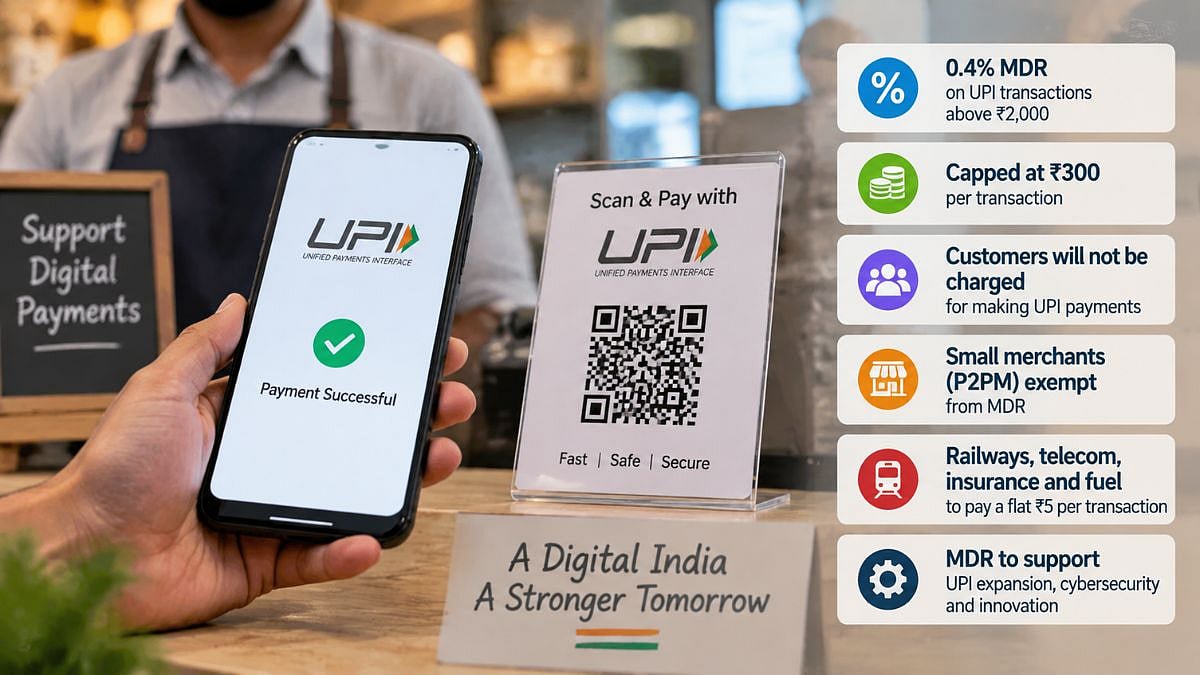
People can continue using UPI to send money to friends, family or their own accounts for free.
Customers also will not pay MDR when buying from a merchant.
The fee applies only to certain direct bank-account-to-merchant payments above ₹2,000.
Usually, the merchant pays 0.4%, with a maximum charge of ₹300.
Small shops and vendors receiving up to ₹1 lakh per month through eligible QR accounts are protected from the fee.
Some sectors, such as railways, fuel, insurance, telecom and utilities, pay a flat ₹5 instead.
Mutual funds, securities and brokers have a much smaller fee.
Credit-card-linked UPI payments and recurring mandates follow separate rules.
The money is intended to help maintain and improve the UPI payment system.

Person-to-person UPI payments remain free, while eligible merchant payments above ₹2,000 generally attract a 0.4% MDR paid by merchants.
The standard MDR is capped at ₹300 for transactions of ₹75,000 or more; payments up to ₹2,000 generally attract no MDR.
Small P2PM merchants receiving up to ₹1 lakh monthly through qualifying UPI QR accounts remain exempt, though they may be reclassified after exceeding the threshold for three consecutive months.
Railways, telecom, insurance, fuel, utilities and education payments above ₹2,000 attract a flat ₹5 MDR, while capital-market payments attract 0.02% capped at ₹300.
The framework starts October 15, 2026, and is intended to fund UPI infrastructure, security and innovation; estimates suggest about 4% of merchant transactions may be affected.
- Who
- The National Payments Corporation of India, the government and other UPI ecosystem participants established the framework; eligible merchants pay applicable MDR.
- What
- A new MDR framework charges 0.4% on specified person-to-merchant UPI payments above ₹2,000, while keeping customers and person-to-person transfers free.
- When
- Announced on September 15, 2026, with the new MDR rules scheduled to take effect on October 15, 2026.
- Where
- The framework applies to eligible UPI merchant payments in India.
- Why
- It is intended to create revenue for payment-system participants and support UPI infrastructure, cybersecurity, resilience, innovation and merchant adoption.
Ecosystem Sustainability
Merchant Cost Concern
Reason for introducing MDR
Ecosystem Sustainability
NPCI and the government say MDR can provide a commercial revenue stream for UPI infrastructure, cybersecurity, resilience, innovation and wider merchant adoption.
Merchant Cost Concern
Merchants covered by the standard rate will have to absorb a new processing cost on eligible higher-value payments, potentially affecting payment economics.
Who bears the charge
Ecosystem Sustainability
The framework says customers should not pay MDR, banks should prevent merchants from passing it on, and UPI applications cannot add platform or hidden fees.
Merchant Cost Concern
Although the charge is formally within the merchant ecosystem, businesses may remain concerned about absorbing it or indirectly reflecting the cost in their prices.
Impact on small merchants
Ecosystem Sustainability
The P2PM exemption and a dedicated fund funded from MDR collections are intended to protect small vendors and support onboarding and adoption in underserved areas.
Merchant Cost Concern
Merchants receiving more than ₹1 lakh monthly for three consecutive months may leave the P2PM category and become subject to the general 0.4% MDR.
- Standard MDR
- 0.4% on eligible person-to-merchant UPI payments above ₹2,000, capped at ₹300 for transactions of ₹75,000 or more.
- Consumer charges
- Customers pay no UPI transaction fee, platform fee or hidden charge under the announced framework; person-to-person transfers remain free without monthly quotas.
- Small-merchant exemption
- P2PM merchants receiving up to ₹1 lakh per month through qualifying UPI QR payments remain exempt, regardless of the individual payment amount.
- Special-sector rate
- Railways, telecom, insurance, fuel, utilities and education payments above ₹2,000 attract a flat ₹5 MDR.
- Capital-market rate
- Payments involving mutual funds, securities, stockbrokers and dealers attract 0.02%, capped at ₹300.
- Excluded transactions
- Credit-linked UPI payments, including RuPay credit cards on UPI and pre-sanctioned credit lines, follow separate credit-product rules; recurring mandates have no prescribed MDR in the stated framework.
- Estimated impact
- One estimate says MDR will apply to about 4% of merchant transactions, while another describes more than 95% of low-value P2M transactions as charge-free; exemptions may reduce theoretical annual collections of about ₹29,000 crore.
Sources
UPI Charges Explained: What Is MDR And Will Customers Pay For Transactions Above ₹2,000?
UPI MDR from 15 October: How merchant charges compare with credit, debit card fees and credit-linked UPI

MDR charges announced: How much will you now pay for UPI transactions, and who is exempt?
EXPLAINER | The new UPI merchant fee: What changes, what doesn’t

MDR on UPI: What consumers and merchants need to know?
