

Archive · 9 Sep 2026
Bundelkhand Farm Ponds Struggle as Weak Monsoon Threatens Crops
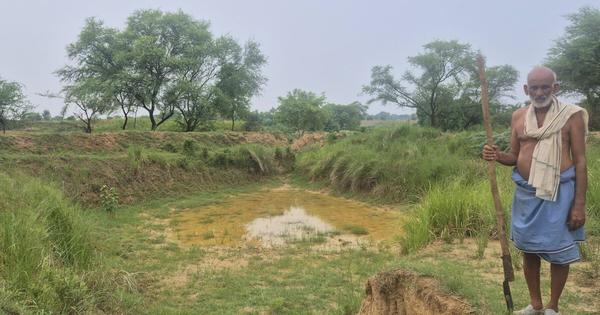
Farmers in Bundelkhand use small ponds to save rainwater for their crops.
This year, the monsoon brought less rain than usual in several districts.
Many ponds therefore did not fill enough to provide water for wheat and mustard.
Some ponds also lose water through sandy soil or leaks.
Others have become shallow because mud has collected inside them.
One farmer said his pond helped him grow much more wheat last year.
Other farmers said their ponds have barely helped or have never worked properly.
Experts say ponds must be built in the right places and maintained regularly.
They also say government programs and village communities should share responsibility for repairs and cleaning.

Banda received 26% below-normal monsoon rainfall by August 1, leaving many farm ponds only partly filled.
Vipin Kumar Yadav used a full pond last year to irrigate wheat twice and more than double his yield, but expects less water this season.
Farmers in Chitrakoot and elsewhere reported pond failures caused by seepage, siltation, broken embankments, shallow excavation and poor site selection.
Government schemes subsidize pond construction, but officials and experts said maintenance, desiltation and seepage control generally lack dedicated funding.
Experts called for science-based pond design, stronger maintenance support, local participation and water-efficient irrigation methods.
- Who
- Farmers in Uttar Pradesh’s Bundelkhand region, along with government officials and water experts, are involved.
- What
- Farm ponds are failing to provide reliable irrigation because of weak rainfall and problems including seepage, siltation, poor construction and inadequate maintenance.
- When
- The accounts focus on July and August of the reported monsoon season, with some ponds constructed between 2009-10 and 2024.
- Where
- Bundelkhand, particularly Banda, Chitrakoot and Mahoba districts in Uttar Pradesh.
- Why
- Below-normal and increasingly erratic rainfall has limited pond supplies, while poor site selection, seepage, siltation and insufficient maintenance have reduced their effectiveness.
Pond Expansion Advocates
Farmers and Reform Critics
Role of farm ponds
Pond Expansion Advocates
Government officials and experts say ponds are important for storing rainwater, supporting irrigation, reducing soil erosion and recharging groundwater.
Farmers and Reform Critics
Several farmers said their ponds provided little or no benefit because they failed to retain water, were too shallow or could not fill during the weak monsoon.
Government construction programs
Pond Expansion Advocates
The government has expanded pond construction and prioritized ponds, check dams and water-harvesting work through rural development programs.
Farmers and Reform Critics
A case study and field accounts indicate that construction sometimes took priority over farmer communication, flexible design, local knowledge and long-term usefulness.
Maintenance responsibility
Pond Expansion Advocates
Officials said farmers are direct beneficiaries and should take ownership, while experts also proposed roles for Gram Panchayats and government programs.
Farmers and Reform Critics
Farmers and officials noted that there is no dedicated scheme provision or budget for key needs such as desiltation, seepage control and structural repairs, leaving many farmers unable to afford them.
- Banda rainfall
- Rainfall was 26% below normal for the monsoon season by August 1.
- Mahoba rainfall
- Rainfall was 43% below normal by August 1.
- Pond subsidy
- The government provides Rs 52,500, or 50% of the stated cost, for a standard 22×20×3-metre pond.
- Vipin Yadav’s results
- His pond enabled two irrigations of four acres of wheat last year, raising yields from about 3.5-4.5 to 9-10 quintals per acre.
- Regional irrigation
- In 2022-23, irrigated net sown area was 47% in Chitrakoot, 54% in Mahoba and 61% in Banda.
- El Niño outlook
- The Ministry of Earth Sciences said El Niño strengthened to moderate levels in July; NOAA later estimated a more than 90% chance of a very strong El Niño in coming months.
- Recommended capacity
- A standard pond can theoretically hold about 11.5 lakh litres, enough for three rounds of irrigation for one hectare of wheat, according to a Mahoba soil conservation officer.