

Archive · 23 Jun 2025
Scientists Measure Muon Wobble to Explore New Physics
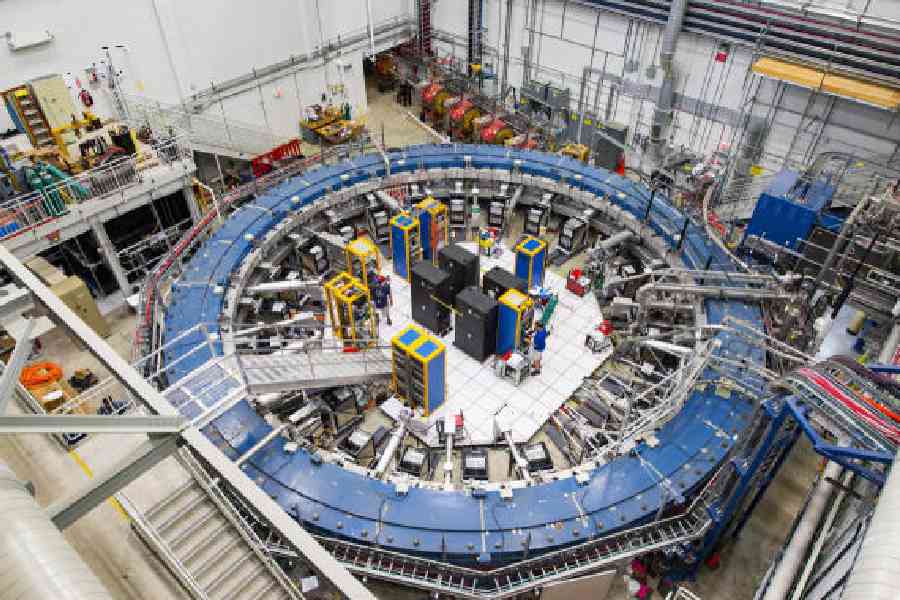
Scientists studied tiny particles called muons to learn more about the universe.
They measured how these particles wobble in a magnetic field.
The speed of the wobble gives clues about the particles' properties and could show the existence of unknown forces or particles.
The results don't match all predictions, meaning scientists aren't sure if they've found something new or if the math is wrong.
The experiment was done with a large magnetic ring that moved from New York to Illinois.
Researchers are still working to understand the results.

Physicists measured the wobble of muons, subatomic particles, with unprecedented precision.
The experiment aimed to uncover evidence of new physics beyond the Standard Model.
The new measurement matches one theoretical prediction but contradicts another.
The experiment was conducted at Fermilab using a giant magnetic ring transported from Brookhaven National Laboratory.
Discrepancies between experimental results and theoretical predictions may indicate undiscovered particles or forces.
- Who
- Physicists from the Muon g-2 Collaboration ran the experiment, using a large magnetic ring.
- What
- Physicists measured the wobble of muons, a subatomic particle, to search for evidence of new physics.
- When
- The experiment's final results were recently unveiled, with the initial measurements dating back to the 1990s.
- Where
- The experiment was conducted at Fermi National Accelerator Laboratory (Fermilab) in Illinois, with the magnetic ring originating from Brookhaven National Laboratory in New York.
- Why
- To determine if new physics exist, and to test the Standard Model of particle physics.
Theoretical Prediction 1
Theoretical Prediction 2
Agreement
Theoretical Prediction 1
Prediction matches the new experimental result, suggesting consistency.
Theoretical Prediction 2
Prediction has not been confirmed.
Model Implications
Theoretical Prediction 1
Standard Model needs adjustments.
Theoretical Prediction 2
No need to adjust the model.
- Particle
- Muon
- Experiment Location
- Fermilab, Illinois
- Magnetic Ring Diameter
- 50 feet
- Measurement Precision
- 127 parts per billion
- Experiment Goal
- To search for evidence beyond the Standard Model