

0 months ago
India's Shipbuilding Revival: From Colonial Glory to Global Ambition
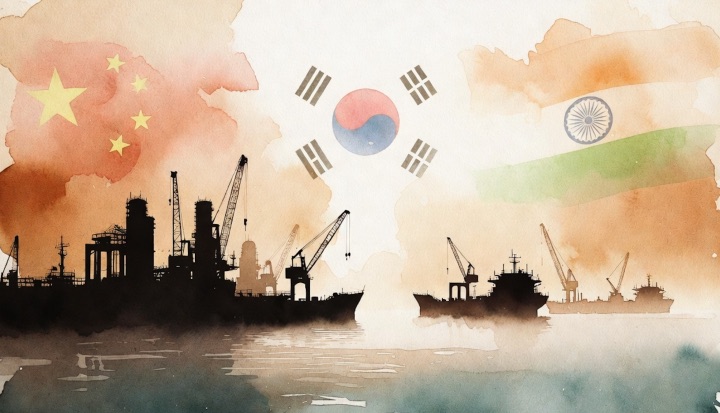
A very long time ago, India was famous for building amazing ships.
One of those ships, HMS Trincomalee, was built in Bombay in 1816 by Indian craftsmen using strong Indian teak wood, and it still floats today.
But the British government made rules that stopped Indian-built ships from trading, so India's shipbuilding business almost disappeared.
After India became independent, its shipyards mostly built warships for the Navy instead of ships for world trade.
Meanwhile, China, South Korea and Japan started building most of the world's cargo ships.
Today, India only builds a small number of ships compared to these countries.
The Indian government has now approved a big spending plan to help Indian shipyards build more commercial ships.
New projects with South Korean companies and an order from a French shipping company are already underway.
India's shipbuilding grew by 41% in one year, which is good news, but it still has a long way to go to become a top shipbuilding country.

HMS Trincomalee, built at Bombay's Wadia shipyards in 1816-17 by Indian craftsmen, still floats today as a museum ship in England.
Colonial laws such as the Registry Act of 1815 throttled Indian shipbuilding after the Wadia dynasty had built over 400 ships for the British Empire.
China, South Korea and Japan account for more than 90% of global shipbuilding output and orders, with China holding 65-70% of the global order book by mid-2026.
India's shipbuilding output rose 41% from 40,923 GT in 2024 to 57,637 GT in 2025, yet India remains outside the top 10 shipbuilding nations.
A ₹69,725 crore government package is showing early results, including Cochin Shipyard's ~$360 million export order from CMA CGM for six feeder container vessels.
- Who
- Indian shipyards such as Cochin Shipyard, Mazagon Dock and Swan Defence, global leaders China, South Korea and Japan, and historically the Wadia family of Bombay.
- What
- An assessment of India's small share of the global commercial shipbuilding market and a major government push to revive the industry.
- Where
- India, including the historic Bombay Dockyard, Kochi, Vadinar and new greenfield clusters in Andhra Pradesh, Gujarat and Tamil Nadu, within a global market dominated by China, South Korea and Japan.
- When
- Mid-2026, drawing on output data for 2024-2025 and Cabinet approvals made through May 2026.
- Why
- To reverse a decline rooted in British colonial restrictions and move India from a marginal player toward meaningful global commercial shipbuilding competitiveness.
Key facts
- India shipbuilding output
- 57,637 GT in 2025, up 41% from 40,923 GT in 2024
- Government package
- ₹69,725 crore approved by the Union Cabinet
- Top shipbuilding nations
- China, South Korea and Japan hold over 90% of global output and orders
- China's order book share
- Around 65-70% of the global order book by mid-2026
- CMA CGM order
- Six feeder container vessels (~1,700 TEU each) worth about $360 million
- Vadinar ship repair facility
- ₹1,570 crore project by Cochin Shipyard and Deendayal Port Authority, approved May 2026
- Greenfield clusters
- In-principle approvals in Andhra Pradesh, Gujarat and Tamil Nadu; Thoothukudi is the flagship project
- Historical shipbuilding
- Wadia family built over 400 ships at Bombay Dockyard between 1736 and 1884
Sources
Related news
Rajnath Singh Backs India as Global Shipbuilding Hub
GRSE Plans Rs 2,500 Crore Expansion for Global Growth
GRSE and Mazagon Dock: Can Indian Shipyard Stocks Deliver?

Indian shipyard stocks chase commercial growth beyond warships

India’s 2047 Ambitions Raise Need for Stronger Navy
Rajnath Singh Launches ₹3,500 Crore Bengal Defence Expansion
Trump tariffs draw foreign investment while US supplier gaps loom

Foreign Ownership of South Korean Stocks Hits 5-Year High

Hanwha Ocean Secures $1.75 Billion LNG Carrier Order

Indian firms explore shipyard JV with Korean giants
