

Archive · 26 Dec 2025
World's smallest programmable autonomous robots developed
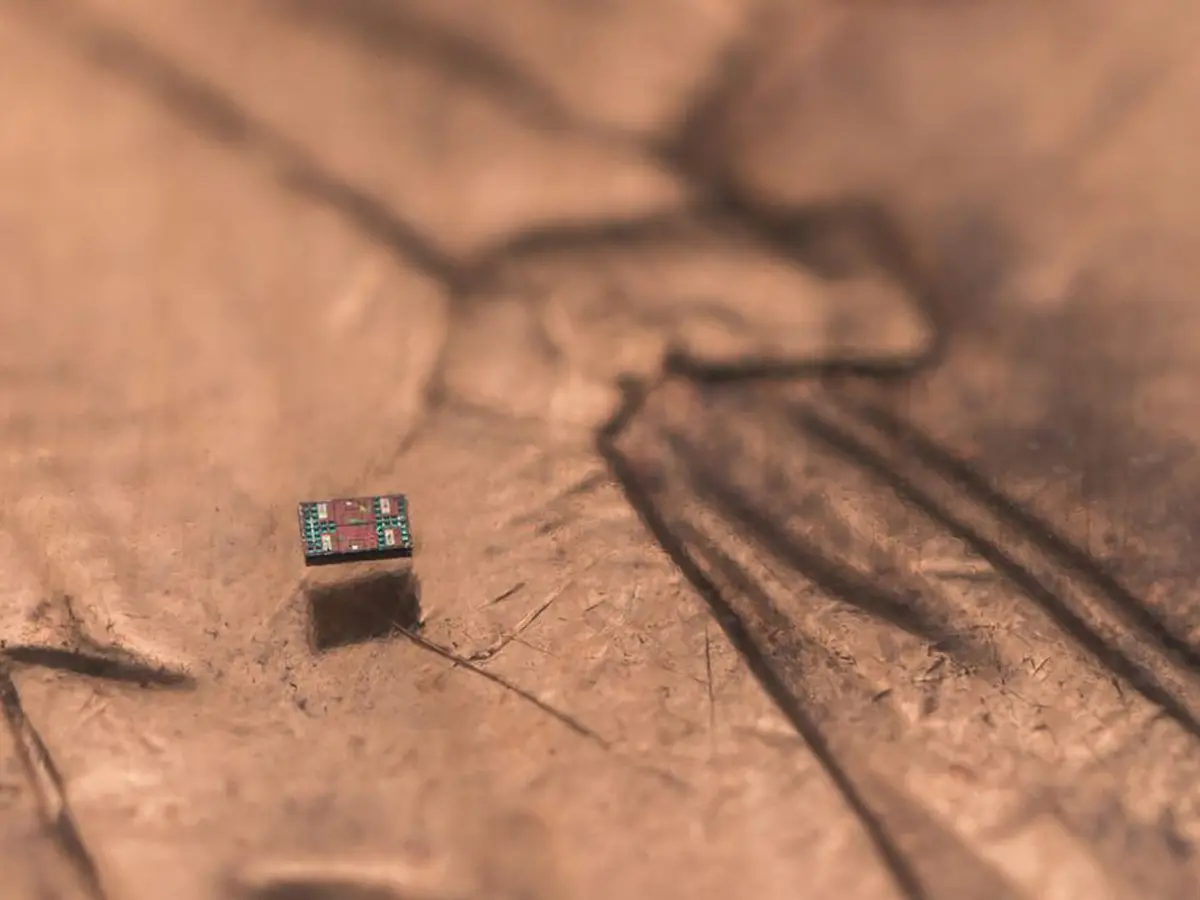
Scientists have made the world's smallest robots that can work on their own.
These robots are smaller than a grain of salt and cost just one penny to make.
They can swim through liquids, sense their surroundings, and even work together like a school of fish.
They are powered by tiny solar panels and can be programmed using light.
These robots could be used in medicine to check on cells and in manufacturing to build very small things.
The researchers say this is just the beginning of a new era for tiny robots.

Researchers developed the world's smallest programmable, autonomous robots, measuring 200 by 300 by 50 micrometers.
These robots can swim through liquids using electrokinetic propulsion and are powered by microscopic solar panels.
Each robot has an onboard computer and sensors, enabling it to respond to its environment.
The robots can be individually programmed using light pulses and can perform different roles in coordinated tasks.
Potential applications include monitoring individual cells in medicine and constructing microscale devices in manufacturing.
- Who
- Researchers at the University of Pennsylvania and the University of Michigan
- What
- Developed the world's smallest programmable, autonomous robots
- When
- Not specified
- Where
- University of Pennsylvania and University of Michigan
- Why
- To explore new scales for programmable robots and their potential applications in medicine and manufacturing
- Size
- 200 by 300 by 50 micrometers
- Cost
- One penny each
- Power Consumption
- 75 nanowatts
- Power Source
- Microscopic solar panels
- Programming Method
- Light pulses
- Researchers
- University of Pennsylvania and University of Michigan
- Publication
- Science Robotics and the Proceedings of the National Academy of Sciences
