

Archive · 2 Nov 2025
India's Apostille Process: Enhancing Global Document Authentication for Citizens
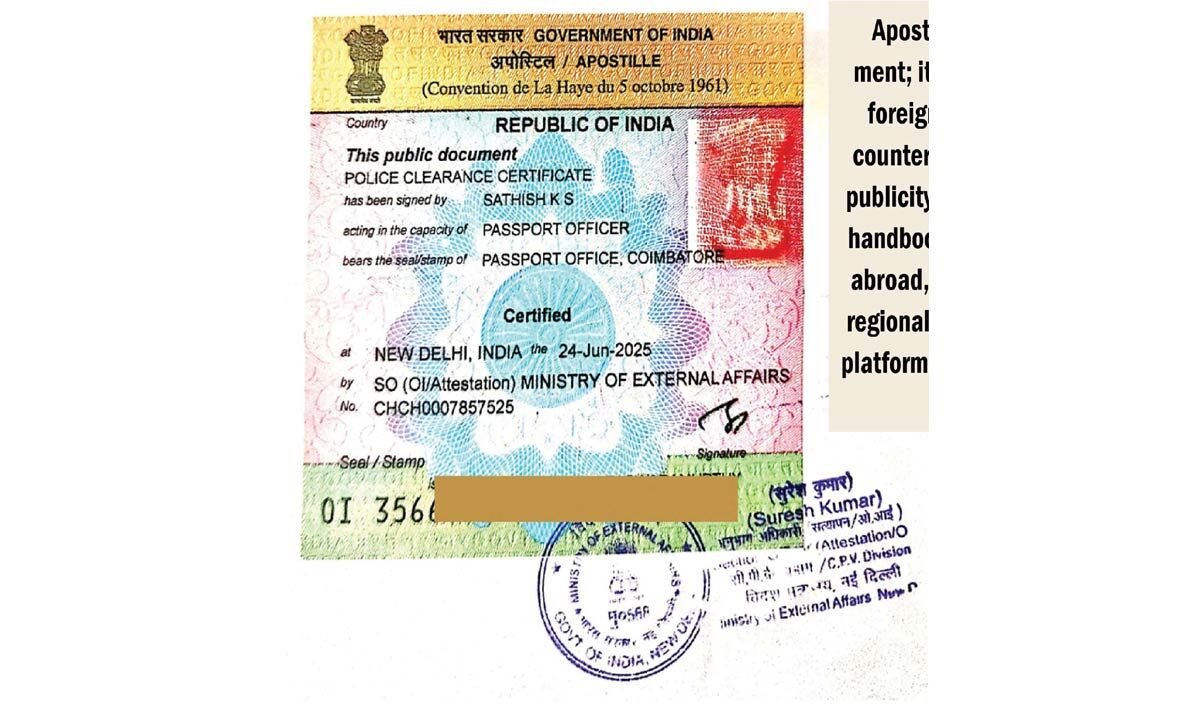
Imagine you have a special paper from India that proves who you are or what you've done, like a school certificate.
If you want to use this paper in another country, like the USA or Australia, that country needs to be sure it's a real Indian paper.
Instead of a long, complicated process involving many government offices and embassies, there's a simpler way called an Apostille.
India joined an international agreement called the Hague Convention, which created a special stamp, or Apostille, that acts like a universal OK for documents.
This stamp verifies that the original signature and seal on your document are genuine.
It's like a secret handshake between countries that speeds up how quickly your document is accepted abroad.
While the process has become much easier with digital stamps, sometimes people still find it tricky to get, especially at the last minute.
The goal is to make it even easier, like getting the stamp online or at the same place you get your original document, so people can move, study, or work abroad with less worry.

The Apostille is an international certification for documents to be used abroad, simplifying authentication for over 120 member countries of the Hague Convention.
India acceded to the Hague Apostille Convention in 2004, with the Ministry of External Affairs (MEA) designated as the issuing authority.
The process aims to eliminate the need for lengthy embassy or consular legalisation for documents, facilitating global mobility for students, professionals, and entrepreneurs.
Recent reforms include computer-generated apostilles with QR codes for instant online verification by foreign authorities.
Challenges remain in implementation, including lack of public awareness and potential bottlenecks in pre-authentication, with suggestions for single-window facilities and greater digitalization.
- Who
- Indian citizens interacting with foreign systems for education, employment, family, or business expansion.
- What
- The process and reform of apostille stamping for authenticating documents for international use.
- When
- When Indian citizens need to use their documents in foreign countries, often discovered at the last moment.
- Where
- Globally, in over 120 countries party to the Hague Apostille Convention.
- Why
- To simplify and standardize the authentication of public documents, reducing bureaucratic hurdles for international mobility and commerce.
- What is Apostille?
- A standardized international authentication of public documents for use in foreign countries, verifying the origin like signature and seal.
- International Agreement
- The Hague Apostille Convention of 1961
- India's Accession
- 2004
- Nodal Authority in India
- Ministry of External Affairs (MEA)
- Countries Accepting Apostille
- Over 120 member countries of the Hague System
- Recent Indian Innovation
- Computer-generated apostilles with unique numbers and QR codes for online verification.