

Archive · 31 Oct 2025
Trump's Asia Trip Sparks Geopolitical Shifts and Challenges for India
President Trump visited several countries in Asia, meeting with leaders and attending important economic meetings.
During his visit to Japan, the Prime Minister promised big investments in America, partly to avoid new taxes.
They also talked about important materials and technology.
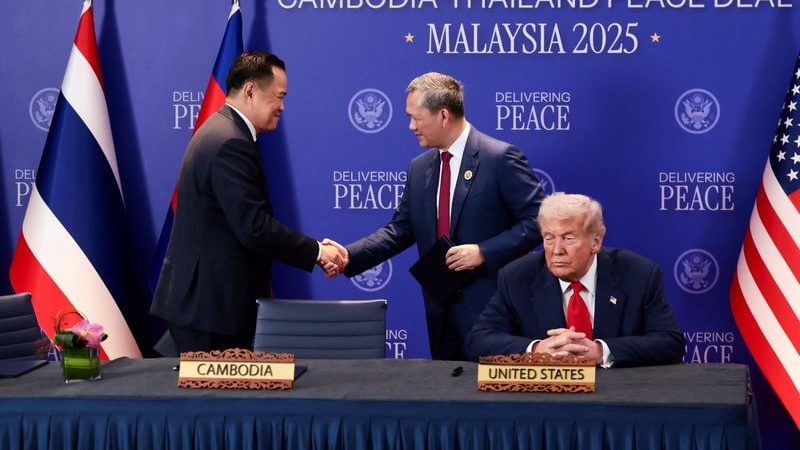
Trump helped settle a fight between Thailand and Cambodia.
This trip made some people wonder if the US and China might become closer allies.
India, a neighbor, is concerned because Trump's actions could change the balance of power in Asia, making things harder for them, especially with China being a strong competitor.
India also worries about missing out on important discussions by not attending the ASEAN summit.
They want to make trade deals but not at the expense of their own security or relationships with other countries.

President Trump's Asia tour involved bilateral meetings and participation in ASEAN and APEC, aiming for transactional deals.
Japan pledged $550 billion in investments to the US, partly to mitigate tariff threats.
Trump helped broker a peace deal between Thailand and Cambodia concerning their border dispute.
The US President's engagements in Asia could potentially lead to a new US-China axis, altering regional power dynamics.
India faces challenges from Trump's Asia strategy, including increased US-China rivalry and potential weakening of its regional influence due to its absence from the ASEAN summit.
- Who
- US President Donald Trump, Japan's Prime Minister Sanae Takaichi, and India's government officials.
- What
- President Trump's Asia trip, focusing on bilateral deals and transactional diplomacy, potentially altering regional power dynamics and presenting challenges for India.
- When
- Following the ASEAN summit in Malaysia, during Trump's whirlwind tour of Asia.
- Where
- Asia, including Malaysia, Japan, South Korea, China, and regional institutions like ASEAN and APEC.
- Why
- To reassert US leverage through individual deals, secure economic concessions, address regional disputes, and potentially reshape the US-China relationship, posing strategic questions for India.
India's Strategic Approach
US and Global Dynamics
Engagement with ASEAN
India's Strategic Approach
India should have engaged more seriously with ASEAN, viewing it as a cooperative partner, rather than dismissing past agreements or being absent from summits, which weakens its ability to shape the regional economic agenda and allows China strategic space.
US and Global Dynamics
India's absence from the ASEAN summit might have been due to legitimate apprehensions, especially with Trump's presence, but risks losing influence over supply chains, digital trade, and investment security discussions crucial for maritime security and freedom of navigation.
Trade Deal Negotiations
India's Strategic Approach
India should assert its strategic autonomy to trade with the US but not at the cost of its security, strategic footprints, or South-South Cooperation, indicating a reluctance to make deals 'with a gun to its head'.
US and Global Dynamics
Trump's administration focuses on transactional diplomacy and bilateral deals, using tariffs as a weapon, which reshapes the regional economic landscape and may necessitate concessions from allies like Japan to secure favorable terms.
- US President's Tour
- Donald Trump's Asia trip included bilateral meetings with Malaysia, Japan, South Korea, and China, plus participation in ASEAN and APEC CEO luncheon.
- Japan's Pledges
- $550 billion in strategic investments in the US, primarily for tariff relief.
- US-Japan Cooperation
- Focus on critical minerals, energy, and AI, with a list of Japanese companies set to invest.
- Thailand-Cambodia Dispute
- Trump presided over a 'peace deal' for a border dispute that had escalated to armed conflict.
- India's ASEAN Trade
- India is part of the ASEAN-India Trade in Goods Agreement (AIFTA), a large FTA with a population of 1.8 billion and a $3 trillion GDP.
- India's Policy
- Committed to ASEAN centrality, underpinning its Look East-Act East Policy (LEAE) and Indo-Pacific Region strategy.
