

Archive · 14 Aug 2025
Black Hole 'Heartbeat' Reveals Cosmic Mysteries, IXPE Finds
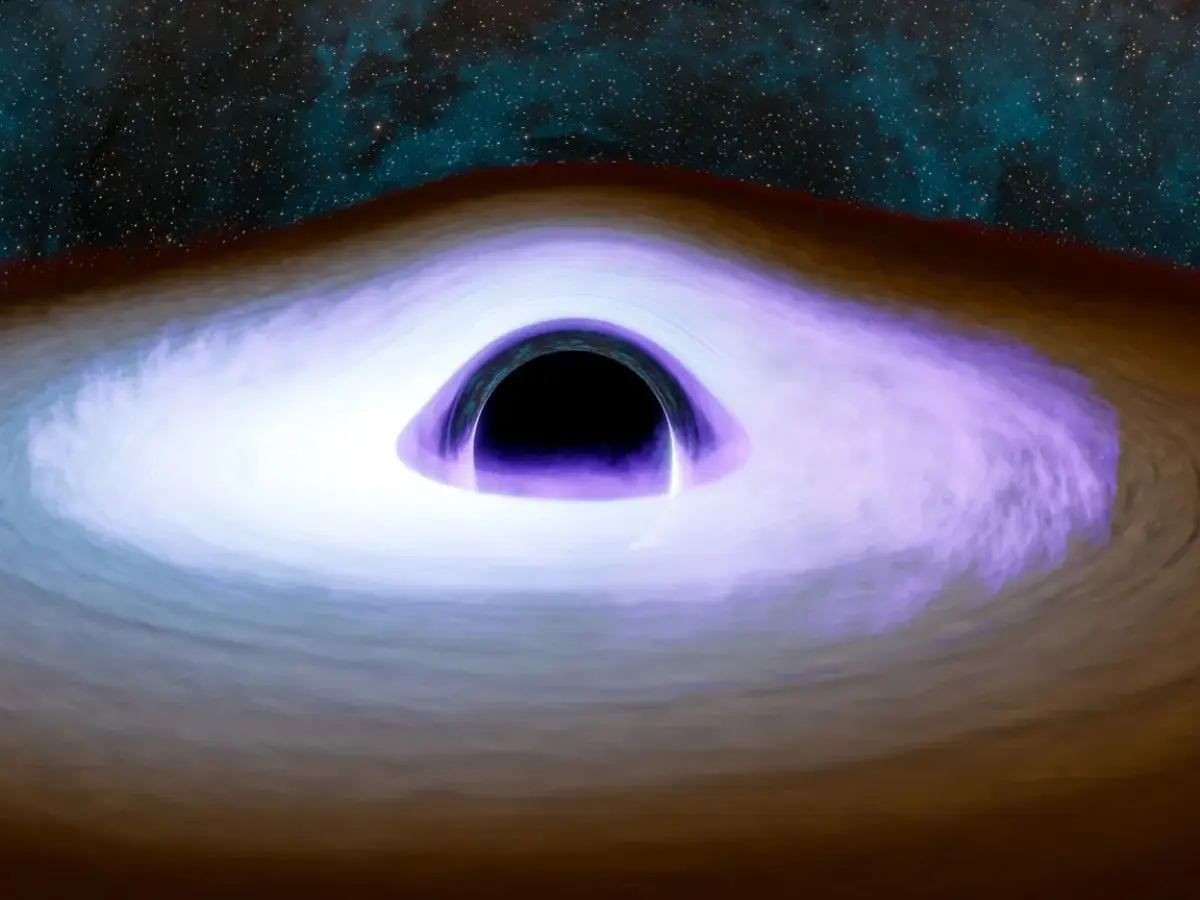
Imagine a giant vacuum cleaner in space called a black hole, sucking up everything around it.
Scientists used a special telescope to watch this vacuum cleaner and were surprised to find it has a 'heartbeat'!
It brightens and dims in a regular pattern.
This 'heartbeat' is caused by the way the black hole eats stuff, and we can measure how its magnetic field is behaving.
It’s like the black hole is showing us how it works, and by studying the light it gives off, scientists can learn how black holes grow and affect entire galaxies.
The telescope can measure the way the light is ‘polarized,’ helping scientists understand the magnetic fields better, and what they observed goes against what scientists previously thought.

NASA's IXPE has revealed a 'heartbeat' pattern in X-ray emissions from a black hole.
The black hole IGR J17091-3624 is located approximately 28,000 light-years from Earth.
Astronomers detected a 9.1% polarisation degree in the X-ray emissions.
This high polarisation suggests a highly ordered magnetic field around the black hole.
The findings challenge existing theories about black hole dynamics and offer new insights.
- Who
- An international team of astronomers and NASA's IXPE mission.
- What
- IXPE detected a 'heartbeat' pattern in X-ray emissions from black hole IGR J17091-3624.
- When
- Observations occurred in April 2025.
- Where
- IGR J17091-3624 is approximately 28,000 light-years from Earth.
- Why
- To understand the behaviour of matter near black holes, their growth, and their role in galactic evolution.
- Black Hole Name
- IGR J17091-3624
- Distance from Earth
- Approximately 28,000 light-years
- Observing Instrument
- NASA's IXPE
- Polarisation Degree
- 9.1%
- Discovery
- 'Heartbeat' pattern in X-ray emissions