

Archive · 14 Jan 2026
Old Tax Regime: Higher TDS in Last 3 Months
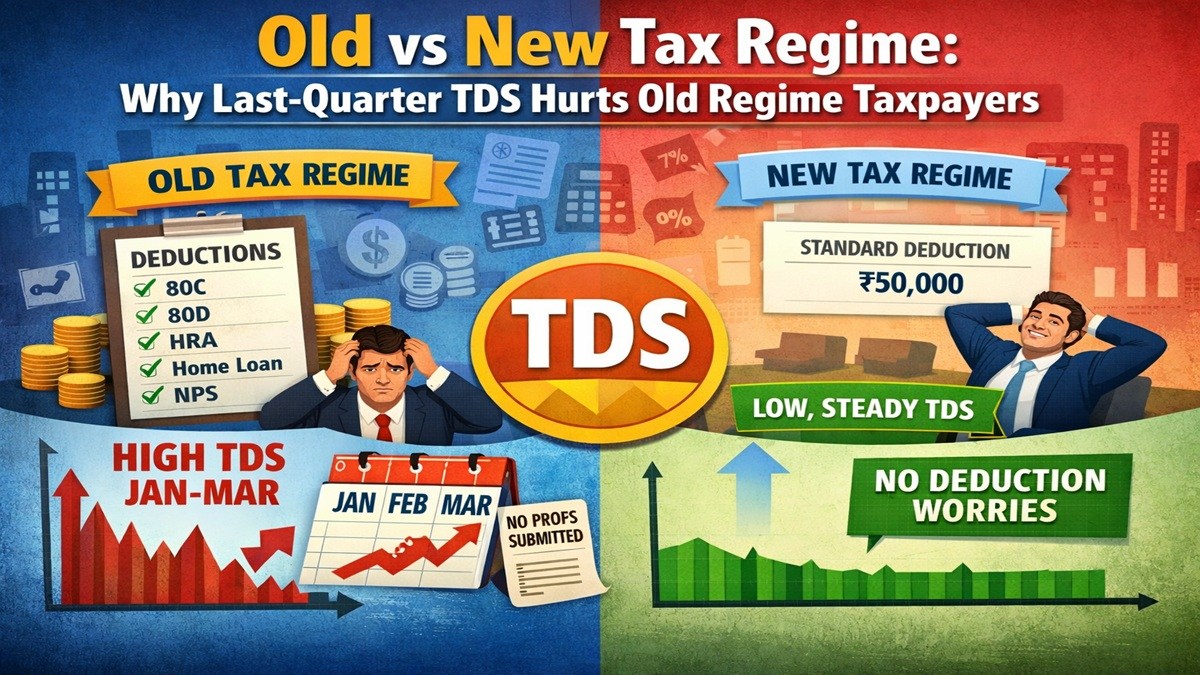
At the start of the year, employees tell their employers how much they plan to save on taxes through investments.
The employer then spreads out the tax deduction over 12 months.
But if the employee doesn't actually make those investments, the employer has to catch up on the tax in the last three months.
This is because the employer needs proof of the investments by January to adjust the tax correctly.
Employees under the old tax regime face this issue because they have more deductions to claim.
Those under the new regime don't have this problem because the new regime has fewer deductions and doesn't require as much proof.

Salaried employees under the old tax regime may see higher TDS in the last three months of the financial year due to discrepancies between declared and actual tax-saving investments.
Employers estimate annual tax liability based on employee declarations in April and spread TDS evenly across 12 months.
In January, employers ask for investment proofs to recalculate the final tax liability and adjust TDS accordingly.
If actual investments fall short of declared amounts, the taxable income increases, leading to higher TDS in the last three months.
Employees under the new tax regime do not face this issue as it offers fewer deductions and does not require proof submission.
- Who
- Salaried employees under the old tax regime
- What
- Higher TDS in the last three months of the financial year
- When
- January to March
- Where
- India
- Why
- Due to discrepancies between declared and actual tax-saving investments
- Financial Year
- April to March
- TDS Calculation Period
- April to December (based on declarations)
- Proof Submission Deadline
- January
- Tax Regimes
- Old and New
- Old Regime Deductions
- 80C, HRA, home loan interest, etc.
- New Regime Benefits
- Lower slab rates, standard deduction, employer NPS contribution