

Archive · 21 Sep 2025
Study Questions Origin of Organic Compounds on Enceladus
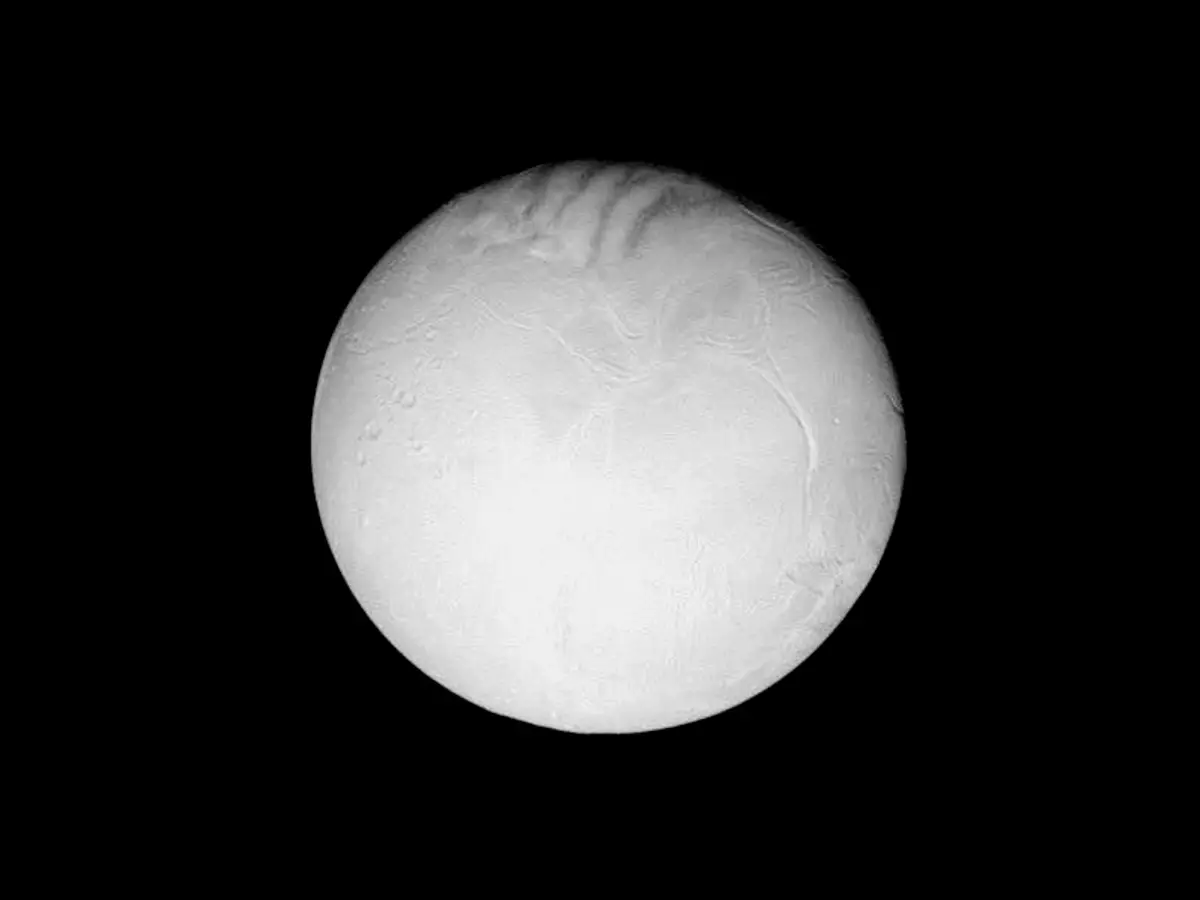
Scientists are studying Saturn's moon, Enceladus, to see if it could have life.
They've found water and organic compounds coming from cracks in the moon's surface.
Some scientists thought these compounds came from an ocean inside the moon, which might mean there's life there.
New research suggests these chemicals could also be made on the moon's icy surface by radiation.
Scientists recreated the moon's environment in a lab and found similar compounds.
This means we need to be careful about assuming there's life just because we see these chemicals.

Scientists are investigating the origin of organic compounds on Saturn's moon, Enceladus.
Enceladus releases water vapor, ice particles, and organic compounds from its cracks.
New research suggests organic compounds can form on the moon's surface due to radiation.
Experiments simulated Enceladus's environment and produced similar compounds.
The findings raise questions about whether the compounds originate in the ocean or on the surface.
- Who
- Grace Richards and colleagues
- What
- Research on the origin of organic compounds on Enceladus.
- When
- Results presented at a planetary science gathering; Cassini mission ended in 2017.
- Where
- Experiment conducted in a laboratory in Hungary; focused on Saturn's moon Enceladus.
- Why
- To determine whether organic compounds detected in Enceladus's plumes originate from its subsurface ocean or its surface.
- Moon
- Enceladus
- Planet
- Saturn
- Plumes composition
- Water vapor, ice particles, and organic compounds
- Study focus
- Origin of organic compounds in Enceladus's plumes
- Technique
- Radiation experiments
- Key findings
- Some compounds can form on Enceladus's surface