

Archive · 24 May 2025
NGT Recommends UP's 2018 Guidelines for Urban Landscaping Nationwide
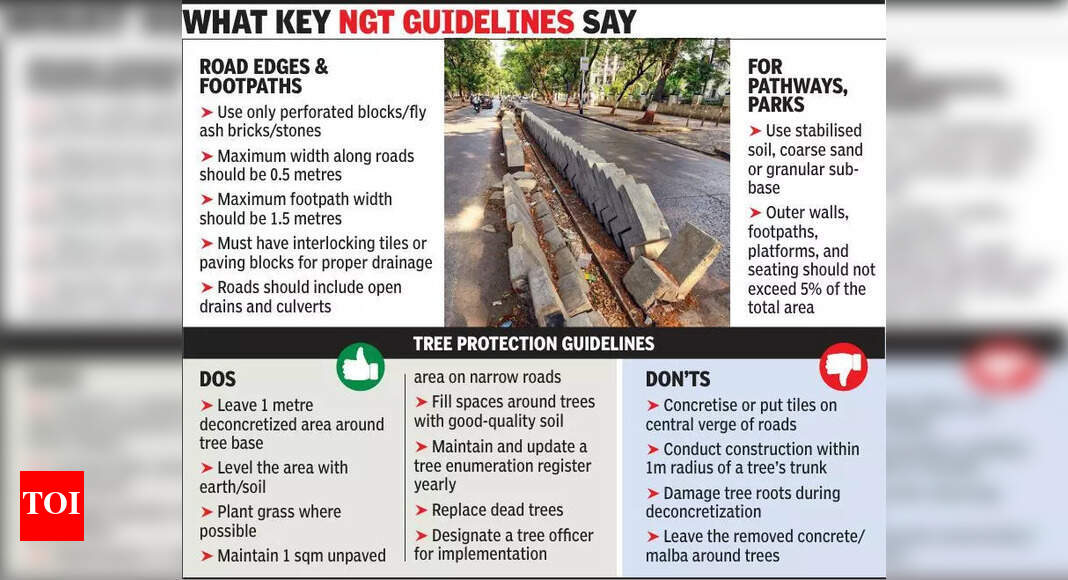
Imagine the government is trying to help cities build roads and parks in a way that's good for the environment.
The National Green Tribunal (NGT) has told all the states to follow some rules, and they're using guidelines from Uttar Pradesh (UP) as a model.
These rules say that cities shouldn't cover everything with concrete because it stops rainwater from going into the ground and can cause flooding.
Instead, they should use special materials for sidewalks and roads that let water through.
This helps the trees grow and keeps the cities cooler.
People in Noida complained about too much concrete, so the NGT made this decision to help protect the environment.

NGT cited UP's 2018 guidelines on urban landscaping as a template for other states and Union Territories.
The judgment comes from a 2022 case related to Noida concerning the concretization of roadsides.
UP's guidelines limit pavement tiling or concretization to a maximum of 5%.
The guidelines mandate permeable or semipermeable materials for footpaths and tracks.
Petitioners sought to prevent excessive concretization, citing issues like water runoff and groundwater depletion.
- Who
- National Green Tribunal (NGT), the UP government, environmentalists, and local authorities.
- What
- NGT is asking all states and Union Territories to follow UP's 2018 guidelines to limit concretization and use permeable materials for urban landscaping.
- When
- The judgment was issued on Wednesday in a 2022 case.
- Where
- Across India, with specific focus on Noida.
- Why
- To curb indiscriminate concretization and promote environmentally friendly urban landscaping.
- Case Year
- 2022
- Case Details
- Noida (Vikrant Tongad & Dr Supriya Sardana vs State of UP and others)
- Permissible Concretization
- Maximum of 5%
- Footpath Materials
- Permeable or semipermeable materials (perforated blocks)
- Judgment Length
- 80-page