

Archive · 29 May 2025
Black Holes: Cosmic Mysteries Explained
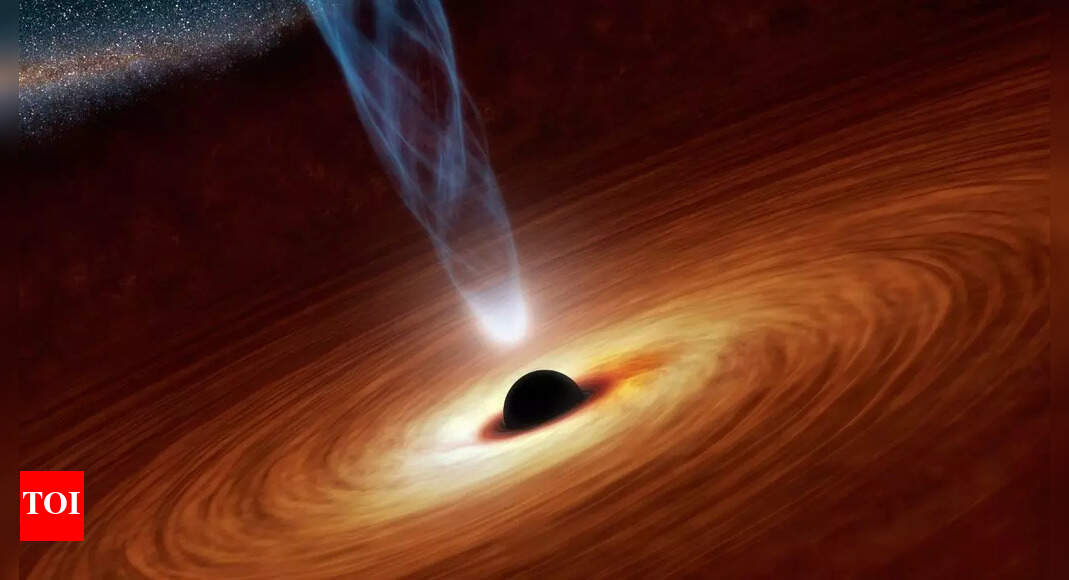
Imagine a place in space where gravity is so strong, nothing, not even light, can escape!
That's a black hole.
They're formed when big stars die and collapse.
At the center is a point called a singularity.
Black holes can be found throughout the galaxy, including in the center of our Milky Way.
While the center of a black hole is incredibly cold, the area around it can emit radiation.
Scientists study black holes to understand the universe, even though they are invisible, they affect nearby objects.
The biggest known black hole is TON 618, which is billions of times bigger than our sun.

Black holes have gravity so strong that nothing can escape, not even light.
Gaia BH1 is the closest confirmed black hole to Earth, about 1,500 light-years away.
TON 618 is the biggest known black hole, with a mass about 66 billion times that of the Sun.
Sagittarius A* is the supermassive black hole at the center of the Milky Way galaxy.
Black holes' cores can be extremely cold, approaching absolute zero.
- Who
- Formed from the collapse of massive stars.
- What
- Regions of spacetime with gravity so strong that nothing, not even light, can escape.
- When
- The concept of black holes was introduced in 1916.
- Where
- Found throughout the universe, including at the center of the Milky Way galaxy.
- Why
- To understand gravity, space, and time and learn about the fundamental laws of the universe.
- Distance to Gaia BH1
- 1,500 light-years
- Mass of TON 618
- About 66 billion times the sun's mass
- Mass of Sagittarius A*
- 4 million times the mass of the Sun
- Estimated black holes in the Milky Way
- Millions
- Temperature at the core of a black hole
- Approaching absolute zero