

Archive · 19 Jul 2026
Next Evolution Of Capitalism: Shared Value In AI And Circularity Age
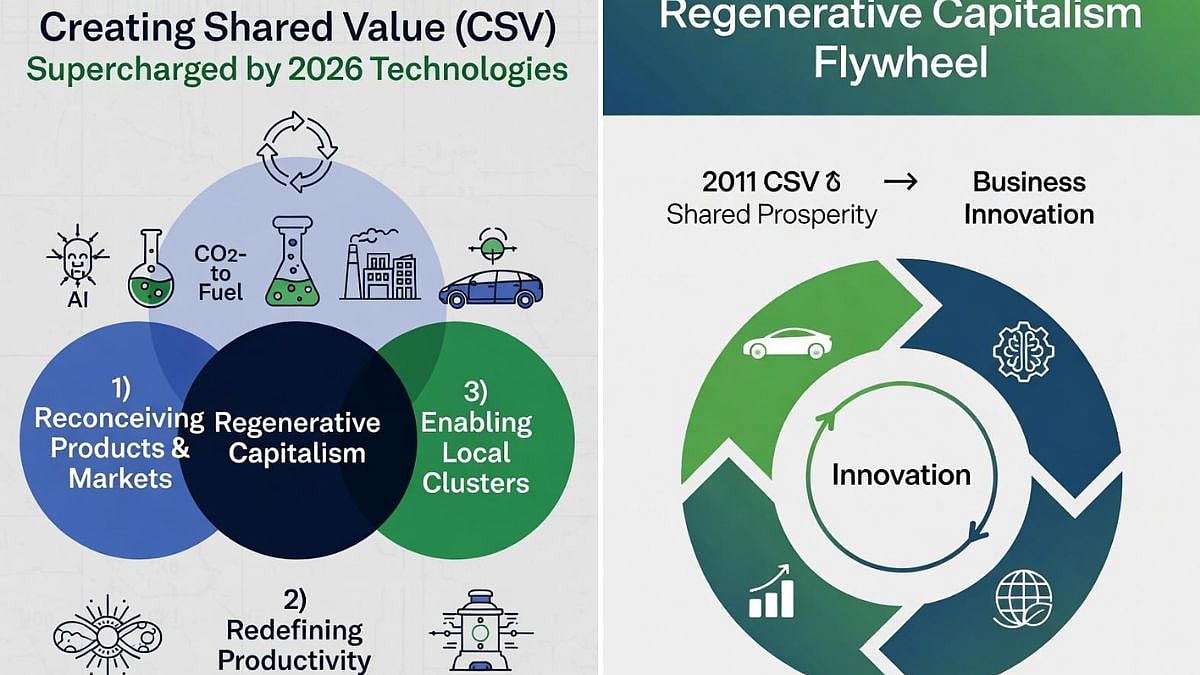
In 2026, businesses are using new technologies like AI, carbon conversion, and circularity to create shared value.
This means they make money while also helping society and the environment.
For example, AI can help with education and healthcare in poor areas, and waste can be turned into useful things like fuel.
Factories are becoming more efficient and eco-friendly, and cities are being designed to be more sustainable.
Governments and schools need to update their rules and teachings to support this new way of doing business.
The goal is to make capitalism work better for everyone, not just a few.

Creating Shared Value (CSV) framework from 2011 is being enhanced by new technologies in 2026.
Agentic AI, carbon conversion, waste-to-energy, fusion, green mobility, and circularity are key technologies driving CSV.
CSV has three main avenues: reconceiving products, redefining productivity, and enabling local cluster development.
Governments and NGOs should shift to value-focused regulation and public procurement to support CSV.
Business schools must update curricula to include AI, fusion, circularity, and other new technologies.
- Who
- Businesses, Governments, NGOs, and Leaders
- What
- The evolution of capitalism through Creating Shared Value (CSV) with advanced technologies
- When
- Mid-2026
- Where
- Globally, with specific examples in former coal regions and urban mobility clusters
- Why
- To address capitalism's legitimacy crisis and reconnect business success with social progress
- Authors
- Michael E. Porter, Mark R. Kramer, Shailesh Haribhakti
- Publication Year
- 2026
- Key Technologies
- Agentic AI, Carbon Conversion, Waste-to-Energy, Fusion, Green Mobility, Circularity
- CSV Framework
- Creating Shared Value (CSV)
- Private Funding in Fusion
- Over $4.5 billion
- CSV Avenues
- Reconceiving Products, Redefining Productivity, Enabling Local Clusters
- Business Model Shift
- From ownership to access
- Government Role
- Value-focused regulation and public procurement