

Archive · 14 Aug 2026
How first clockmaker knew right time: sun, water, stars
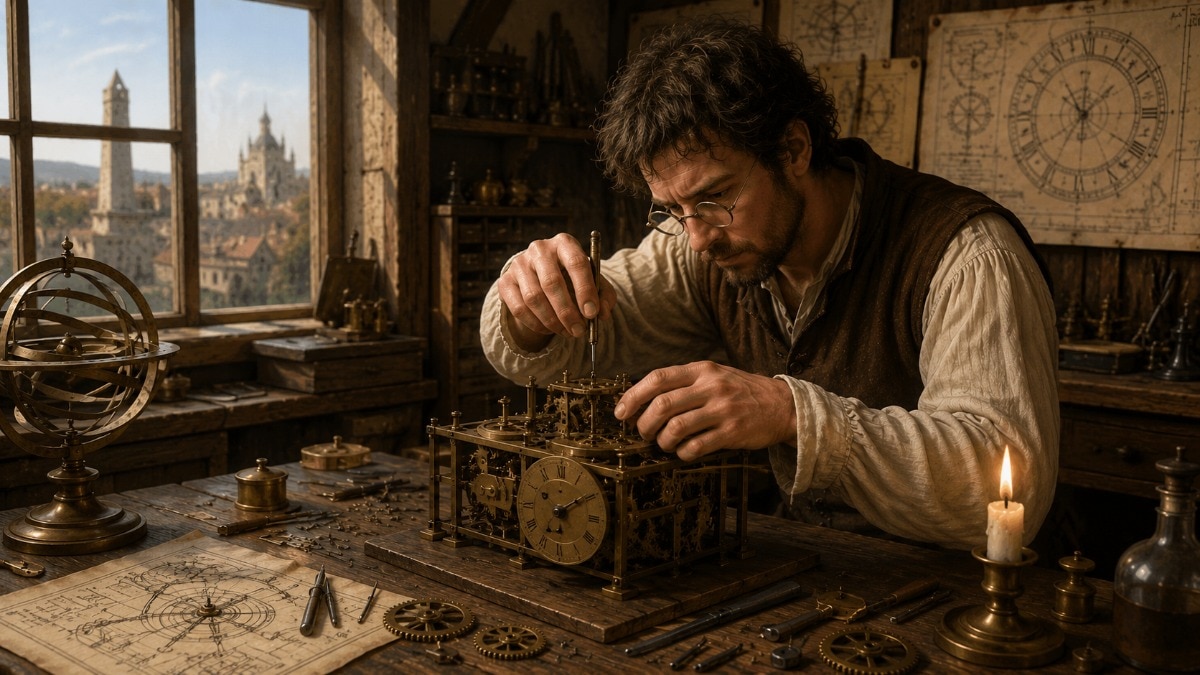
Long ago, there were no clocks or watches.
People figured out the time by looking at nature.
They watched the Sun move across the sky and used its shadow to tell the time.
Sundials used a stick on a plate, and the shadow moved as the Sun moved.
But at night, or when clouds hid the Sun, sundials did not work.
So people made water clocks that used the slow drip of water to measure time.
Those were not very exact either, because water drips at different speeds.
Later, people invented the first mechanical clocks in Europe.
They were big machines with weights and gears, but they still lost about 15 minutes every day.
Over time, clocks got better and helped people organize their days.

Early humans measured time through recurring natural events, including the Sun's movement, Moon phases and changing star positions.
Sundials, developed by the ancient Egyptians thousands of years ago, used a gnomon's changing shadow to divide daylight into hours.
Water clocks (clepsydras) enabled timekeeping after sunset but were imprecise because water does not flow at a constant rate.
The first large mechanical clocks appeared in Europe in the first half of the 14th century and were accurate to only about 15 minutes per day.
Chinese engineers built sophisticated water-powered astronomical clock mechanisms centuries earlier, including Su Song's celebrated clock tower of 1088.
- Who
- Early humans, the ancient Egyptians, Greek and Roman engineers, Chinese engineer Su Song, and 17th-century clock innovator Christiaan Huygens.
- What
- The evolution of timekeeping — from sundials and water clocks to the first mechanical clocks — and how early clockmakers determined the correct time.
- When
- Timekeeping practices date back thousands of years; Su Song's clock tower was built in 1088; the first European mechanical clocks appeared in the first half of the 14th century; Huygens' pendulum clock came in the 17th century.
- Where
- Ancient Egypt, Greece and Rome, China, and Europe.
- Why
- To move timekeeping beyond dependence on sunlight and flowing water and reproduce standard divisions of the day for coordinating religious observances, trade, work and transport.
- First sundials
- Developed by ancient Egyptians thousands of years ago
- Water clocks (clepsydras)
- One of the oldest known examples from ancient Egypt
- Su Song's clock tower
- Built in 1088, water-powered astronomical clock
- First European mechanical clocks
- First half of the 14th century, weight-driven
- Early mechanical clock accuracy
- About 15 minutes per day
- Key escapement mechanism
- Verge-and-foliot
- Huygens' pendulum clock
- 17th century, dramatically improved precision
- Other early timers
- Sandglasses, candle clocks and oil lamps