

Archive · 29 Jul 2026
Global Resilience Amid Geopolitical Uncertainty and Economic Shifts
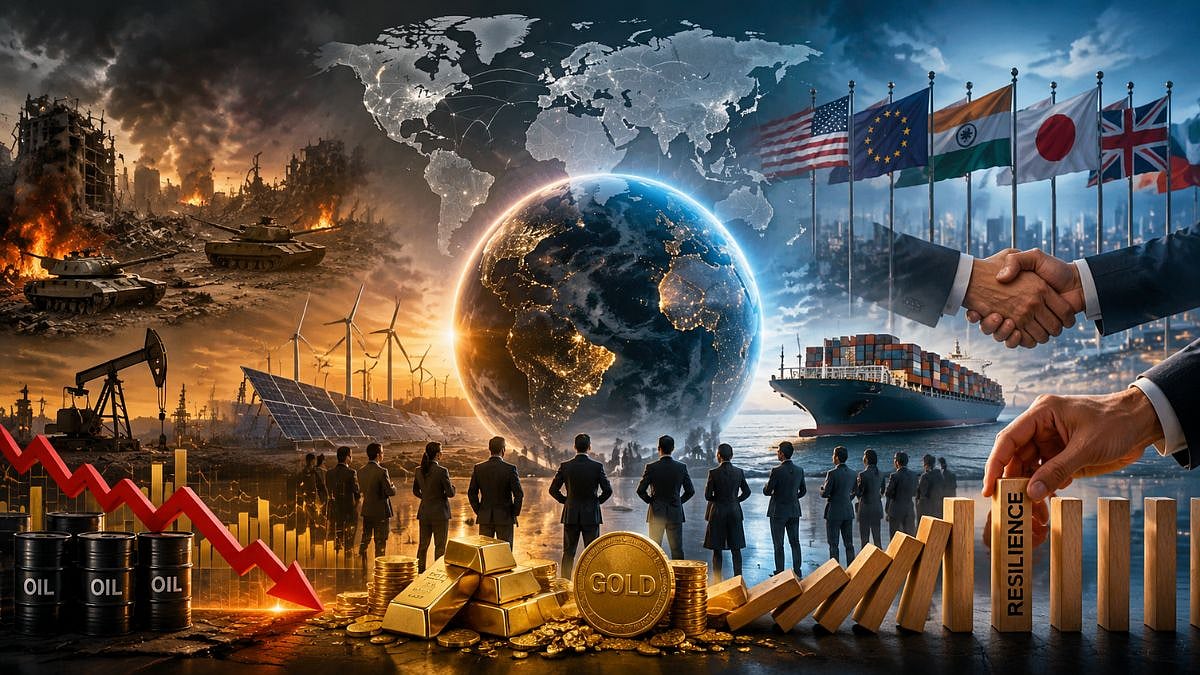
The world has faced many challenges recently, like wars and changes in trade rules.
Despite these issues, the global economy has not collapsed or seen extreme inflation.
Countries are finding ways to protect themselves, such as reducing dependence on oil, making new trade deals, and using different currencies.
However, the world's economies are still connected, so what happens in one place can affect others.
The US remains a major player, but other countries are becoming more important too.

Global economic shifts are reshaping trade, energy, and financial strategies amid prolonged geopolitical uncertainty.
Countries are reducing dependence on oil and investing in renewables to lower demand growth.
The US has become the largest oil producer, ensuring self-reliance and exporting oil despite OPEC cuts.
Bilateral trade agreements are emerging as global cooperation breaks down, with India forging deals with the EU, UK, and soon the US.
Countries are diversifying their currency reserves into gold and exploring alternative payment arrangements like rupee transactions.
- Who
- Global nations, including the US, Russia, Ukraine, Israel, Hamas, and GCC countries
- What
- Geopolitical conflicts and economic shifts affecting global trade, energy, and financial strategies
- When
- Post-COVID era, with specific events in 2025 and 2026
- Where
- Globally, with a focus on the US, Europe, Russia, Ukraine, Israel, Hamas, and GCC countries
- Why
- To adapt to prolonged geopolitical uncertainty and economic disruptions
Pro-US Policies
Anti-US Policies
Trade and Tariffs
Pro-US Policies
Countries should align with the US to benefit from lower tariffs and economic deals.
Anti-US Policies
Countries should resist US unilateral policies and seek alternative trade agreements to maintain economic sovereignty.
Energy Dependence
Pro-US Policies
The US should maintain its role as a major oil producer and exporter to ensure global energy security.
Anti-US Policies
Countries should reduce dependence on US oil and invest in renewable energy to achieve energy independence.
- Key Events
- Russia-Ukraine war, Israel-Hamas conflict, US invasion of Iran, US tariff policies
- Economic Shifts
- Decrease in oil dependence, rise in renewables, US as largest oil producer, bilateral trade agreements
- Currency Shifts
- Diversification into gold, rupee payment arrangements, reduced reliance on the dollar
- Market Interconnectivity
- Stock markets, bond yields, and currencies remain interconnected globally
- Author
- Chief Economist, Bank of Baroda