

Archive · 3 Oct 2026
Earth and Mars Formed Differently Despite Sharing Solar System Origins
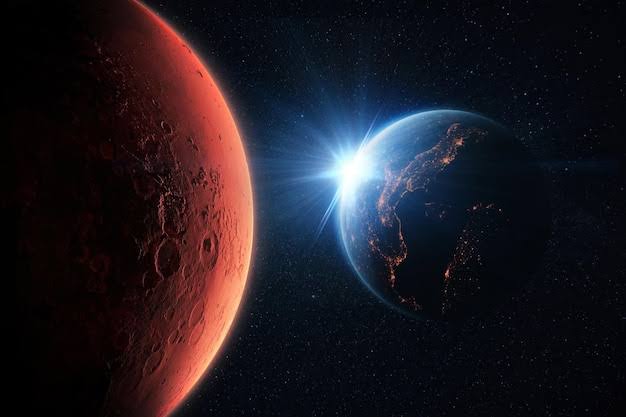
Earth and Mars began forming from the same cloud of gas and dust.
But researchers say the two planets grew in different ways.
Earth seems to have gained most of its mass from two large young planets that grew by collecting small particles called pebbles.
Mars seems to have gained most of its mass from much smaller rocky bodies called planetesimals.
Both planets also formed through a mix of these processes.
The researchers studied elements that evaporate easily, such as sodium, zinc, and potassium.
These elements can preserve clues about how the planets formed.
Their study helps explain why neighboring planets ended up with different histories.

Researchers reconstructed how Earth and Mars formed about 4.5 billion years ago.
They analyzed volatile elements, including sodium, zinc, and potassium, in the planets’ crusts and mantles.
The study estimates that at least 75% of Earth’s mass came from two protoplanets that grew by pebble accretion.
About 75% of Mars’s mass appears to have come from planetesimals, with the rest from pebble accretion.
The findings support a hybrid model in which planets form through both pebble accretion and planetesimals.
- Who
- Researchers Anders Johansen and Haiyang Wang, with colleagues.
- What
- A study found that Earth and Mars formed through different mixes of pebble accretion and planetesimals.
- When
- The planets formed about 4.5 billion years ago; the study was published in Nature Astronomy.
- Where
- The research concerns Earth and Mars and was conducted by researchers at the University of Copenhagen’s Globe Institute.
- Why
- Researchers used volatile elements in the planets’ crusts and mantles as chemical clues to investigate their formation.
- Approximate formation time
- 4.5 billion years ago
- Earth’s estimated protoplanet contribution
- At least 75% of its mass
- Earth’s estimated planetesimal contribution
- Up to 25% of its mass
- Mars’s estimated planetesimal contribution
- Roughly 75% of its mass
- Mars’s estimated pebble-accretion contribution
- Roughly 25% of its mass
- Elements examined
- Volatile elements including sodium, zinc, and potassium
- Journal
- Nature Astronomy