

Archive · 15 Jan 2026
Ring Of Fire Eclipse To Be Visible In February 2026
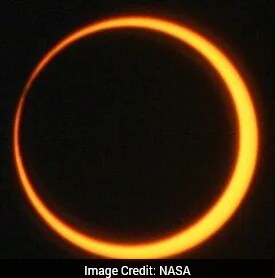
In February 2026, there will be a special kind of solar eclipse called a 'Ring of Fire' eclipse.
During this event, the Moon will pass between the Sun and Earth, but because the Moon is far away, it won't cover the Sun completely.
Instead, it will create a beautiful ring of sunlight around the Moon.
This eclipse will last for up to 2 minutes and 20 seconds and will only be visible in remote parts of Antarctica.
It's the first of three solar eclipses that will happen in the next few years, with the next ones visible in South America, West Africa, and parts of South America and Europe.

The first solar eclipse of 2026 will occur on February 17, creating an annular 'Ring of Fire' effect visible from remote regions of Antarctica.
During the eclipse, 96% of the Sun's center will be eclipsed by the Moon for up to 2 minutes and 20 seconds.
This eclipse is the first of three solar eclipses in 708 days, with the next ones visible on February 6, 2027, and January 26, 2028.
An annular solar eclipse occurs when the Moon is at or near its farthest point from Earth, appearing smaller than the Sun and not completely covering it.
The upcoming eclipses will be visible in South America, West Africa, the Galapagos Islands, Ecuador, Brazil, and Spain.
- Who
- Visible to people in remote regions of Antarctica
- What
- Annular solar eclipse (Ring of Fire)
- When
- February 17, 2026
- Where
- Remote regions of Antarctica
- Why
- Occurs when the Moon is at or near its farthest point from Earth, appearing smaller than the Sun and not completely covering it
- Date
- February 17, 2026
- Type
- Annular Solar Eclipse
- Duration
- Up to 2 minutes and 20 seconds
- Visibility
- Remote regions of Antarctica
- Percentage of Sun Eclipsed
- 96%
- Next Eclipses
- February 6, 2027 (South America, West Africa) and January 26, 2028 (Galapagos Islands, Ecuador, Brazil, Spain)