

Archive · 23 May 2025
Ancient Giants: Discovering the World's Largest Prehistoric Snakes
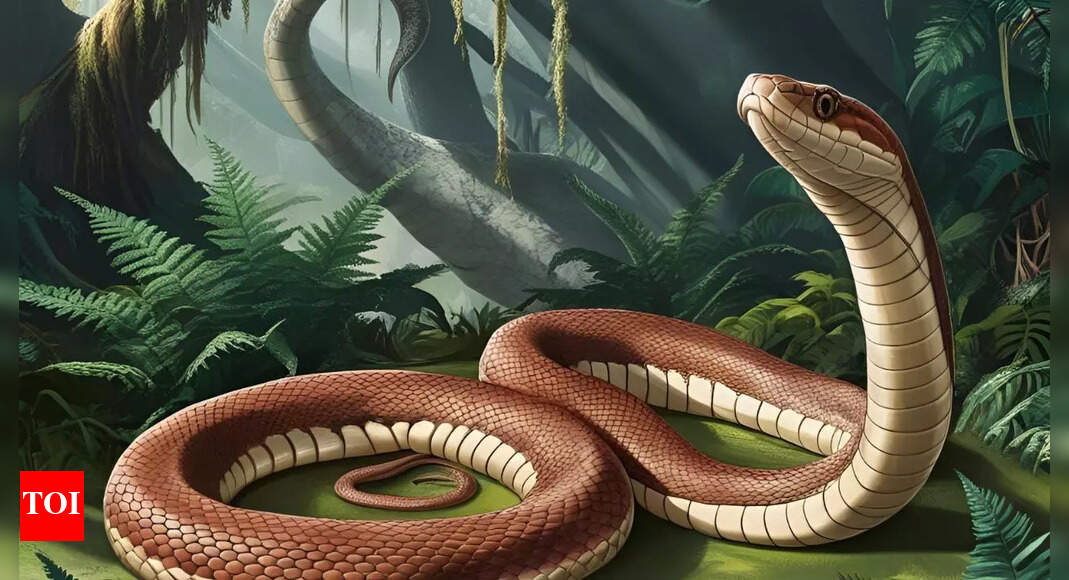
Imagine snakes that lived millions of years ago!
Some were as long as a bus, like Titanoboa, and others still had tiny legs.
Eophis was one of the earliest snakes, and Sanajeh ate baby dinosaurs!
Vasuki might have been even longer than Titanoboa.
These snakes show us how different the world was and how snakes changed over time.
Some snakes survived by eating less, while others hunted in the sea, and some even had legs!

Various extinct snakes, like Eophis, Titanoboa, and Vasuki, reveal insights into snake evolution.
Eophis is the oldest known snake, dating back to the Middle Jurassic period.
Titanoboa was a massive snake, potentially up to 13-14.6 meters long, that lived in the Paleocene.
Madtsoia survived the dinosaur extinction by having a slow metabolism and eating less.
Sanajeh preyed on dinosaur hatchlings, demonstrating specialized hunting behaviors.
- Who
- Eophis, Titanoboa, Madtsoia, Sanajeh, Haasiophis, Vasuki, and Pachyrhachis.
- What
- Discoveries and characteristics of various extinct snake species.
- When
- From the Jurassic period to around 47 million years ago (Paleocene era).
- Where
- Worldwide, including areas now known as the UK, Colombia, India, Israel.
- Why
- To understand snake evolution, environmental changes, and prehistoric ecosystems.
- Snakes’ Timeline
- 160 million years
- Oldest Known Snake
- Eophis
- Titanoboa/Vasuki Length
- Up to 13-15 meters
- Survived Dinosaur Extinction
- Madtsoia
- Sanajeh Timeline
- 70 million years ago
- Haasiophis Habitat
- Lived in warm, shallow seas
- Vasuki Discovery
- Discovered in 2024
- Family of Vasuki and other Giant Prehistoric Snakes
- Madtsoiidae