Archive · 17 Sep 2026
UPI Merchant Fee Sparks Opposition Attack, Government Rejects Foreign Pressure
A new rule will charge some shops a small fee when people pay them more than Rs 2,000 through UPI.
The fee will be 0.4 per cent and is scheduled to begin on October 15, 2026.
Sending money to another person will remain free.
Paying a shop Rs 2,000 or less will also remain free.
Small merchants earning up to Rs 1 lakh each month through UPI QR codes will not have to pay the fee.
The government says the shop or payment system, not the customer directly, will pay it.
Opposition leaders worry that shops could raise prices to recover the cost.
They also accuse the government of acting because of pressure from the United States.
The government rejects that accusation and says the fee will help keep UPI financially sustainable.

A 0.4 per cent Merchant Discount Rate will apply from October 15, 2026, to specified merchant UPI payments above Rs 2,000.
Person-to-person transfers and merchant payments up to Rs 2,000 will remain free, while small merchants earning up to Rs 1 lakh monthly through UPI QR codes are exempt.
The government says customers will not be charged directly and denies that foreign pressure influenced the decision.
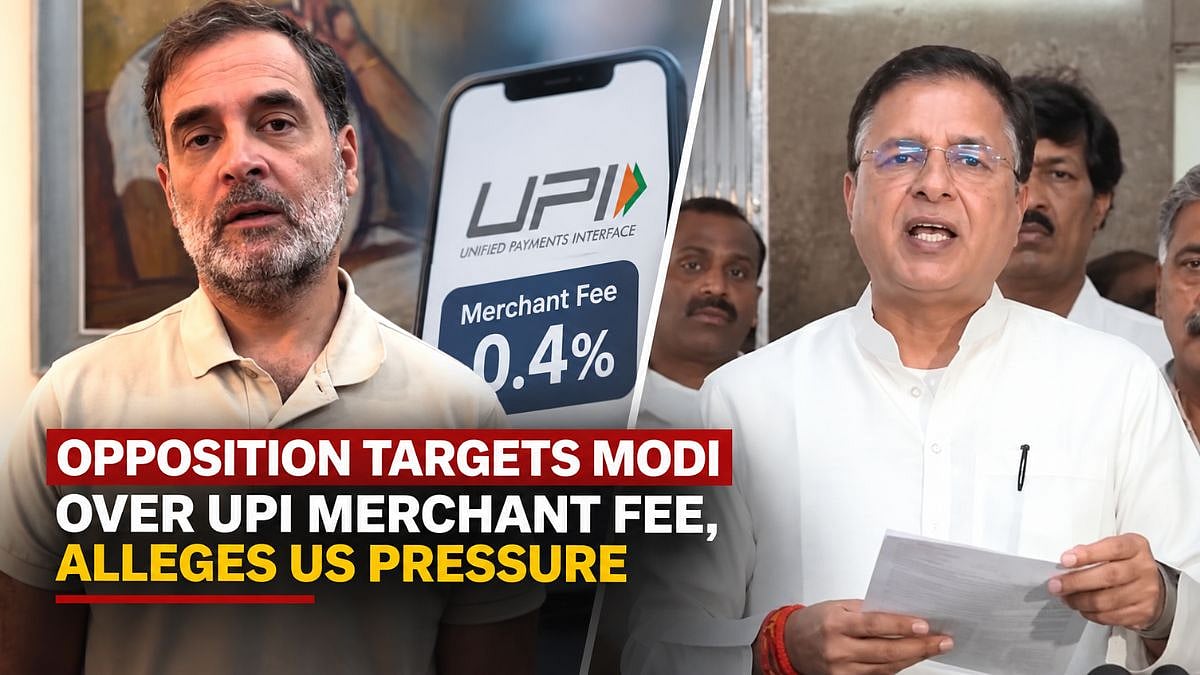
Rahul Gandhi and other Opposition leaders demand a rollback, alleging US pressure and warning merchants may pass the cost to consumers.
Officials say the MDR will support banks, payment providers and UPI’s long-term sustainability; government sources say there will be no rollback.
- Who
- The Indian government, the National Payments Corporation of India, Rahul Gandhi and other Opposition leaders are involved.
- What
- A 0.4 per cent MDR is being introduced for specified person-to-merchant UPI transactions above Rs 2,000.
- When
- The framework is scheduled to take effect on October 15, 2026; the political dispute was reported on September 16, 2026.
- Where
- Across India's UPI merchant-payment ecosystem.
- Why
- The government says the fee will support payment-system participants and UPI's long-term sustainability, while the Opposition alleges US pressure and warns of higher consumer prices.
Opposition parties
Government and BJP
Foreign influence
Opposition parties
Rahul Gandhi and other Opposition leaders allege that the MDR was introduced under US pressure to help American card companies compete with UPI.
Government and BJP
The Ministry of Finance says the claim is false and that India's UPI policy decisions are made independently.
Who ultimately pays
Opposition parties
Opposition leaders argue that merchants may recover the MDR by raising prices, indirectly burdening consumers.
Government and BJP
The government says the charge is borne within the merchant ecosystem, customers will not be charged, and banks have been told to stop merchants from passing it on.
Need for the MDR
Opposition parties
Opposition parties describe the measure as anti-people and say a publicly developed, low-cost payment system should remain free.
Government and BJP
The government says maintaining UPI infrastructure can cost up to Rs 20,000 crore annually and that MDR will help banks, payment providers and the system's long-term sustainability.
Rollback
Opposition parties
Rahul Gandhi, Congress leaders and other Opposition parties demand that the framework be withdrawn immediately.
Government and BJP
Government sources say there is no question of reversing the decision, although a plea challenging it has been filed in the Supreme Court.
- MDR rate
- 0.4 per cent for specified merchant UPI transactions above Rs 2,000.
- Effective date
- October 15, 2026.
- Transactions remaining free
- Person-to-person transfers and merchant payments up to Rs 2,000.
- Small-merchant exemption
- Merchants receiving up to Rs 1 lakh per month through UPI QR codes into personal bank accounts will remain exempt.
- Customer protection
- The government says customers cannot be charged MDR directly and banks have been instructed to prevent merchants from passing on the cost.
- Large-transaction cap
- The MDR will be capped at Rs 300 for transactions of Rs 75,000 and above.
- UPI transaction impact
- Payments above Rs 2,000 represented about 4 per cent of person-to-merchant transactions by volume but around two-thirds by value in 2025-26.
- Reported coverage
- The Finance Ministry said more than 95 per cent of merchant payments are below Rs 2,000, while another report described about 96 per cent of person-to-merchant transactions as unaffected.
Sources
UPI MDR fee hike: Opposition demands rollback, claims US pressure; false, no foreign influence, says government
UPI MDR fee hike explained in 10 points: No rollback, Rahul Gandhi vs Centre