

Archive · 16 Aug 2025
Ancient Human Species Coexisted in Ethiopia 2.6 Million Years Ago
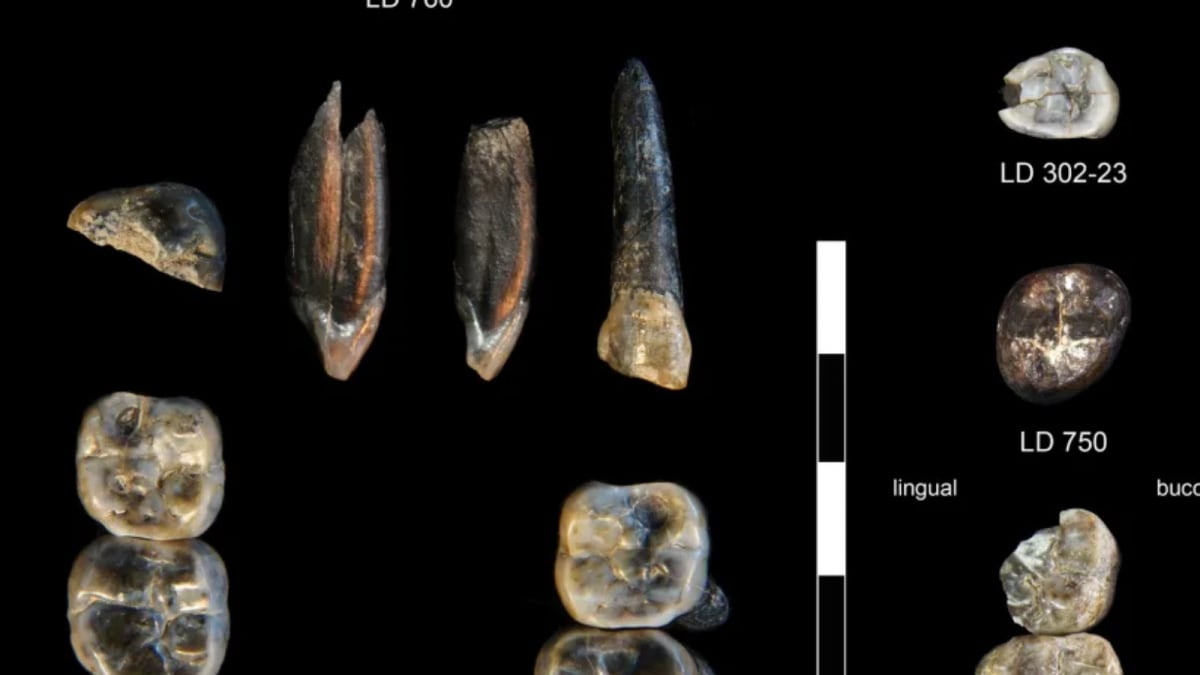
Imagine our ancient family tree!
Scientists found old teeth in Ethiopia showing two different kinds of early humans lived at the same time, about 2.6 million years ago.
One group, called Australopithecus, might even be a new kind we didn't know about.
These ancestors are like cousins who lived together, but looked a bit different – one had smaller brains.
This discovery changes what we thought, as we now know that these species were around at the same time and possibly interacted.
Scientists will continue to dig to find more bones and learn more about how these groups lived and if they competed for resources.

Fossilized teeth discovered in Ethiopia indicate two early human ancestor species coexisted 2.6 million years ago.
Researchers identified ten teeth belonging to Australopithecus and three to early Homo.
The Australopithecus fossils may represent a previously unknown species.
The findings challenge previous assumptions that the Homo genus emerged after the extinction of Australopithecus.
Further excavations are planned to understand the species' interaction and resource competition.
- Who
- Researchers from the Ledi-Geraru Research Project
- What
- Discovery of fossilized teeth indicating coexistence of two early human ancestor species.
- When
- 2.6 to 2.8 million years ago
- Where
- Afar region, Ethiopia
- Why
- To understand a poorly understood period in human evolution and the interaction of early human species.
Prior Understanding
New Discovery
Evolutionary Timeline
Prior Understanding
Homo emerged only after Australopithecus extinction.
New Discovery
Homo and Australopithecus coexisted.
- Location
- Afar region, Ethiopia
- Time Period
- 2.6 to 2.8 million years ago
- Species Found
- Australopithecus and early Homo
- Number of Australopithecus Teeth
- 10
- Number of Homo Teeth
- 3
- Research Project
- Ledi-Geraru Research Project