

Archive · 28 Sep 2025
Rajasthan's Khejri Tree Under Threat Due to Development
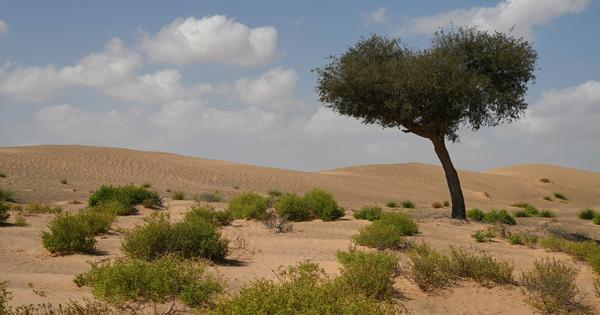
Imagine a special tree called Khejri that grows in the desert and provides food and shelter.
But this tree is starting to disappear because of new solar power plants, modern farming, and changes in the weather.
Farmers used to rely on the Khejri's pods, called sangri, for food, but now there are other ways to make money and the weather is not suitable for the tree.
Also, when they build solar farms, they cut down many Khejri trees.
Even too much rain is hurting the trees!
Because of these changes, the Khejri tree, which is very important to the desert, is in trouble.

The Khejri tree, vital to Western Rajasthan, faces decline due to solar plants and farming.
Mining activities, such as gypsum extraction, are a significant cause of Khejri tree loss.
Increased rainfall and irrigation negatively affect the tree's growth and sangri production.
Experts and local communities are concerned about biodiversity loss and demand action.
Government is working towards increasing the capacity of solar energy plants which require land previously occupied by Khejri trees.
- Who
- Farmers, experts, and residents of Rajasthan
- What
- The decline of the Khejri tree due to various factors like mining, solar energy expansion, and climate change, affecting sangri production.
- When
- Over the last few decades, with a notable decline in recent years.
- Where
- Rajasthan, particularly the Thar desert region.
- Why
- Expansion of solar plants, mechanised farming, climate change impacts, and changes in water availability are diminishing Khejri trees.
- Khejri Tree Lifespan
- Up to 80 years
- Primary Produce
- Sangri pods
- Solar Energy Capacity in Rajasthan
- 29,546.70 MW (installed)
- Rainfall Increase (2001-2023)
- 63%
- Khejri Density Decline
- 90 to 35 trees per hectare (1950s/60s to 2010s)