

4 days ago
Judge Bars Khalid Sheikh Mohammed’s FBI Confessions Over Torture Concerns
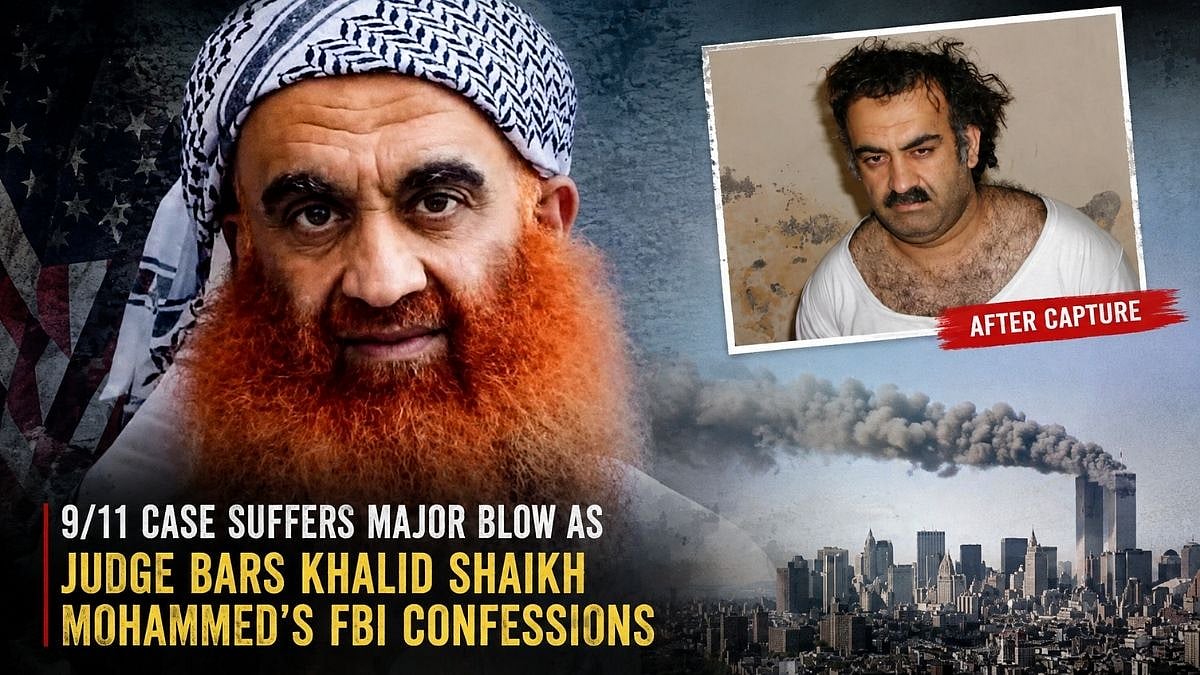
A military judge decided that statements Khalid Sheikh Mohammed made to FBI agents cannot be used in his trial.
Mohammed is accused of helping plan the September 11 attacks.
The FBI questioned him for four days at Guantanamo Bay in January 2007.
Before that, the CIA held him in secret prisons and waterboarded him.
The judge said those earlier experiences may have made Mohammed afraid not to cooperate.
He also said agents did not properly explain that Mohammed could stay silent or speak with a lawyer.
A retired FBI agent said he believed Mohammed spoke willingly.
Prosecutors may appeal the ruling, which could delay a trial planned for 2028.

Military judge Lt. Col. Michael Schrama ruled Khalid Sheikh Mohammed’s 2007 FBI statements inadmissible.
The judge found prosecutors failed to prove the statements were made voluntarily after earlier CIA detention and waterboarding.
Schrama said Mohammed was not properly informed of his rights to remain silent or consult a lawyer.
Prosecutors are reviewing whether to appeal, while a former FBI agent said he believed Mohammed confessed voluntarily.
The ruling further complicates a Guantanamo case with a trial scheduled for June 5, 2028.
- Who
- Khalid Sheikh Mohammed, three other defendants, military judge Lt. Col. Michael Schrama, prosecutors, and FBI agents.
- What
- The judge excluded Mohammed’s 2007 statements to FBI agents after finding prosecutors had not proved they were voluntary.
- Where
- The questioning occurred at the U.S. naval base at Guantanamo Bay, Cuba; Mohammed had previously been held in secret CIA facilities overseas.
- When
- The ruling was issued on a Friday; the articles give differing dates, including August 18 and August 29, 2026. The FBI questioning occurred in January 2007.
- Why
- The judge cited the possible continuing effects of CIA coercion, including waterboarding, and the failure to properly inform Mohammed of his legal rights.
Defense and coercion concerns
Prosecution and voluntary-confession arguments
Whether the statements were voluntary
Defense and coercion concerns
The judge found that prior CIA detention, waterboarding, psychological conditioning, and severe coercion could have made Mohammed fear further mistreatment if he did not cooperate.
Prosecution and voluntary-confession arguments
Retired FBI agent Frank Pellegrino said he believed Mohammed confessed voluntarily and understood that he did not have to speak.
Legal warnings and access to counsel
Defense and coercion concerns
The judge found that FBI agents intentionally failed to explicitly tell Mohammed that he could remain silent, consult a lawyer, and understand that his statements could be used against him.
Prosecution and voluntary-confession arguments
Pellegrino said he made clear that Mohammed did not have to speak, while acknowledging that the court had to decide whether the warnings met legal requirements.
Effect on the prosecution
Defense and coercion concerns
Defense lawyers described the ruling as evidence of the lasting legal consequences of the government’s coercive interrogation practices, and the decision removes evidence prosecutors have called crucial.
Prosecution and voluntary-confession arguments
Prosecutors may appeal and could rely on documents, telephone intercepts, and other conversation transcripts if the statements remain excluded. The articles differ on the death penalty: one says it remains possible, while another says it was taken off the table previously.
Key facts
- Defendant
- Khalid Sheikh Mohammed, also known as KSM
- Suppressed evidence
- Statements from a four-day FBI interrogation at Guantanamo Bay in January 2007
- Judge
- Lt. Col. Michael Schrama
- Earlier treatment
- Mohammed was captured in Pakistan in 2003 and held in secret CIA facilities, where the articles say he was waterboarded
- Legal finding
- The prosecution failed to prove by a preponderance of the evidence that the FBI statements were voluntary
- Trial date
- June 5, 2028
- Potential next step
- Prosecutors said they would decide soon whether to appeal
Quotes
Frank Pellegrino
Retired FBI agent who questioned Khalid Sheikh Mohammed
“Now, whether that fits within what is required legally, based on other activities, a court's got to decide that,”
 wionews.com
“serves as a civics lesson for why the government shouldn’t engage in such shameful conduct”
 freepressjournal.in
Lieutenant Colonel Michael Schrama
US military judge who issued the ruling in Mohammed’s Guantanamo case
“The prosecution has failed to prove by a preponderance of the evidence that Mr. Mohammad’s statements to the F.B.I. were voluntarily given.”
 firstpost.com
freepressjournal.in
firstpost.com
freepressjournal.in
Sources
Related news
Khalid Sheikh Mohammed Set for Long-Delayed 2028 9/11 Trial

9/11 Trial Set for June 2028 After Decades of Delays

New Evidence Delays Trial in Pan Am 103 Bombing Case
Osama bin Laden's Hand-Picked Hijacker Nearly Dropped From 9/11 Plot
Trial in Absentia Begins Against Six 26/11 Accused Under BNSS
Court Examines Saudi Man's Alleged 9/11 Hijacker Assistance
Trump to Mark 25th 9/11 Anniversary at Pentagon

CBC Tells Journalists Avoid 'Terrorist Attack' in 9/11 Coverage
