

Archive · 16 Sep 2026
U.S. Space-Control Claims Fuel Debate Over Orbital Militarization
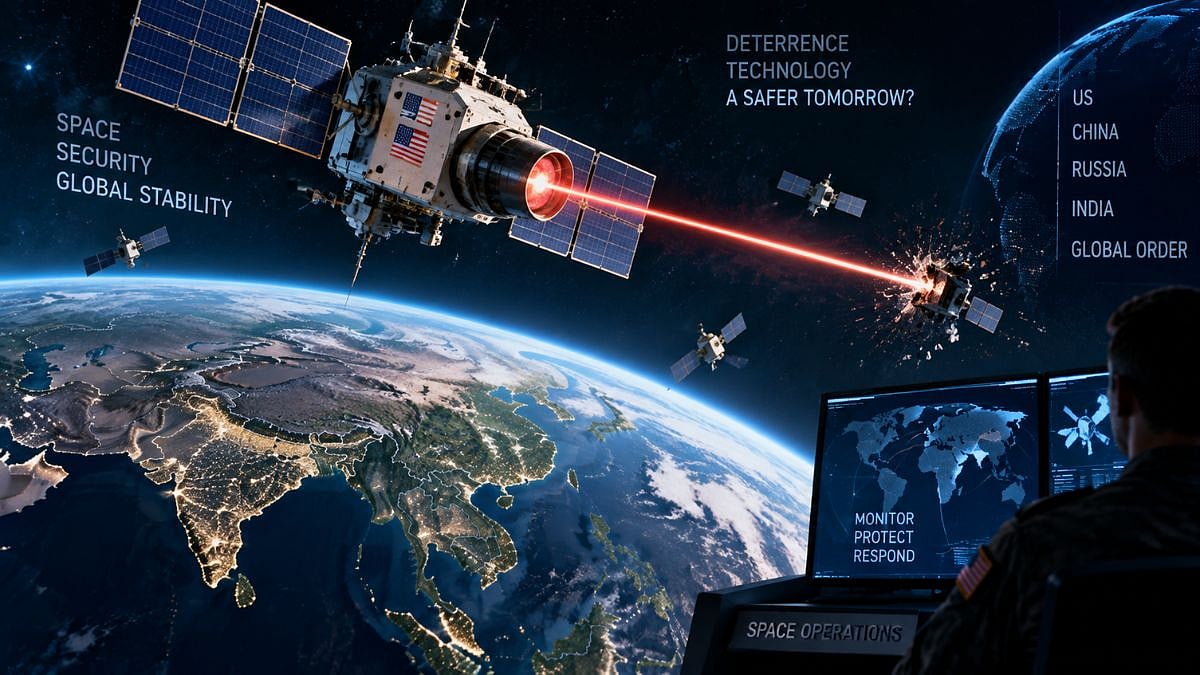
The United States says it has military tools operating in space.
Some could physically attack objects, while others could jam or disrupt signals.
The article does not clearly explain who these systems might be used against.
Beijing and Moscow criticized the announcement and said it could worsen an arms race in space.
Experts worry that openly confirming such weapons could make countries feel less secure.
The article’s author is doubtful that the United States has the strong space dominance being suggested.
This skepticism is linked to reported shortages of weapons after the war in Iran.
India is described as staying silent on the issue.

The United States military reportedly acknowledged deploying active space-control weapons in orbit.
The systems are described as kinetic weapons and non-kinetic tools such as jammers and directed-energy devices.
Beijing and Moscow condemned the disclosure as evidence of increasing militarization and an orbital arms race.
Experts and legal watchdogs warned that official confirmation could destabilize strategic deterrence frameworks.
The article questions whether the claims reflect genuine capability or political posturing amid reported U.S. munitions shortages.
- Who
- The United States military made the reported disclosure; Beijing, Moscow, legal watchdogs, and space-security experts responded critically.
- What
- The United States reportedly acknowledged deploying active on-orbit space-control weapons, including kinetic and non-kinetic systems.
- When
- The article does not provide a specific date; it describes the disclosure as recent.
- Where
- In orbit around Earth, with reactions from Beijing and Moscow.
- Why
- According to the article, the systems are intended to protect friendly space infrastructure or deny adversaries access to theirs; critics say the disclosure could accelerate an arms race.
Critics and Skeptics
U.S. Capability Claims
Meaning of the disclosure
Critics and Skeptics
Critics argue that the announcement may exaggerate U.S. space dominance and serve domestic political purposes.
U.S. Capability Claims
The United States military reportedly presents the systems as real tools for protecting friendly space infrastructure and disrupting adversary assets.
Effect on global security
Critics and Skeptics
Beijing, Moscow, legal watchdogs, and experts warn that openly confirming orbital weapons could accelerate an arms race and weaken strategic stability.
U.S. Capability Claims
The reported U.S. approach treats space-control systems as capabilities needed to protect or deny access to space infrastructure.
Credibility of broader claims
Critics and Skeptics
The article’s author says reported munitions shortages and difficulties in the war in Iran undermine claims of robust, futuristic space dominance.
U.S. Capability Claims
The article states that non-kinetic electronic-disruption systems have a degree of technical plausibility, even while questioning the broader narrative.
- Reported capability
- Active on-orbit space-control weapons
- Weapon types
- Kinetic systems and non-kinetic tools
- Non-kinetic examples
- Electronic warfare payloads, jammers, and directed-energy tools
- Reported reactions
- Beijing and Moscow condemned the disclosure
- Main concern
- Possible destabilization of strategic deterrence frameworks
- Article's skepticism
- The author questions whether the claims represent actual dominance or political posturing
- Related context
- The article links the disclosure to reported U.S. munitions shortages after the war in Iran