

Archive · 3 Aug 2025
Rising Nest Temperatures Threaten Endangered Gharial Population
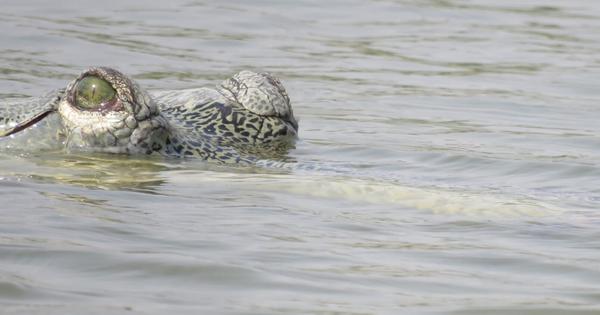
Imagine gharials, the ancient crocodile relatives, are having babies, but the world is getting hotter.
The baby gharial's sex depends on the temperature of its nest.
Hotter nests mostly make girl gharials, and very few boys.
Scientists studied nests and found many more girls than boys.
If there aren't enough boys, the gharial population may struggle to reproduce.
To help, scientists might watch the nests' temperature and move them to cooler spots.
The goal is to protect these special creatures from a future with too many girls and not enough boys.

Rising nest temperatures are skewing the sex ratio of gharial hatchlings towards females, potentially harming the species.
Researchers monitored 17 gharial nests in the Chambal River over three breeding seasons.
Gharial sex is determined by temperature during incubation; a narrow temperature range produces males.
Study found an average of one male for every 3.2 females in the monitored nests.
Adaptive management strategies like nest monitoring and relocation are proposed to help the species.
- Who
- Researchers from the Wildlife Institute of India conducted the study on gharials.
- What
- Rising temperatures are skewing the sex ratio of gharial hatchlings, potentially endangering the species.
- When
- The study was conducted between 2017 and 2019.
- Where
- Chambal River in Madhya Pradesh, India, particularly at the Baroli and Nadigaon nesting sites.
- Why
- Rising temperatures, likely due to climate change, are affecting the sex ratio of gharial hatchlings.
Impacts of Climate Change
Proposed Mitigation Strategies
Climate change's effect on gender imbalance
Impacts of Climate Change
The study highlights the potential for skewed sex ratios due to rising temperatures driven by climate change and habitat alterations.
Proposed Mitigation Strategies
No opposing viewpoint in the article.
- Species
- Gharial (Gavialis gangeticus)
- Location of Study
- Chambal River, India
- Study Period
- 2017-2019
- Nest Monitored
- 17
- Temperature Range for Males
- Around 32 degrees Celsius
- Observed Sex Ratio
- One male to 3.2 females
- Adult Gharials in Sanctuary (2024)
- 2,456