

Archive · 12 Jun 2025
Voyager Spacecraft Encounter 'Wall of Fire' in Interstellar Space
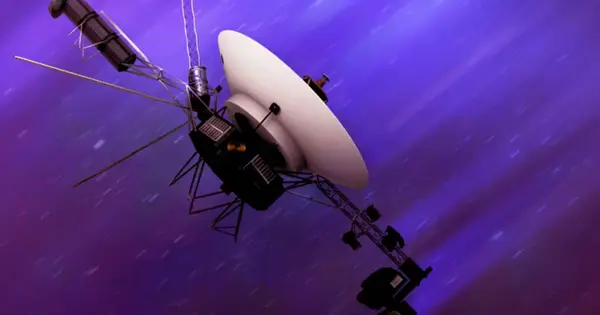
Imagine the sun blowing a giant bubble around itself, called the heliosphere.
At the very edge of this bubble is a place called the heliopause, where the sun's bubble meets the space between stars.
The Voyager spacecraft, sent out long ago, had to cross this edge, sometimes called the 'wall of fire' because it's super hot.
They survived temperatures reaching up to 90,000 degrees and made it through to the space outside the solar system.
Scientists learned that this edge moves closer and farther away from the sun.
The spacecraft are still sending data, helping us learn more about what's beyond our solar system.

Voyager 1 and 2 spacecraft encountered the 'wall of fire' at the edge of the solar system.
This 'wall of fire' is the heliopause, the boundary between the solar wind and interstellar wind.
The probes measured temperatures of 54,000-90,000 degrees Fahrenheit at the heliopause.
Voyager 1 crossed the heliopause in 2012; Voyager 2 in 2018, entering interstellar space.
The heliopause's distance from the Sun varies, expanding and contracting.
- Who
- Voyager 1 and 2 spacecraft.
- What
- The heliopause, the boundary between the solar wind and interstellar wind, referred to as the 'wall of fire'.
- When
- Voyager 1 crossed in 2012 and Voyager 2 in 2018.
- Where
- At the edge of the solar system, where the heliosphere meets interstellar space.
- Why
- To study the Sun's heliosphere and explore interstellar space.
- Spacecraft
- Voyager 1 and Voyager 2
- Launched
- 1977
- Objective
- To study the Sun's heliosphere.
- Heliopause Temp
- 54,000-90,000 degrees Fahrenheit
- Voyager 1 Crossed
- August 25, 2012
- Voyager 2 Crossed
- 2018
- Expected data transmission end
- Voyager 1: 2030; Voyager 2: Well into the 2030s