

Archive · 18 Jul 2025
Scientists Create Baby Mice with Two Male Parents
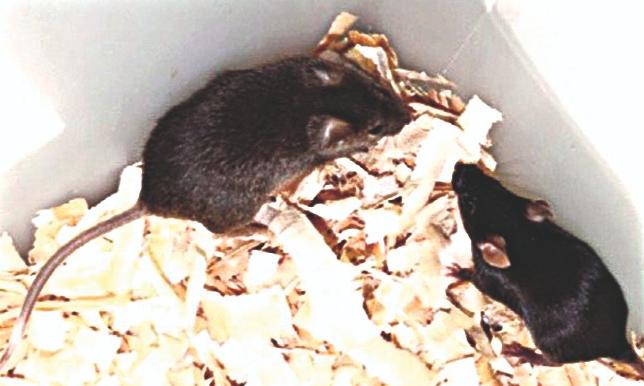
Scientists in China made baby mice from two male mice, no mother needed!
They did this by changing how genes work, a process called genomic imprinting.
Normally, you need DNA from a mom and a dad.
But, they figured out how to use special tricks in the lab to make it happen with just two dads.
This is just in mice right now.
Scientists are still figuring out all the risks and how this could work in humans.
It could help us understand how our bodies grow and how we might fix certain problems with genes.

Scientists created baby mice with genetic material from two male mice, without a mother.
The experiment involved stem cell engineering techniques and genetic imprinting research.
Genomic imprinting, which regulates gene activity, was manipulated to achieve the outcome.
Experts emphasize the complexity of human imprinting and ethical considerations for human applications.
The research is currently limited to mice and potential human applications would require extensive research.
- Who
- Researchers at the Chinese Academy of Sciences, led by molecular biologist Zhi Kun Li.
- What
- Scientists created baby mice from two male mice.
- When
- The research was recently published in the Cell Stem Cell Scientific Journal.
- Where
- The research was conducted at the Chinese Academy of Sciences.
- Why
- To understand genetic imprinting and explore the possibilities of rewriting these rules.
Scientific advancement
Ethical Concerns
Research implications
Scientific advancement
Potential for deeper understanding of reproduction, imprinting disorders and regenerative medicine.
Ethical Concerns
High complexity, ethical supervision required.
Potential and risks
Scientific advancement
Pushing boundaries of science and DNA cloning.
Ethical Concerns
Success rate of experiment was believed to be low by experts.
- Experiment Type
- Creating mice from two male parents.
- Institution
- Chinese Academy of Sciences
- Key Mechanism
- Manipulation of genomic imprinting.
- Current Scope
- Limited to mice
- Expert Insight
- Dr. Harsh Sheth, Gogineni Kishore Sai