

Archive · 19 May 2025
JWST Spots New Clouds and Chemicals on Saturn's Moon Titan
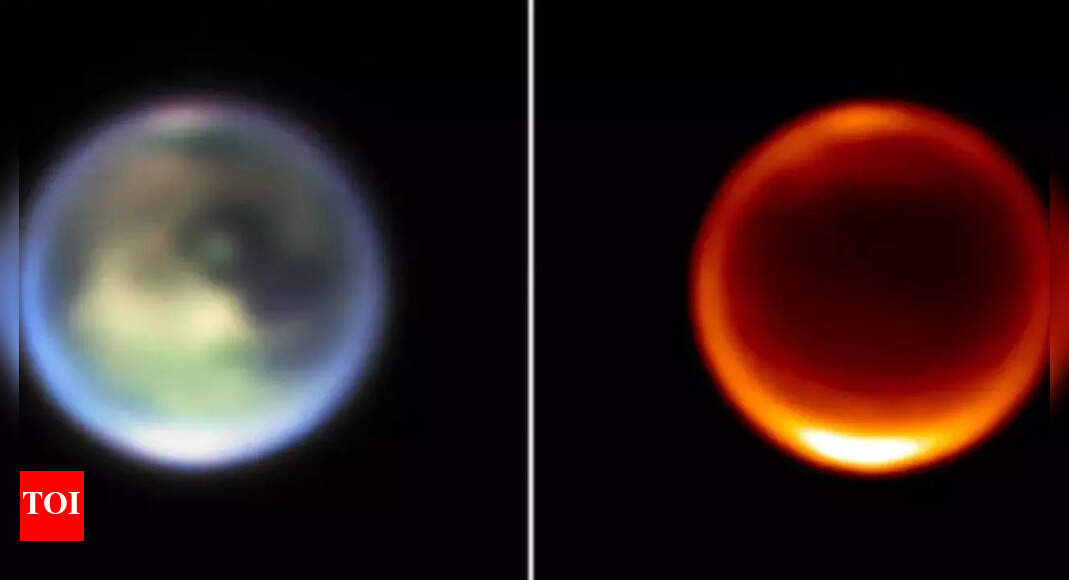
Imagine Saturn has a giant moon called Titan, which has clouds and rain like Earth.
Scientists used a super-powerful telescope, the James Webb Space Telescope (JWST), to look at Titan and saw clouds in a part of Titan that they'd never seen clouds before!
They saw this during Titan's summer.
These clouds are made of methane, like the stuff in natural gas.
Scientists also found a special chemical in the air called methyl radicals, which helps us understand how Titan's air works.
It's like learning more about how the weather works on another planet, and could even give hints about how other planets might have life.

The James Webb Space Telescope (JWST) captured images of cloud formations in Titan's northern hemisphere.
These methane clouds were observed for the first time in this region of Titan.
Ground-based observations from the W. M. Keck Observatory confirmed the JWST findings.
The observations took place during Titan's northern summer season, a previously unobserved period.
JWST also identified methyl radicals, important for understanding Titan's atmospheric chemistry.
- Who
- Scientists using the James Webb Space Telescope (JWST) and the W. M. Keck Observatory.
- What
- Observed cloud formations and identified methyl radicals in Titan's northern hemisphere.
- When
- Late 2022 and mid-2023.
- Where
- Titan, Saturn's largest moon.
- Why
- To gain insights into Titan's climate patterns and atmospheric chemistry.
- Telescope Used
- James Webb Space Telescope (JWST)
- Moon
- Titan
- Location of Clouds
- Northern Hemisphere
- Observation Time
- Late 2022 and mid-2023
- Key Finding
- Detection of methyl radicals in the atmosphere