1 hr ago
India's Age-Fraud Crisis Exposes Gaps Despite New Testing and Enforcement
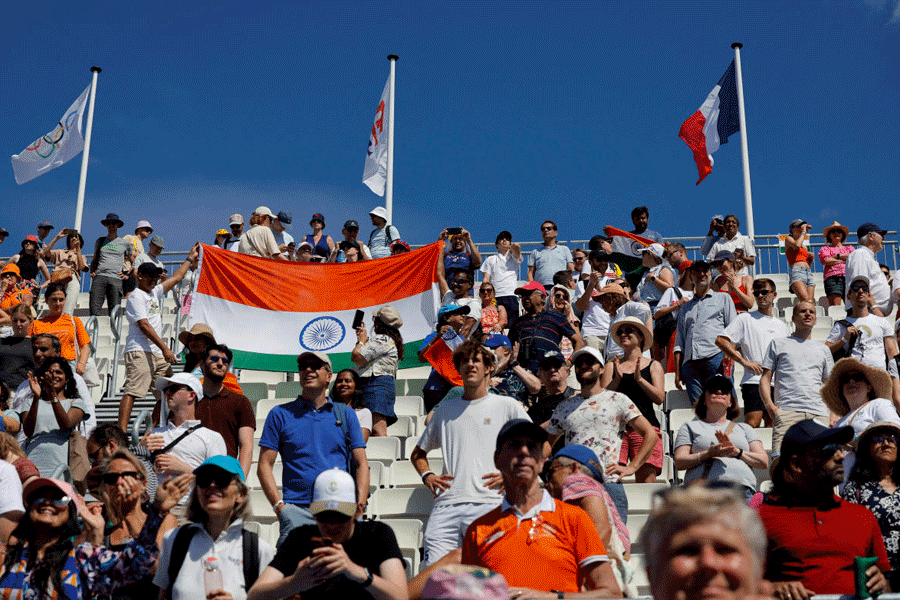
Some young athletes in India’s sports competitions are accused of pretending to be younger than they really are.
This can give them an unfair advantage over other children.
More than 500 wrestlers were removed from one under-17 championship, and many football teams were also expelled from a major school tournament.
Experts say the problem is widespread because records are not always reliable and checks can be weak.
Being older can help athletes win scholarships, sponsorships, or other opportunities.
Cricket authorities use bone tests, but those tests are not always perfect and can sometimes be misused.
A proposed government plan would keep athletes’ identities in a secure digital database and use several kinds of checks.
Experts also say young athletes should be protected because adults may be responsible for changing their records.

More than 500 wrestlers were disqualified from India’s under-17 championships in Gonda in June for alleged age fraud.
About 20 teams were expelled from the Subroto Cup after fielding overage players.
Experts say age fraud is widespread in youth sports, driven by rewards and weak oversight.
The BCCI has used mandatory bone-density testing since 2012, but specialists say the method has limitations.
A proposed Sports Ministry code would create a central digital database, combine testing methods, and introduce criminal penalties.
- Who
- Young Indian athletes, parents, coaches, sports federations, medical experts, and government authorities are involved.
- What
- India is confronting widespread age fraud in youth sports, with calls for stronger testing, recordkeeping, and penalties.
- Where
- The reported wrestling disqualifications occurred at the under-17 championships in Gonda, India; the issue affects age-group sports across India.
- When
- The latest reported mass disqualifications occurred in June; the BCCI adopted the TW3 method in 2012.
- Why
- Age fraud can provide an advantage in competitions and access to scholarships, sponsorships, fame, and potentially lucrative cricket opportunities.
Experts' concerns
Authorities' proposed response
Are bone tests enough?
Experts' concerns
Sports experts say TW3 testing has limitations, can be vulnerable to fraud, and may wrongly flag naturally early-maturing teenagers.
Authorities' proposed response
The BCCI requires bone-density tests in its approved tournaments, while the proposed code would combine TW3 with documentary, MRI, dental, and physical checks.
How should fraud be deterred?
Experts' concerns
Experts argue age fraud should face consequences comparable to doping and say penalties must be routinely enforced to have meaning.
Authorities' proposed response
The proposed Sports Ministry code would introduce criminal deterrence, while also giving athletes an amnesty period to correct records without punishment.
Who should be held responsible?
Experts' concerns
Experts stress that minors may be victims and that adults who help alter their records should face scrutiny and possible penalties.
Authorities' proposed response
The proposed approach emphasizes early identity verification while including appeals and data protection for young athletes.
Key facts
- Wrestling disqualifications
- More than 500 wrestlers were disqualified from India’s under-17 championships in June.
- Football expulsions
- About 20 teams were expelled from the Subroto Cup for fielding overage players.
- BCCI testing
- The Board of Control for Cricket in India adopted the TW3 bone-age method in 2012.
- Testing limitation
- Experts say TW3 is generally useful only up to about age 16 and may misidentify naturally early-maturing teenagers.
- Proposed database
- The draft Sports Ministry code recommends a central, digitally locked database for athlete identities.
- Proposed safeguards
- The code recommends documentary checks alongside TW3, MRI, dental, and physical examinations.
- Proposed consequences
- The draft code includes criminal deterrence and an amnesty window for athletes to correct records without punishment.
Quotes
Aahna Mehrotra
Sports lawyer and founder of AM Sports Law & Management Co.
“Protect the accused as seriously as you pursue the guilty, which means robust appeals and, because these are minors, strict data protection.”
 telegraphindia.com
“It is endemic.”
telegraphindia.com
PSM Chandran
President of the Indian Federation of Sports Medicine.
“We have such strict punishment for doping. Why can't we have something similar for the age frauds?”
telegraphindia.com
Sources
Related news
Doping Cases Prompt WFI to Tighten Indian Wrestling Rules

Anaya Bangar Hasn’t Played Yet, So Let Her Play
Swapna Barman Provisionally Suspended After Boldenone Test by NADA

Asian Games Runner Abhishek Pal Receives NADA Notice Over Clomiphene

BCCI Tightens Fitness Rules, Tough Bronco Test for All Players

Anaya Bangar Cleared for Australian Community Cricket, Elite Future Conditional
South Indian Doctor Celebrates Awadhi Language In Gonda

Delhi High Court Seeks WFI Stand on Phogat’s Notices
Gonda Villagers Protest Power Cuts, Engineer Swears on Hanuman Chalisa

Yogi Adityanath Gives Appointment Letters To 24 Candidates