

Archive · 11 Dec 2025
Chandrayaan-3 Discovers Dynamic Plasma Near Moon's South Pole
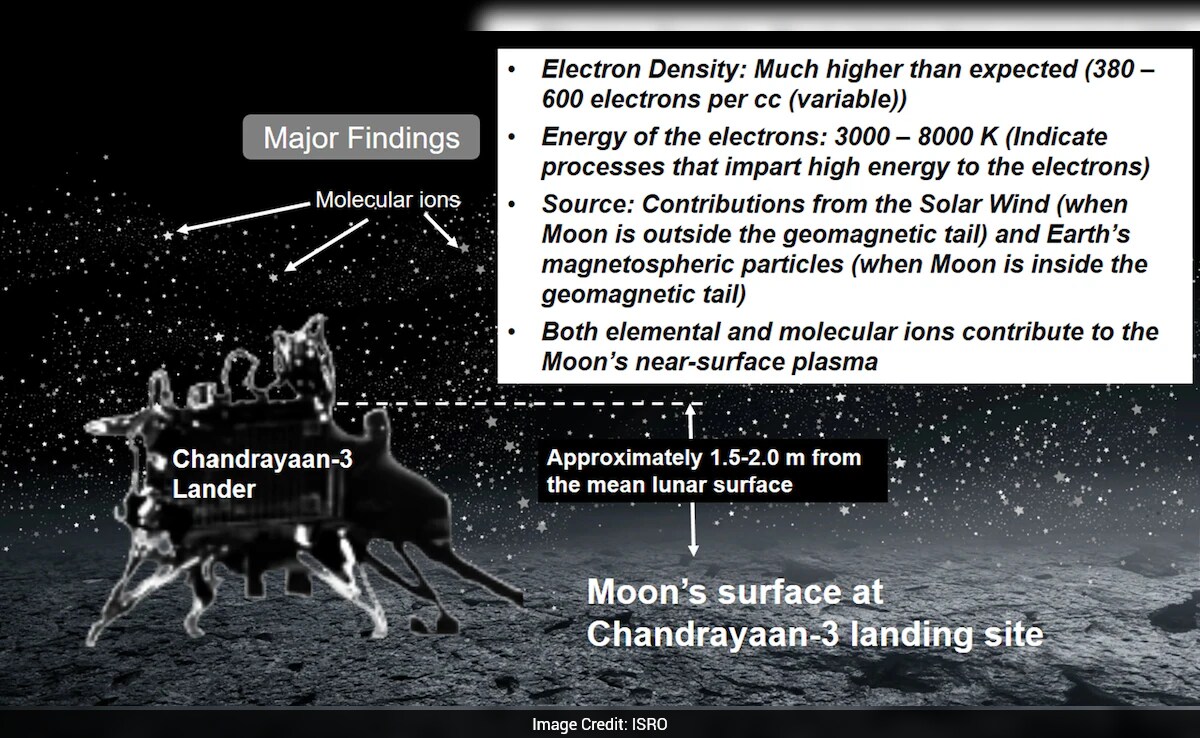
Chandrayaan-3, India's moon mission, found something exciting near the Moon's south pole.
It discovered that the area has a lot of tiny charged particles called plasma.
These particles are much more active than scientists thought before.
The plasma comes from the Sun and sometimes from Earth's magnetic field.
The Moon's plasma environment changes all the time because of these influences.
This is the first time scientists have measured these particles so close to the Moon's surface.
The findings will help future moon missions understand this dynamic environment better.

Chandrayaan-3's RAMBHA-LP instrument made the first direct measurements of lunar plasma near the Moon's south pole.
Electron densities of 380-600 particles per cubic cm were detected, higher than previous satellite-based estimates.
The plasma environment is influenced by solar wind and charged particles from Earth's magnetosphere.
Electron temperatures ranged from 3,000 to 8,000 Kelvin, indicating highly energetic particles.
The findings provide crucial 'ground truth' for future lunar missions, showing the plasma environment is constantly changing.
- Who
- Indian Space Research Organisation (ISRO)
- What
- Discovered a dynamic electrical environment near the Moon's south pole
- When
- During Chandrayaan-3 mission (specific dates not mentioned)
- Where
- Moon's south pole (Shiv Shakti point)
- Why
- To study the lunar plasma environment and its interactions with solar wind and Earth's magnetosphere
- Mission
- Chandrayaan-3
- Lander
- Vikram
- Instrument
- RAMBHA-LP
- Location
- Moon's south pole (Shiv Shakti point)
- Electron Density
- 380-600 particles per cubic cm
- Electron Temperature
- 3,000-8,000 Kelvin
- Key Influences
- Solar wind, Earth's magnetosphere