5 hrs ago
IIT Indore's HGAST Corrects Gender Errors in Speech Translation
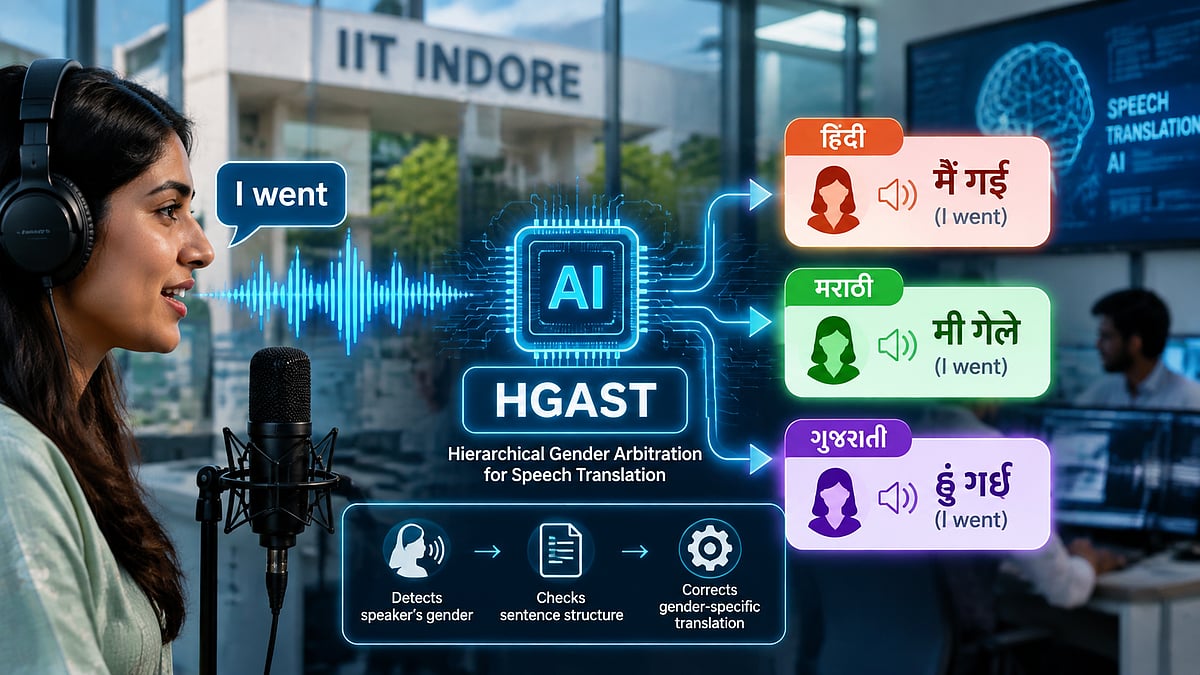
Researchers at IIT Indore made an AI tool called HGAST.
It helps translation programs choose the right gendered words.
English often uses the same verb whether a man or woman is speaking.
Hindi, Marathi and Gujarati can use different verb forms for men and women.
Translation systems sometimes choose male forms when a woman is speaking.
HGAST listens to the voice and examines the sentence.
It then changes incorrect words while trying to preserve the original meaning and grammar.
The tool can be added to existing translation systems without retraining them.
Tests showed that translations became much more accurate for female speakers.

IIT Indore researchers developed HGAST, a correction layer for gender-related errors in English-to-Hindi, Marathi and Gujarati speech translation.
The tool analyzes a speaker’s voice and sentence structure, applies controlled word substitutions, and checks that meaning and grammar remain unchanged.
HGAST is designed to work with existing translation systems without replacing or retraining their underlying models.
Female-speaker accuracy improved from 83.15% to 98.88% in Hindi, about 73–76% to 96–97% in Gujarati, and about 90–93% to 100% in Marathi.
Testing used three translation systems and 500 human reviewers per language; male-speaker accuracy remained between 99% and 100%.
- Who
- Researchers led by Dr Chandresh Kumar Maurya at the Indian Institute of Technology Indore, with Dr Mahendra Gupta and intern Anjil Kumar Raj, developed HGAST.
- What
- They developed an AI correction layer to reduce gender-identification and gendered-verb errors in speech translation.
- Where
- The research was conducted at the Indian Institute of Technology Indore in Indore, Madhya Pradesh, and tested on translations into Hindi, Marathi and Gujarati.
- When
- Officials announced the tool on Tuesday; the articles do not specify when its development or testing occurred.
- Why
- The researchers aimed to reduce systematic misgendering and improve fair representation without retraining existing translation models.
Key facts
- Tool
- HGAST, or Hierarchical Gender Arbitration for Speech Translation
- Languages tested
- English to Hindi, Marathi and Gujarati
- Translation systems
- Three existing systems, including Sarvam AI, were tested
- Hindi result
- Female-speaker accuracy rose from 83.15% to 98.88%
- Gujarati result
- Female-speaker accuracy rose from approximately 73–76% to nearly 96–97%
- Marathi result
- Female-speaker accuracy rose from approximately 90–93% to 100%; native Marathi reviewers independently validated 98.2%
- Human evaluation
- 500 reviewers per language participated, with results broadly matching automated evaluations
Quotes
Dr Chandresh Kumar Maurya
IIT Indore researcher who led the HGAST development team
“HGAST demonstrates that gender-related translation errors can be addressed without retraining the underlying translation model. By combining speech and linguistic information with a controlled correction mechanism, the framework significantly reduces systematic misgendering while preserving translation accuracy,”
 freepressjournal.in
“As more people across India rely on AI to translate speech, getting the basics right matters and correctly recognising who is speaking is about as basic as it gets. I'm glad to see our researchers tackling a problem that's easy to overlook but has a real impact on how fairly people are represented.”
 rediff.com
Sources

Related news

India’s Sovereign AI Faces Test Beyond Twenty-Two Language Coverage

Sarvam AI Launches Saaras V4 for Indian-Language Voice Applications

Meta Launches Muse Voice Transcribe with Indian Language Support

India and Nepal Advance Inclusive Multilingual Language AI Collaboration
IIT Madras Launches Four Open AI Models for Indian Languages

Bodhan AI and AI4Bharat Release Open Indic-Language Models

Bhopal Businessman’s Death Sparks Dispute Over Canteen Contract
Mohan Yadav Faces Criticism After Emotional Ancestral House Demolition

Heavy Rain Ends as Monsoon Withdrawal Nears Madhya Pradesh
Ujjain Shahi Masjid Portion Removal Continues Under Heavy Security