

Archive · 13 Nov 2025
Top players to dominate India's quick commerce in 40 major cities: Report

Imagine India is like a giant house with different rooms!
The biggest, fanciest rooms are the top 40 cities, where lots of people live.
In these busy city rooms, companies that can bring you things super fast, like snacks or medicine in just minutes (that's 'quick commerce'), will be the bosses.
For the next set of rooms, the next 400 cities, slightly bigger stores that have lots of choices like supermarkets ('modern trade') will do really well.
And in the smaller rooms, towns, and villages, the neighborhood corner stores ('general trade') will still be the most popular.
All these different types of stores have different ways of working.
The fast delivery ones focus on speed, while the supermarket ones focus on having many items and good prices.
The report says that soon, just a few fast delivery companies will be the main players in the biggest cities.

A report indicates that 2-3 key players are expected to dominate India's quick commerce market in the top 40 cities.
Quick commerce (QC) will lead in India's top 40 cities, while Modern Trade (MT) will dominate in the next 400 cities.
General Trade (GT), comprising local kirana stores, will continue to lead in smaller cities, towns, and villages.
Quick commerce growth is driven by consumer demand for immediacy and convenience in urban centers.
Modern Trade and E-commerce platforms hold advantages in product cataloguing and cost competitiveness.
- Who
- Quick commerce (QC), Modern Trade (MT), and General Trade (GT) players in India.
- What
- A report suggests that the top two or three quick commerce players will likely dominate India's top 40 cities, while Modern Trade will lead in the next 400 cities, and General Trade will remain dominant in smaller towns and villages.
- When
- The report's findings are current, reflecting the evolving dynamics of India's internet economy.
- Where
- India, specifically focusing on different tiers of cities (Top 40, Next 400, Last 4000).
- Why
- This market segmentation is driven by varying consumer demands for immediacy and convenience across different urban and rural settings, alongside differing business strategies in logistics, cost competitiveness, and product assortment.
Quick Commerce (QC)
Modern Trade (MT) & General Trade (GT)
Market Dominance by City Tier
Quick Commerce (QC)
Quick Commerce is expected to dominate in India's top 40 cities, driven by demand for immediacy and convenience.
Modern Trade (MT) & General Trade (GT)
Modern Trade will flourish in the next 400 cities, while General Trade will remain the leader in smaller cities, towns, and villages.
Advantages in Product Cataloguing and Cost
Quick Commerce (QC)
QC and E-commerce platforms are investing heavily in warehouse networks and logistics optimization to cut costs.
Modern Trade (MT) & General Trade (GT)
Modern Trade retailers focus on margins and deeper assortments, holding advantages in product cataloguing and cost competitiveness.
Growth Trajectory and Market Share
Quick Commerce (QC)
QC will dominate the retail channel in top urban markets and is predicted to gain ground from General Trade.
Modern Trade (MT) & General Trade (GT)
Modern Trade and E-commerce are expected to have healthy growth, with MT flourishing in tier 2 and 3 cities.
- Report Source
- Bernstein Research
- Dominant Model in Top 40 Cities
- Quick Commerce (QC)
- Dominant Model in Next 400 Cities
- Modern Trade (MT)
- Dominant Model in Smaller Cities/Villages
- General Trade (GT)
- Key Growth Drivers for QC
- Consumer demand for immediacy, convenience, technological advancements, operational effectiveness
- Key Advantages for MT/EC
- Product cataloguing, cost competitiveness
- Population in Top 40 Cities
- Approx. 200 million people
- Number of Pin Codes in Top 40 Cities
- 1,700
Sources
Online Grocery market in India sees strong growth, but fresh produce purchases remain largely offline: PwC Report
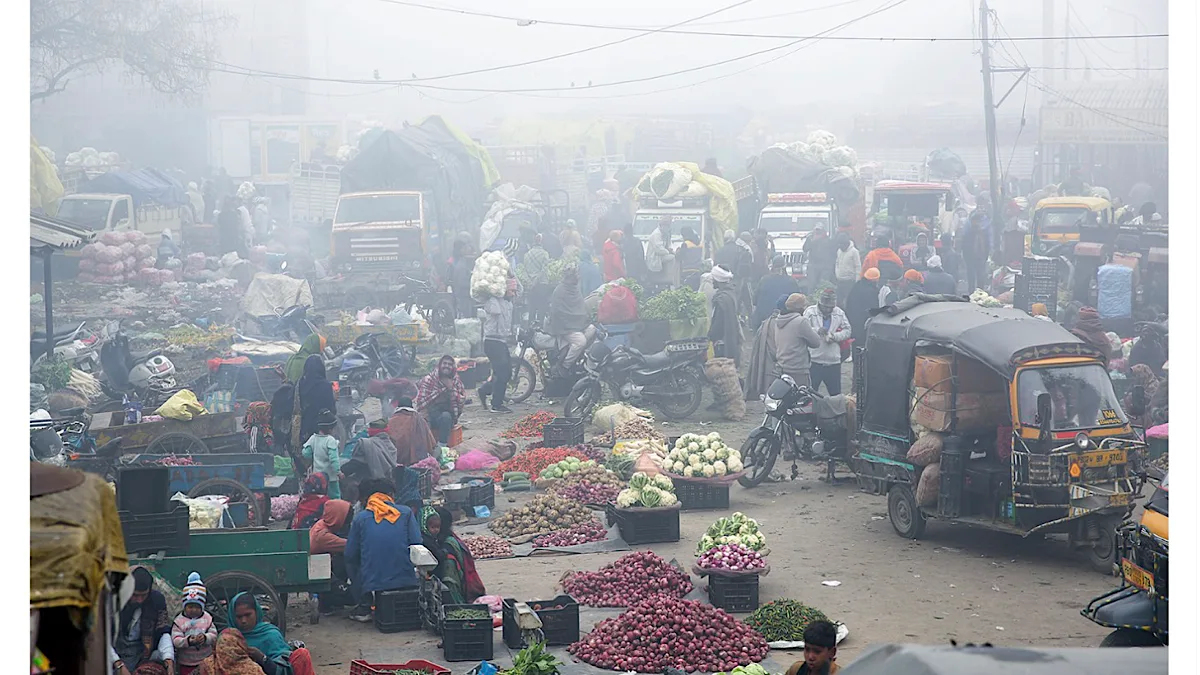
Online Grocery market in India sees strong growth, but fresh produce purchases remain largely offline: PwC Report
