

Archive · 20 May 2025
New Ising Model Extends Physics to Study Complex Real-World Systems
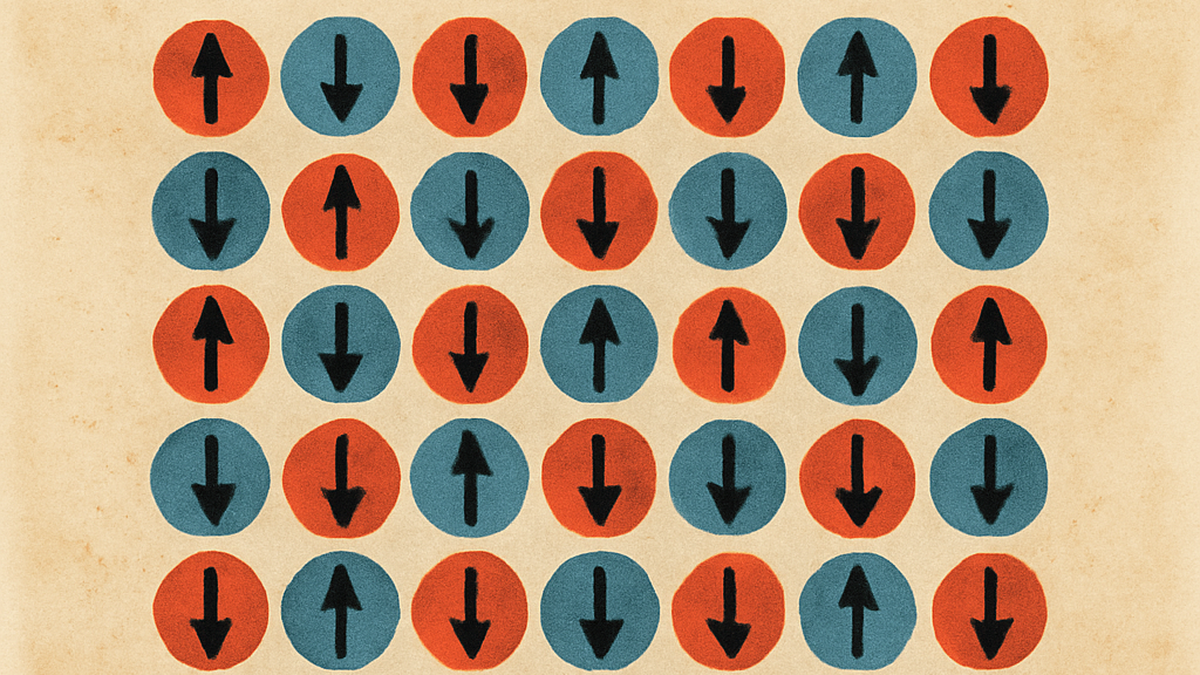
Scientists have developed a new model based on the Ising model to better understand complex systems with one-way interactions.
The original Ising model helps solve problems involving interacting units, like atoms in a magnetic field.
The new model includes non-reciprocal interactions, meaning the effect of one component on another isn't the same in reverse.
This model can simulate social networks, political strategies, and ecological dynamics.
Researchers found the model can have disordered, ordered, or a swap phase that acts like a clock.
The model's findings could help understand biological systems and design synthetic materials.

Researchers created a non-reciprocal Ising model to study systems with asymmetric interactions.
The model builds on the original Ising model, used to understand interacting units.
The new model can simulate various real-world systems, like social networks and ecosystems.
The model can exist in disordered, ordered, or swap phases.
Findings may help understand biological systems and create synthetic materials.
- Who
- Researchers Yael Avni, David Martin, Daniel Seara, Vincenzo Vitelli, and Michel Fruchart.
- What
- Developed a new non-reciprocal Ising model to understand complex systems with asymmetric interactions.
- When
- May 20, 2025
- Where
- University of Chicago and ESPCI Paris.
- Why
- To better understand systems where interactions are one-way and to expand the Ising model's usefulness across scientific fields.
- Original Model Creator
- Ernst Ising
- Ising Model Creation Year
- 1924
- Grid Dimensions Used
- Two dimensions and three dimensions
- Model Type
- Non-reciprocal Ising model
- Model Phases
- Disordered, ordered, and swap phase