

Archive · 8 Sep 2026
UPSC GS-3 Practice Covers Banking Liquidity and Satellite Orbits
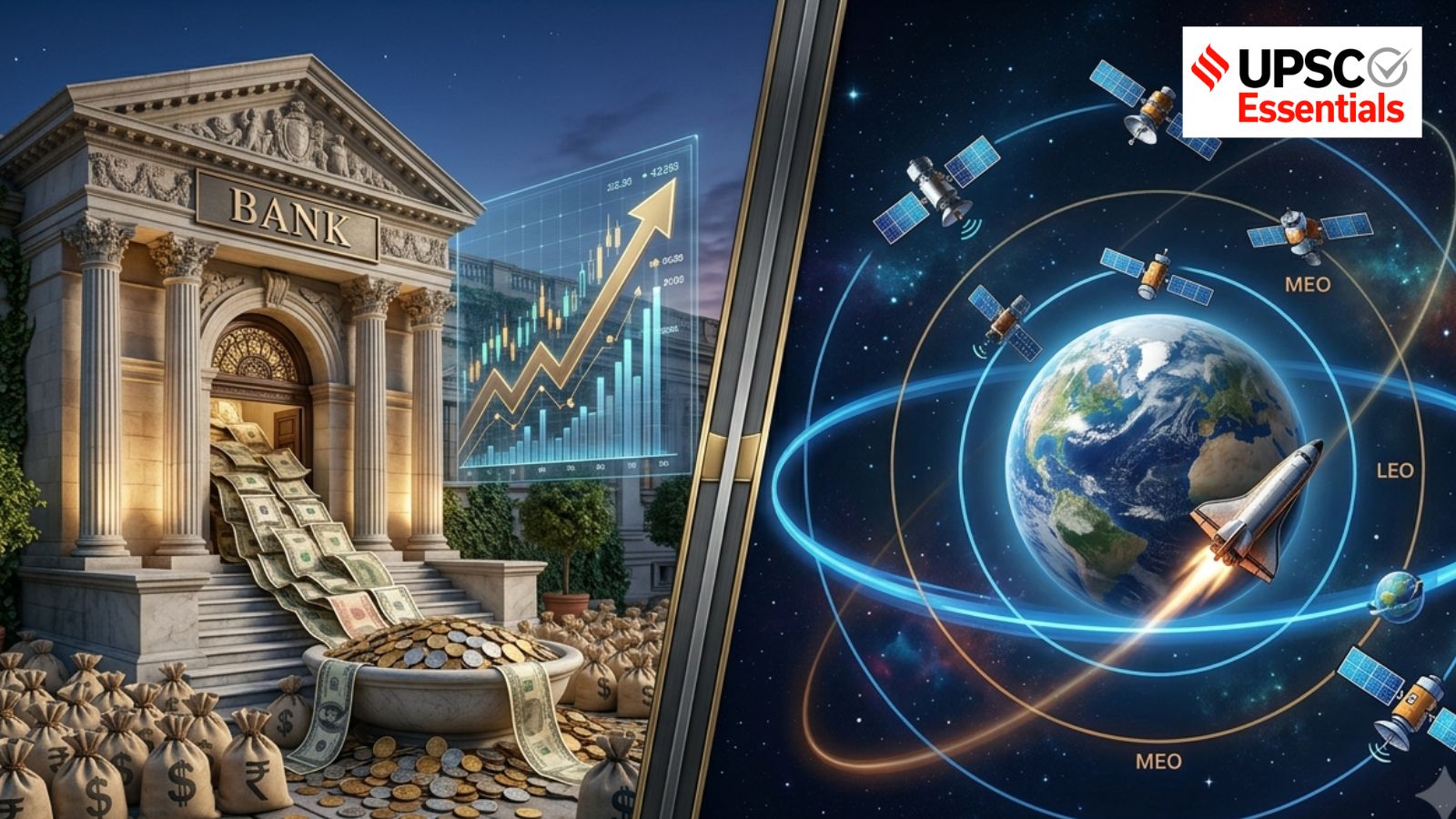
This article gives civil-service students two questions to practise.
The first question is about banks having more money available than they need.
When there is too much money, short-term interest rates can fall below the rate the Reserve Bank of India wants to guide them.
This can make monetary policy less effective.
The RBI can use tools such as VRRR operations, OMOs and the CRR to manage the surplus.
The second question explains that satellites can fly at different heights above Earth.
LEO satellites are closer and can take sharper pictures with less delay, while MEO satellites are useful for navigation.
GSO satellites cover very large areas continuously, but they require more energy and have greater signal delays.

The first question examines how excess banking-system liquidity can weaken monetary-policy transmission even when the repo rate is unchanged.
Banking-system liquidity reportedly reached ₹10.3 lakh crore on September 3, 2026, while average surplus rose to ₹3.67 lakh crore in August.
Foreign-currency inflows linked to the Reserve Bank of India’s dollar-rupee swap facility and foreign-exchange operations contributed to the liquidity surplus.
The second question compares LEO, MEO and GSO satellites based on coverage, resolution, latency and energy requirements.
LEO favours high resolution and low latency, MEO supports navigation, and GSO provides broad, persistent coverage with higher latency and energy needs.
- Who
- UPSC Essentials, an Indian Express initiative, presents the practice material; the Reserve Bank of India and satellite missions provide the subjects discussed.
- What
- The article provides two GS-3 Mains answer-writing questions on excess banking liquidity and the trade-offs among LEO, MEO and GSO satellite orbits.
- When
- The material refers to developments in 2026, including liquidity data from September 3, 2026, and an August 2026 magazine.
- Where
- The first topic concerns India’s banking system and the second concerns satellite orbits around Earth.
- Why
- The questions are intended to help UPSC Civil Services Examination aspirants practise issues related to the Indian economy, monetary policy and space technology.
- Banking-system liquidity
- Reached ₹10.3 lakh crore on September 3, 2026, according to the article.
- Average liquidity surplus
- Rose from ₹1.07 lakh crore in July to ₹3.67 lakh crore in August.
- Foreign-currency deposits
- The RBI’s special US dollar-rupee swap facility had garnered $136.377 billion by August 31.
- Liquidity-management tools
- The article identifies VRRR operations, OMOs and the CRR as tools for managing surplus liquidity.
- LEO altitude
- Approximately 160–2,000 km.
- MEO altitude
- Approximately 2,000–35,786 km.
- GSO altitude
- Roughly 35,786 km and above.
- Satellite example
- EOS-05 used a sub-geosynchronous transfer orbit before its propulsion system raised and circularised its orbit.