

Archive · 23 Dec 2025
Auroras Light Up Skies Beyond Poles
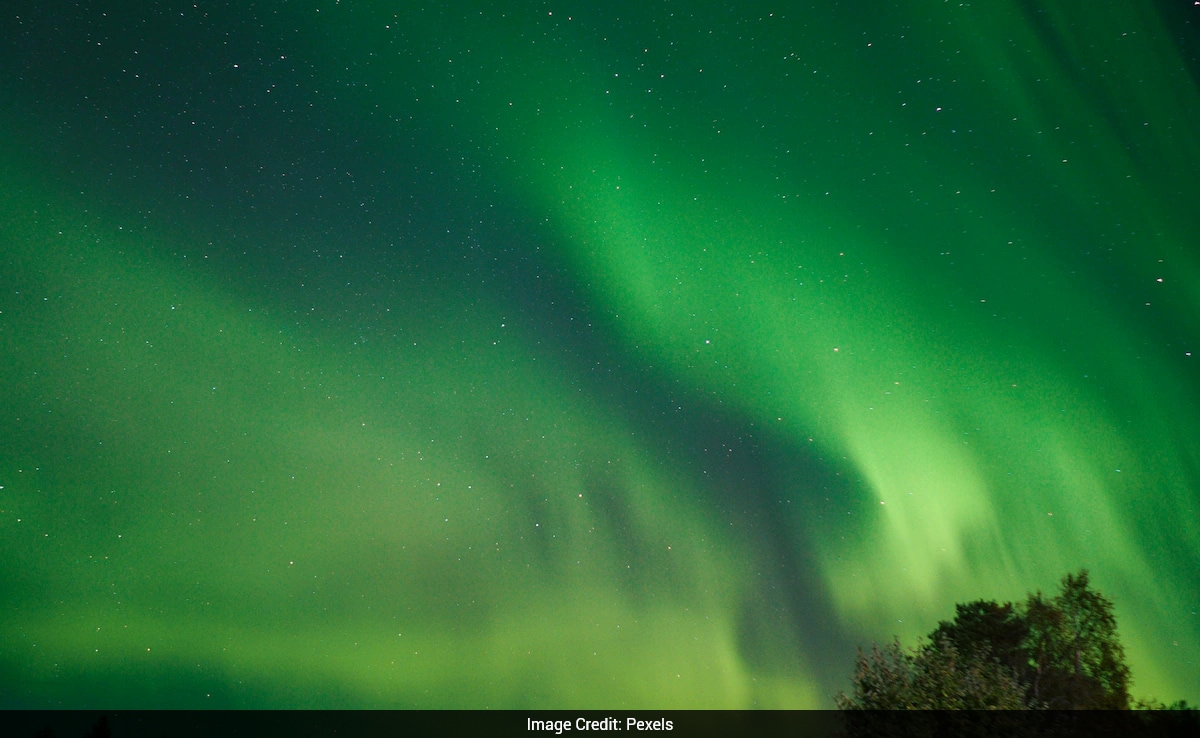
Auroras are beautiful lights in the sky that usually appear near the North and South Poles.
They happen when the Sun sends tiny charged particles towards Earth.
These particles collide with gases in our atmosphere, like oxygen and nitrogen, making them glow.
Oxygen makes green lights, while nitrogen makes purple, blue, or pink lights.
Sometimes, very high-up oxygen can make rare red lights.
Normally, we only see auroras near the poles, but recently, they've been seen much farther away because the Sun is extra active.
Scientists are studying these lights to understand if they affect our ozone layer.
People are so excited about seeing auroras that special tours and apps help them find the best places to watch.

Auroras are caused by solar storms releasing charged particles that collide with Earth's atmosphere.
Colors depend on atmospheric gases: oxygen produces green, nitrogen produces purple/blue/pink, and high-altitude oxygen can produce rare red.
Recent solar maximum has expanded aurora visibility beyond usual polar regions.
Auroras have been observed in unusual locations like Hungary, Switzerland, Florida (USA), southern Australia, and New Zealand.
Scientists are researching potential impacts of aurora particles on Earth's ozone layer.
- Who
- Scientists at Kjell Henriksen Observatory, Aurora enthusiasts
- What
- Auroras expanding beyond usual polar regions
- When
- During the 11-year solar maximum cycle
- Where
- Observed in Hungary, Switzerland, Florida (USA), Southern Australia, New Zealand
- Why
- Increased solar activity during solar maximum
- Aurora Types
- Aurora Borealis (North), Aurora Australis (South)
- Cause
- Solar storms releasing charged particles
- Colors
- Green (Oxygen), Purple/Blue/Pink (Nitrogen), Rare Red (High-altitude Oxygen)
- Recent Expansion
- Solar maximum increasing aurora range
- Research Focus
- Impact on Earth's ozone layer
- Observation Locations
- Hungary, Switzerland, Florida (USA), Southern Australia, New Zealand