Archive · 19 Jan 2026
Astronomers Discover Mysterious Iron Bar in Ring Nebula

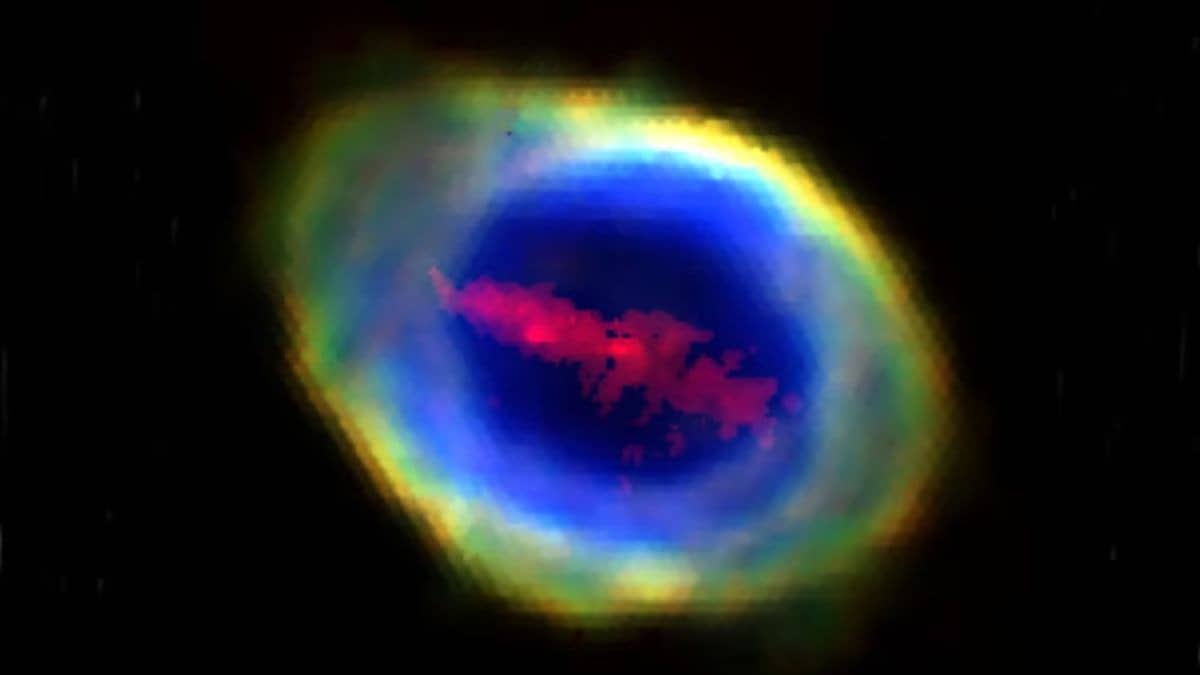
Astronomers have found a huge cloud of iron in the shape of a bar in the Ring Nebula, which is a glowing gas cloud from a dying star.
This iron bar is as long as 3.7 trillion miles and is a mystery because no other element is found in the same shape.
Scientists think it might be the remains of a planet that was destroyed when the star was dying, but they are not sure.
The Ring Nebula is about 2,600 light-years away from Earth and is a well-known object in the sky that can be seen with binoculars.
Studying such nebulas helps scientists understand how stars die and how elements are recycled in space.

Astronomers discovered a large iron bar in the Ring Nebula using the WEAVE instrument on the William Herschel Telescope.
The iron bar stretches about 3.7 trillion miles (6 trillion km) and is uniquely shaped compared to other elements in the nebula.
The Ring Nebula, located 2,600 light-years away in the constellation Lyra, is a well-known celestial structure formed about 4,000 years ago.
Scientists speculate the iron bar might be the remnants of a vaporized planet, though this explanation is still conjectural.
The nebula formed when a star about twice the mass of the sun expelled its outer layers, becoming a white dwarf.
- Who
- Astronomers using the WEAVE instrument on the William Herschel Telescope
- What
- Discovered a large cloud of iron atoms in the shape of a bar in the Ring Nebula
- When
- Observation made recently, with the nebula formed about 4,000 years ago
- Where
- Ring Nebula (Messier 57) in the constellation Lyra, about 2,600 light-years from Earth
- Why
- To understand the origin and composition of the iron bar, possibly linked to a vaporized planet
- Discovery
- Iron bar in Ring Nebula
- Length of Iron Bar
- 3.7 trillion miles (6 trillion km)
- Location
- Ring Nebula (Messier 57) in constellation Lyra
- Distance from Earth
- 2,600 light-years
- Age of Nebula
- Approximately 4,000 years
- Observation Tool
- WEAVE instrument on William Herschel Telescope
- Research Publication
- Monthly Notices of the Royal Astronomical Society