

Archive · 22 Dec 2025
NASA Discovers Exoplanet with Diamond-Forming Carbon Clouds
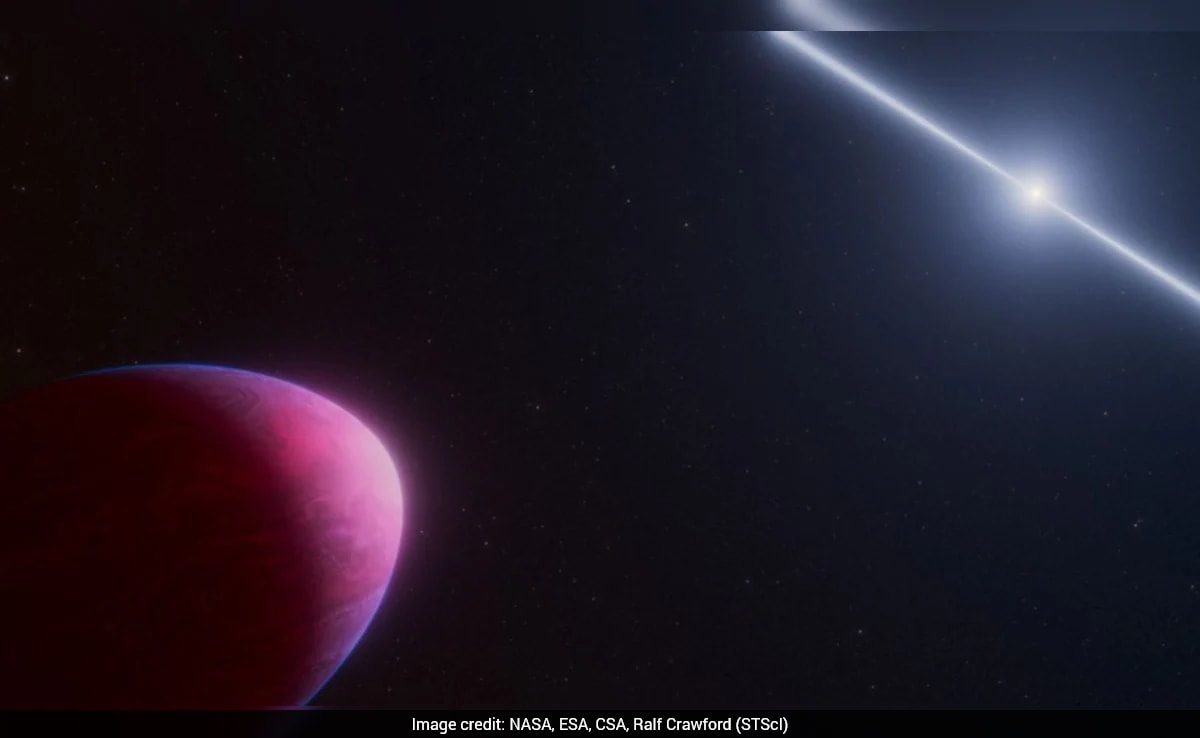
NASA's James Webb Space Telescope found a really weird planet called PSR J2322-2650b.
This planet is as big as Jupiter and goes around a special kind of star called a pulsar.
It's super close to the pulsar, so a year on this planet is only 7.8 hours long!
The planet is shaped like a lemon because the pulsar's gravity stretches it.
The planet's air is mostly helium and a special kind of carbon that can make diamonds.
Scientists are surprised because this planet doesn't have oxygen or nitrogen, which are usually found on other planets.
They're trying to figure out how this planet formed because it's unlike any other planet they've seen before.

NASA's James Webb Space Telescope discovered a rare exoplanet, PSR J2322-2650b, orbiting a pulsar at a distance of 1 million miles, with an orbital period of 7.8 hours.
The exoplanet's atmosphere is dominated by helium and molecular carbon (C3 and C2), with no detectable oxygen or nitrogen, making it unique among the 150 planets studied in detail.
The planet's surface temperatures range from 1,200°F to 3,700°F, and its shape is lemon-like due to the pulsar's intense gravity.
Scientists are puzzled by the planet's formation, as it doesn't fit known planetary formation mechanisms, with theories including crystallization of carbon and oxygen in the planet's interior.
The discovery was published in a paper in The Astrophysical Journal Letters, with scientists expressing surprise and interest in studying the planet's unique atmosphere and formation.
- Who
- NASA's James Webb Space Telescope (JWST) and a team of scientists led by Michael Zhang of the University of Chicago
- What
- Discovered a rare exoplanet, PSR J2322-2650b, with a unique atmosphere dominated by helium and molecular carbon, capable of forming diamonds
- When
- The discovery was published in a paper on Tuesday in The Astrophysical Journal Letters
- Where
- The exoplanet orbits a pulsar outside our solar system, 1 million miles away from the pulsar
- Why
- The exoplanet's unique composition and formation defy known planetary formation mechanisms, making it a subject of scientific interest and study
- Planet Name
- PSR J2322-2650b
- Host Star
- Pulsar (rapidly spinning neutron star)
- Orbital Distance
- 1 million miles
- Orbital Period
- 7.8 hours
- Atmospheric Composition
- Helium and molecular carbon (C3 and C2)
- Surface Temperatures
- 1,200°F to 3,700°F
- Shape
- Lemon-shaped due to pulsar's gravity
- Unique Feature
- No detectable oxygen or nitrogen