Archive · 3 Sep 2026
Uber and Wayve Launch London’s First Public Robotaxi Service
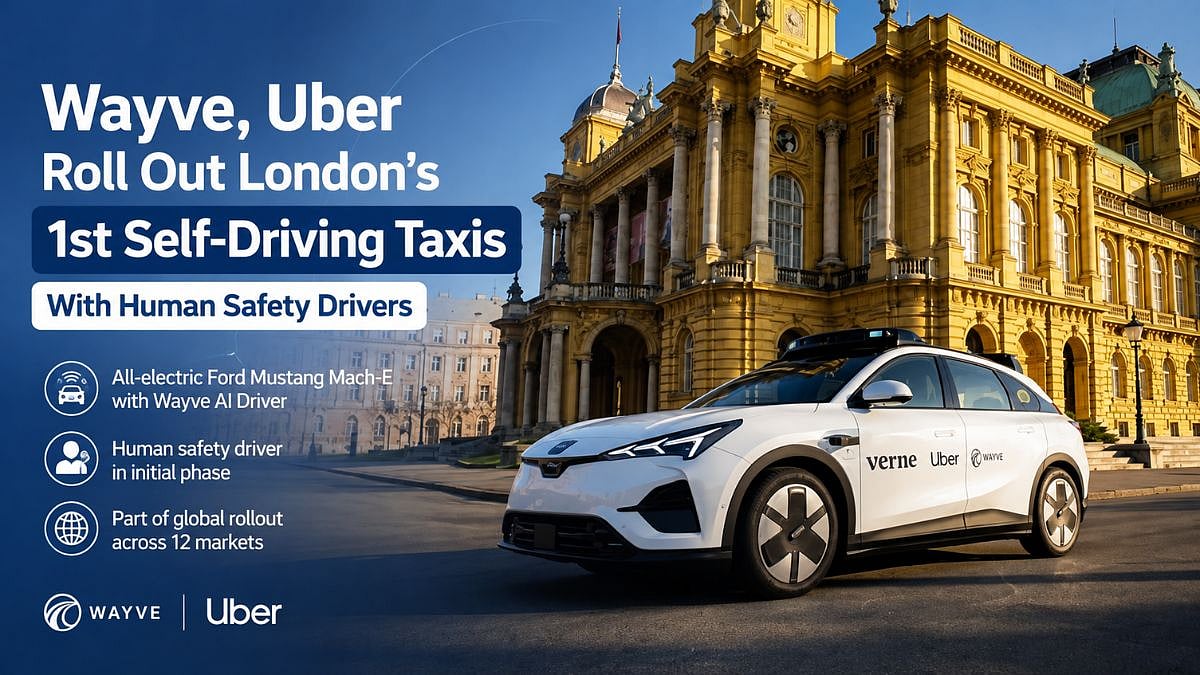
Uber and Wayve Technologies are letting some people in London ride in cars that can drive themselves.
The cars are electric Ford Mustang Mach-Es.
Wayve’s computer system uses cameras and other sensors to watch the road.
A trained human still sits in each car and can take control if needed.
During an early journalist ride, the human took control when a parked van created a confusing situation.
Passengers pay the same fare as for certain regular Uber rides.
They can reject an autonomous car and ask for a normal vehicle instead.
The companies hope the cars will eventually drive without a human, but officials must approve that first.

Uber and Wayve Technologies launched the United Kingdom’s first public robotaxi service in London on September 3, 2026.
The initial fleet includes 15 all-electric Ford Mustang Mach-E vehicles equipped with Wayve’s AI Driver.
Selected UberX, Uber Electric and Uber Comfort passengers may be matched with a robotaxi at no additional cost.
A trained human safety driver remains in every vehicle and can take control; one intervened during an early journalist ride.
Fully driverless operation depends on further testing, regulatory approval and local consent under the United Kingdom’s planned 2027 framework.
- Who
- Uber and British autonomous-driving company Wayve Technologies are operating the service, with London passengers as riders.
- What
- A public robotaxi service offering selected Uber passengers rides in vehicles using Wayve’s autonomous-driving technology.
- When
- The launch was announced for September 3, 2026; the Uber-Wayve partnership began in 2024 and London public-road trials followed the next year.
- Where
- London, with Wayve-equipped Nissan LEAF vehicles planned for Uber riders in Tokyo later in 2026.
- Why
- The rollout is intended to test autonomous driving in a complex urban environment and begin a wider commercial deployment.
Autonomous-Transport Supporters
Safety and Workforce Critics
Readiness for public roads
Autonomous-Transport Supporters
Uber and Wayve Technologies describe the launch as a milestone toward broader and eventually fully autonomous operation. Uber said more than 100,000 surveyed London customers would choose a self-driving taxi if one were available.
Safety and Workforce Critics
The service is not fully driverless because a safety driver must supervise every journey, and that driver intervened during an early journalist ride.
AI driving capability
Autonomous-Transport Supporters
Wayve Technologies says its AI Driver learns from real-world experience and can adapt to unfamiliar roads, vehicles, weather and cities without relying primarily on detailed high-definition maps or extensive hand-coded rules.
Safety and Workforce Critics
The intervention caused by a parked van illustrates concerns about unexpected situations. Questions remain about how autonomous systems will handle emergency vehicles, pedestrians, cyclists and unusual traffic behavior.
Expansion and regulation
Autonomous-Transport Supporters
The companies plan to expand the partnership internationally, including with Nissan LEAF vehicles in Tokyo, while the launch gives passengers more transport choice and could support investment and skills.
Safety and Workforce Critics
The United Kingdom is requiring approval before vehicles operate without a safety driver, and the Department for Transport is working toward a 2027 framework. Transport for London stresses safety, while trade unions have raised concerns about effects on professional drivers’ jobs.
- Initial fleet
- 15 all-electric Ford Mustang Mach-E vehicles.
- Operating companies
- Uber and Wayve Technologies.
- Eligible services
- UberX, Uber Electric and Uber Comfort.
- Passenger cost
- The robotaxi option initially costs the same as a standard ride in those services.
- Human supervision
- A trained safety driver remains in every vehicle and can brake or take control.
- Passenger choice
- Passengers are notified when offered an autonomous vehicle and can reject it in favor of a conventional Uber.
- Vehicle experience
- An in-car interactive screen displays the planned route and supports journey-start controls in 64 languages.
- Planned expansion
- Wayve and Uber plan to introduce Wayve-equipped Nissan LEAF vehicles in Tokyo later in 2026.