

Archive · 8 Nov 2025
Sea Urchins Possess Brain-Like System Throughout Body, Study Reveals
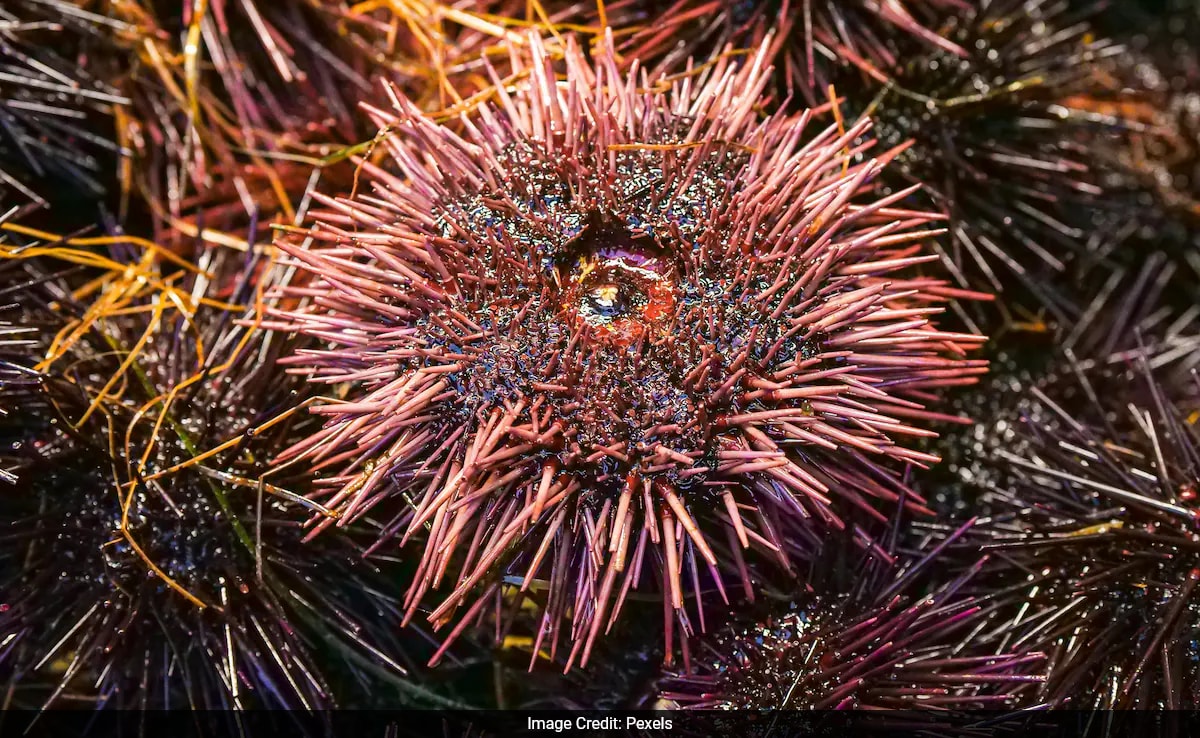
Imagine a spiny ball called a sea urchin.
Scientists found that it doesn't have a brain like humans do, with one main part.
Instead, its whole body acts like a very spread-out brain!
It has many tiny nerve cells all over, organized in a way that's surprisingly like our own brains.
These sea urchins start life looking different, with a body that can be cut in half like ours.
But as they grow up, they change into a star-like shape.
The study looked at how this happens and found that the genes for a 'head' in other animals are active in the sea urchin's whole body.
They even found that parts of their body can sense light, like little eyes all over!
This discovery changes how we think about how brains evolve in animals.

Sea urchins possess a complex nervous system organized similarly to vertebrate brains, functioning as an 'all-body brain.'
Researchers found that adult sea urchins have a 'head-like' body structure with no distinct trunk region.
Genes typically forming central body structures in other species are active only in internal organs in sea urchins.
Sea urchins exhibit a previously underappreciated ability to detect and process light using light-sensitive cells and receptors.
The study challenges traditional understanding of nervous system evolution, showing complex brain-like organization is possible without a central brain.
- Who
- An international team of researchers led by biologist Jack Ullrich-Luter
- What
- Discovered that sea urchins have a complex, brain-like nervous system spread throughout their bodies, with genetic organization similar to vertebrate brains.
- When
- The study focused on sea urchins immediately after metamorphosis, and the findings were recently published.
- Where
- The research involved sea urchins and was conducted by an international team, with a biologist from the Natural History Museum in Berlin mentioned.
- Why
- The research aimed to understand how the same genome can produce two completely different body structures in echinoderms and which cells play a role in this transformation.
- Animal Phylum
- Echinodermata
- Studied Species
- Purple Sea Urchin (Paracentrotus lividus)
- Key Finding
- Nervous system organization similar to vertebrate brains
- Body Symmetry (Adult)
- Radial, pentamerous
- Body Symmetry (Larval)
- Bilateral
- Unique Feature
- Lack of conventional central nervous system, "all-body brain"