

1 hr ago
India-MERCOSUR Paperless Trade Could Cut Exporters’ Costs
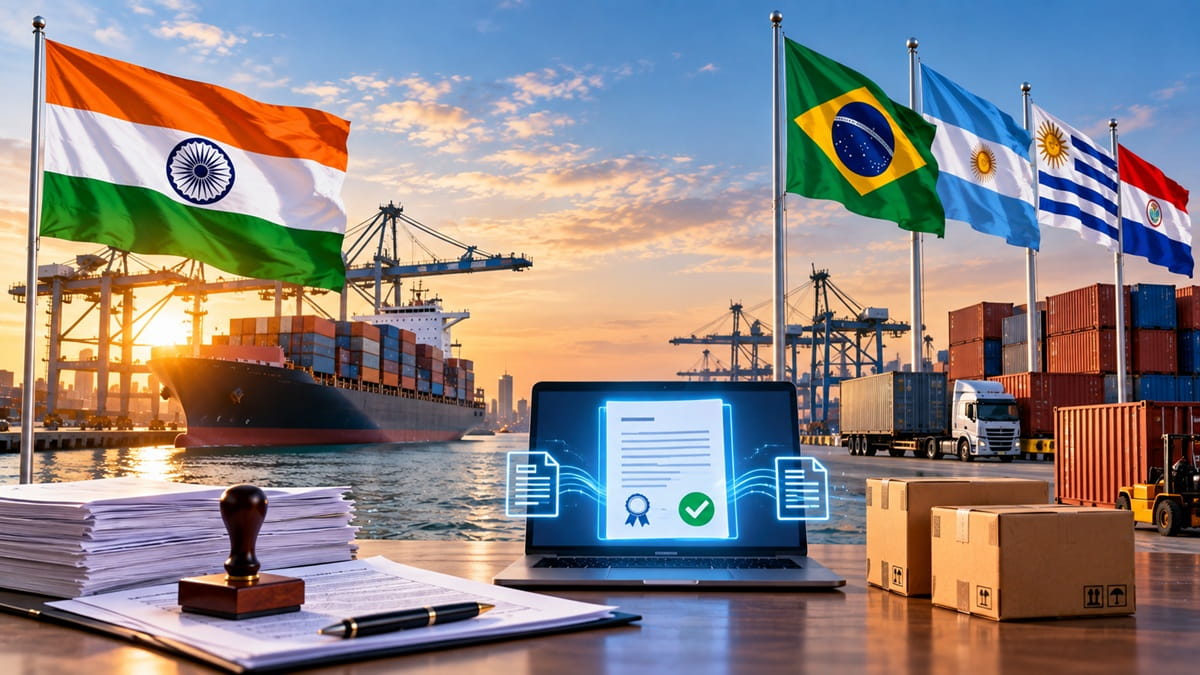
India and MERCOSUR want exporters to use electronic trade certificates instead of paper ones.
A Certificate of Origin shows where a product was made.
Import authorities use it to decide whether goods qualify for lower tariffs.
The new agreement says approved digital certificates will be legally equal to paper certificates.
This could make exporting faster, cheaper and less repetitive.
India is also connecting its government certificate system with companies’ own software.
The agreement does not provide new tariff discounts by itself.
Businesses must still wait for the agreement to take effect.
Smaller companies and frequent exporters could benefit if fewer manual steps are needed.

India and MERCOSUR signed a protocol recognizing electronic Certificates of Origin as legally equivalent to paper certificates.
The change could reduce paperwork, administrative costs, processing time and manual verification for exporters.
It does not create new tariff concessions; it helps businesses use benefits already available under the existing PTA.
India’s DGFT has introduced an Open API linking exporters’ business software with its Certificate of Origin system.
The protocol will benefit exporters only after internal procedures are completed and the digital system becomes operational.
- Who
- India and the MERCOSUR bloc signed the protocol, affecting exporters and import authorities.
- What
- They agreed to recognize electronically issued and signed Certificates of Origin with the same legal validity as paper certificates.
- Where
- The arrangement applies to trade between India and MERCOSUR member countries.
- When
- The protocol was signed on September 14; it will take effect after the parties complete internal procedures and notify one another.
- Why
- The aim is to reduce paperwork, processing time, administrative costs and friction when exporters claim preferential tariffs under the existing PTA.
Expected Benefits
Implementation Caveats
Lower export costs
Expected Benefits
Electronic certificates could reduce paperwork, repetitive data entry, errors, processing time and verification costs, especially for frequent exporters and MSMEs.
Implementation Caveats
Actual savings depend on when the protocol becomes operational and how widely businesses adopt the digital process.
Use of tariff preferences
Expected Benefits
Faster certificate processing could make it easier for exporters to claim preferential tariffs available under the existing PTA.
Implementation Caveats
The protocol does not add tariff concessions or expand market access by itself; it only changes how existing benefits can be accessed.
Trade expansion
Expected Benefits
Reducing procedural hurdles could support greater use of India’s trade agreements and help businesses access the MERCOSUR market.
Implementation Caveats
The protocol’s impact may remain limited if verification, adoption or implementation is slow; a separate negotiation is needed to expand the PTA.
Key facts
- Agreement
- First Additional Protocol to the India-MERCOSUR Preferential Trade Agreement
- Document covered
- Electronic Certificates of Origin
- Existing tariff coverage
- India offers concessions on 450 tariff lines, while MERCOSUR offers concessions on 452 tariff lines.
- India-MERCOSUR trade
- Around $20.84 billion in 2025, according to government figures.
- India-Brazil trade
- $15.07 billion in 2025-26, with a target of $30 billion by 2030.
- Domestic digitization
- The Directorate General of Foreign Trade introduced an Open API for Certificates of Origin through the Trade Connect e-Platform on September 7.
- Effective date
- The protocol is not operational until internal procedures and mutual notifications are completed.
Sources
Related news

India, MERCOSUR Sign Protocol for Electronic Origin Certificates

India, MERCOSUR Launch Talks to Expand Trade Pact

DGFT Open API Simplifies Certificate of Origin Process for Exporters

India-US Trade Pact Awaits Preferential Tariff Terms from Washington

Free Trade Agreements Drive India's Record Export Growth
India, Brazil Agree to Double Trade by 2030
DGFT Eases Export Rules for Shipments Up to ₹3 Lakh

India Extends Sugar Import Quota Surrender Deadline Amid Price Rise

Supreme Court Sets Aside Compulsory Retirement, Orders Farewell Ceremony
