Archive · 13 Nov 2025
Indian IT Sector Faces Existential Threat from AI and Security Concerns
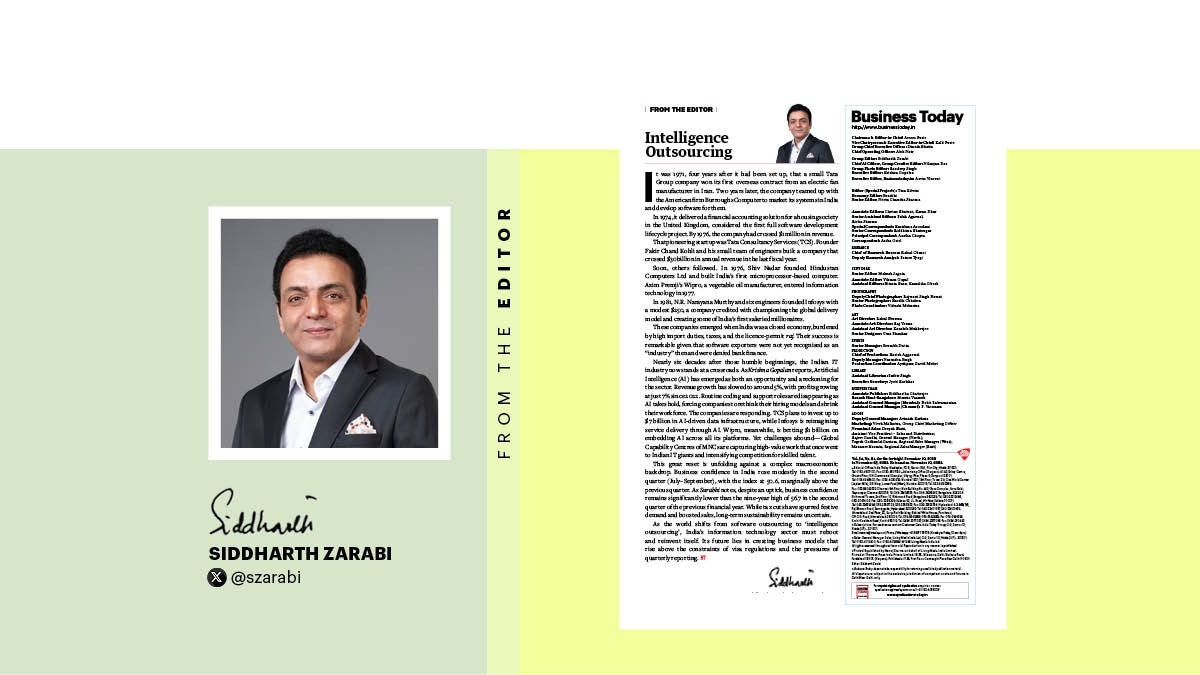
Imagine India's big computer helper companies used to be like a giant factory that could do lots of computer jobs for businesses around the world for cheap.
For a long time, this worked really well because they had many people who knew how to code and spoke English.
But now, super-smart computer programs called AI can do a lot of the easy coding jobs almost as well as people, but faster and cheaper.
Also, some big security problems have happened where these companies were involved, making clients worried about trusting them with important data.
It's like the factory's main selling points – cheap price and good communication – aren't as special anymore.
To stay successful, these Indian companies need to become more like creative problem-solvers and super-secure guardians, not just fast coders.
They have to prove they are trustworthy and can offer unique skills that AI can't replicate, or clients might choose other options.

India's IT services industry, historically strong in low-cost talent, faces disruption from AI automating routine coding tasks.
AI coding assistants are already used by 92% of developers, boosting productivity for repetitive tasks.
Security incidents, including major breaches allegedly linked to TCS-managed systems, are eroding client trust in Indian IT firms.
The industry's traditional advantages of cost and English proficiency are diminishing due to AI's global communication capabilities and AI tools.
Indian IT companies must shift from 'cost efficiency' to 'trust leadership' by prioritizing security, precision, and transparency to remain competitive.
- Who
- The Indian IT services industry, including companies like TCS, Infosys, Wipro, and Cognizant, facing challenges from AI and security incidents.
- What
- The Indian IT sector's traditional model based on low-cost, high-volume outsourcing is being undermined by AI's efficiency and increasing security breaches, forcing a fundamental shift towards 'intelligence outsourcing' centered on trust and advanced capabilities.
- When
- The challenges are current, with AI adoption accelerating and recent security incidents raising significant concerns, impacting UK revenues and leading to shifts in client procurement conversations.
- Where
- India, with impacts felt in its client markets such as the UK.
- Why
- AI is automating routine tasks previously done by human developers, and cyber security incidents, some linked to Indian IT firms, are eroding client trust, necessitating a move beyond cost arbitrage to value creation through trust and specialized intelligence.
Traditional IT Outsourcing Model
Future of IT Services
Value Proposition
Traditional IT Outsourcing Model
Relies on offering abundant, low-cost talent and English proficiency for services like routine coding and maintenance.
Future of IT Services
Must shift to 'intelligence outsourcing,' prioritizing creativity, oversight, security, precision, transparency, and trust leadership to differentiate beyond cost and communication.
Impact of AI
Traditional IT Outsourcing Model
AI tools are rapidly dismantling the advantage of low-cost talent by automating routine coding tasks efficiently and at low operational cost.
Future of IT Services
AI makes cost less relevant, shifting the competitive edge to trust and the ability to provide uniquely human skills like creativity and oversight.
Client Concerns
Traditional IT Outsourcing Model
Clients historically focused on technical capability and cost-effectiveness.
Future of IT Services
Clients now demand proof of robust security against social engineering and insider breaches, zero-breach track records, and contractual liability for security failures, emphasizing resilience and prevention over mere compliance.
- AI Coding Assistants Usage
- 92% of developers use AI coding assistants (GitHub 2024 report)
- AI Productivity Gains (Routine Tasks)
- Up to 55%
- Average Cost of Data Breach (Tech/Services)
- $5.17 million (IBM 2024 Report)
- Marks & Spencer Breach Cost
- £300 million (allegedly via TCS contractor)
- Jaguar Land Rover Cyberattack
- £1.9 billion (disruption linked to TCS-managed systems)
- Clorox Lawsuit against Cognizant
- $380 million (over attack exploiting its helpdesk)