2 hrs ago
India’s EV Shift Creates Growth for Wiring and ECU Makers
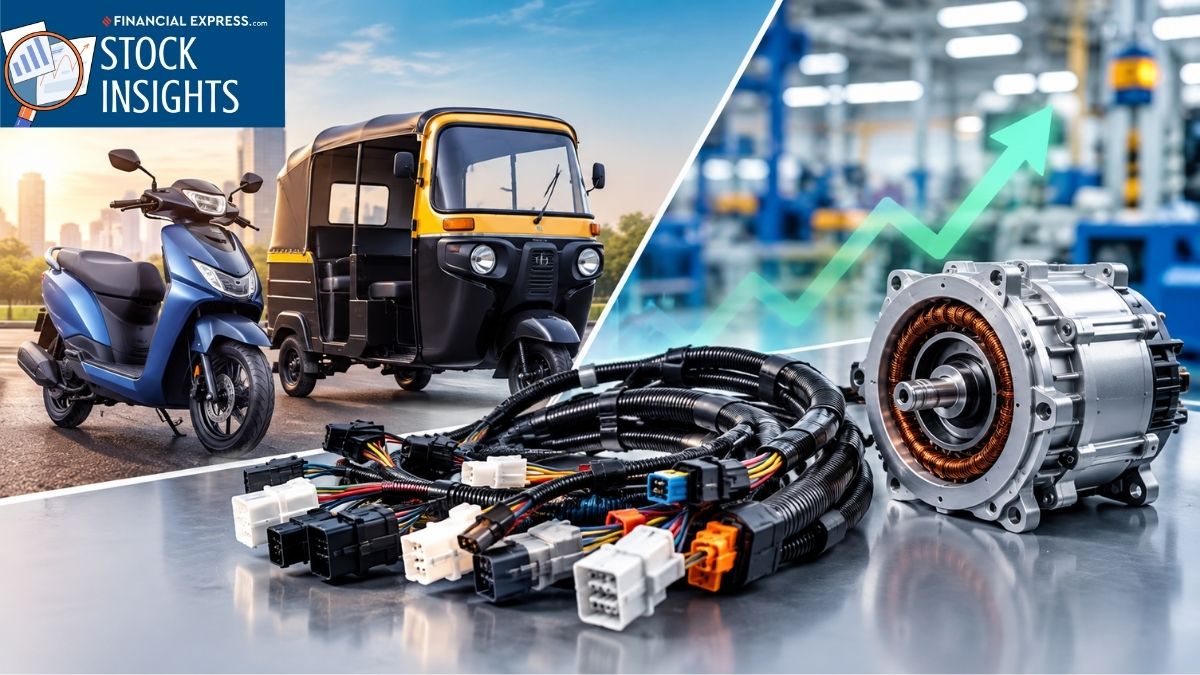
Indian two-wheelers are using more electronics and electric parts.
This means they need more wires, sensors, controllers, and other components.
Electric scooters can require several times more wiring value than petrol scooters.
Dhoot Transmission makes wiring harnesses and has a large share of this market.
SEDEMAC makes electronic control units that help vehicles operate.
Both companies are growing as manufacturers add more technology to their vehicles.
They are also building new factories and increasing production capacity.
However, investors are paying high prices for their shares, so weak execution could be risky.

India’s domestic two-wheeler wiring-harness market is projected to grow at a 14% CAGR from FY26 to FY31.
Electric two-wheeler wiring-harness demand is expected to expand 38–41% annually, compared with 8–10% for ICE vehicles.
Dhoot Transmission holds a 38% share of India’s two-wheeler wiring-harness market and reported ₹1,446.4 crore revenue in Q1FY27.
SEDEMAC accounted for 80% of India’s two- and three-wheeler ISG market-volume growth in FY26.
Both companies are expanding capacity, but their premium valuations leave limited room for execution errors.
- Who
- Dhoot Transmission and SEDEMAC Mechatronics, two Indian automotive-component manufacturers.
- What
- The companies are positioned to benefit from increasing electronics, electrification, wiring-harness demand, and ISG adoption in India’s two- and three-wheeler industry.
- Where
- Primarily India; SEDEMAC also supplies manufacturers in the United States and Europe.
- When
- The article discusses FY26 results and Q1FY27 performance, with projections through FY31.
- Why
- Two- and three-wheelers are adopting more sensors, electrical systems, electrified powertrains, wiring, and electronic control units.
Growth case
Valuation and execution risks
Electric-vehicle expansion
Growth case
Rising EV adoption should increase demand for wiring harnesses, battery assemblies, controllers, sensors, and other higher-value components.
Valuation and execution risks
The companies’ premium valuations leave limited room for slower EV adoption, weaker volumes, or execution mistakes.
Business positioning
Growth case
Dhoot has wiring-harness leadership, while SEDEMAC supplies products across both internal-combustion and electric platforms.
Valuation and execution risks
Future returns depend on successfully ramping new models, facilities, and EV products while managing supply-chain and raw-material pressures.
Financial performance
Growth case
Both companies reported strong Q1FY27 growth, with SEDEMAC’s net profit rising 95% and Dhoot’s rising 37.8%.
Valuation and execution risks
SEDEMAC’s Q1FY27 EBITDA margin was slightly compressed by semiconductor supply tightening and higher raw-material costs.
Key facts
- Dhoot market share
- 38% of India’s two-wheeler wiring-harness market.
- Wiring-harness outlook
- India’s domestic two-wheeler wiring-harness market is expected to grow at a 14% CAGR from FY26 to FY31.
- EV wiring growth
- The electric two-wheeler wiring segment is projected to grow at a 38–41% CAGR during FY26–FY31.
- Dhoot Q1FY27 revenue
- ₹1,446.4 crore, up 49.7% year on year.
- SEDEMAC Q1FY27 revenue
- ₹310 crore, up 43% year on year.
- SEDEMAC ISG position
- The company accounted for 80% of total Indian two- and three-wheeler ISG market-volume growth in FY26.
- Capacity plans
- Dhoot plans to increase wiring-harness capacity from 130 lakh to 160 lakh units by June 2027; SEDEMAC is adding a facility three times the size of its current primary plant.
Sources
Related news

Dhoot Transmission Valuation Prompts Investors to Consider Booking Profits

Vehicle Electronics Set to Drive Major Indian Localisation Opportunity
5 EV Supply Chain Stocks to Watch in 2026
India Electric Two-Wheeler Sales Cross 1.36 Million in 2026
India’s Grid Expansion Highlights Three CTC Supplier Stocks

VinFast Begins India Dealer Hunt Ahead of Electric Scooter Launch

Ola Electric Delays Three-Wheeler Launch After ₹229 Crore Spend
Hero Motors Sets IPO Band, Targets ₹3,815 Crore Valuation
Honda Extends Lead Over Hero MotoCorp in August Sales