

Archive · 20 Jul 2026
Amazon Adapts Strategy for Bharat's E-Commerce Growth
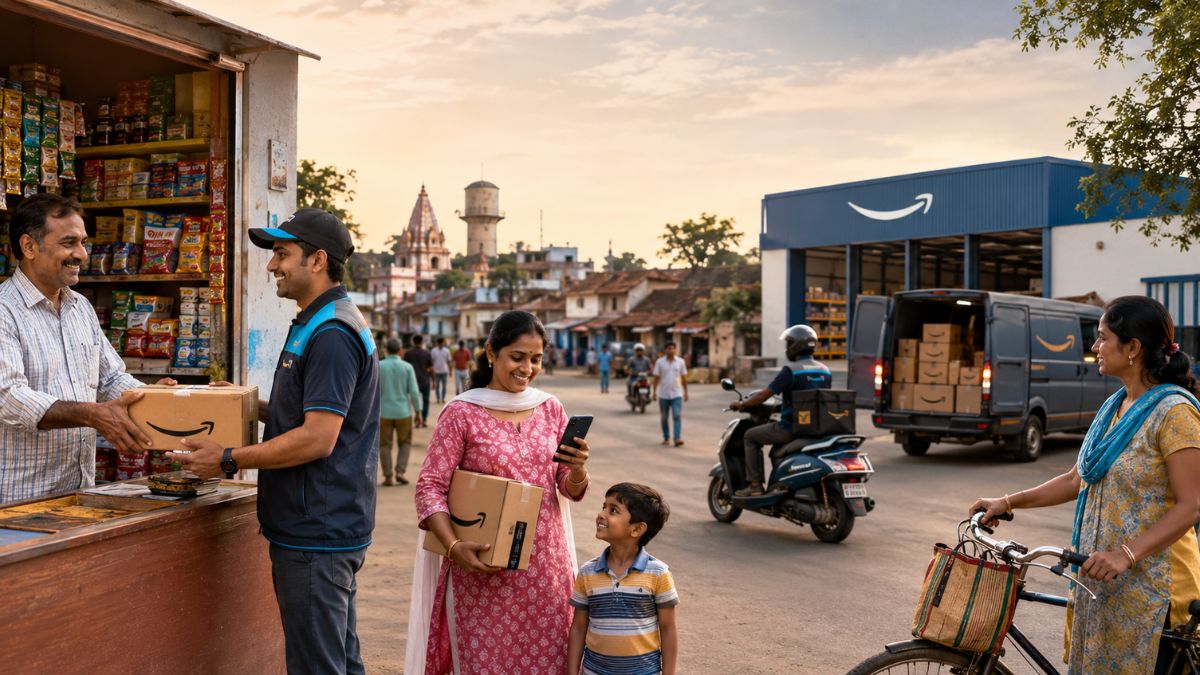
Amazon, which has been a big player in India's e-commerce market, is changing its strategy.
Instead of just focusing on big cities, it's now trying to win over customers in smaller towns.
These towns are where most new online shoppers are coming from.
Amazon has a huge delivery network, but now it's also launching new stores for affordable products and investing more in quick delivery services.
Other companies like Flipkart and Meesho are also competing for these customers.
They are offering good deals and using local influencers to attract shoppers.
The next big challenge for all these companies will be to understand what local customers want and provide the right products and services.

Amazon is shifting its focus to tier-2, tier-3, and smaller towns in India, where 63% of e-commerce orders originate.
Flipkart leads the e-commerce market with 50-60% gross merchandise value (GMV) share, while Amazon holds 25-30% and Meesho has about 10%.
Amazon has launched Amazon Bazaar, a storefront for affordable, unbranded fashion and lifestyle products, to attract value-conscious consumers.
The company is investing Rs 2,800 crore to expand its fulfillment network and strengthen Amazon Now, its quick commerce business.
Experts believe the next phase of competition will be decided by local relevance, region-specific assortments, and stronger partnerships with MSMEs.
- Who
- Amazon, Flipkart, Meesho, and other e-commerce players.
- What
- Amazon is recalibrating its strategy to focus on tier-2, tier-3, and smaller towns in India.
- When
- The shift is ongoing, with recent investments and expansions announced.
- Where
- India, particularly tier-2, tier-3, and smaller towns.
- Why
- To remain relevant in the fastest-growing consumer markets and win over value-conscious consumers.
Amazon's Strengths
Competitors' Advantages
Logistics Network
Amazon's Strengths
Amazon has one of India's largest logistics networks, serving all serviceable PIN codes with fulfillment centers, delivery stations, and partnerships.
Competitors' Advantages
Competitors like Flipkart and Meesho have built strong value propositions and deep penetration in mass-market and value-conscious segments.
Market Share
Amazon's Strengths
Amazon holds around 25-30% of the e-commerce market share.
Competitors' Advantages
Flipkart leads with 50-60% market share, while Meesho has about 10% share, focusing on value-conscious consumers in smaller towns.
Consumer Behavior
Amazon's Strengths
Amazon is expanding its fulfillment network and quick commerce business to meet evolving consumer expectations.
Competitors' Advantages
Competitors are leveraging vernacular content, creator-led commerce, and local influencers to shape purchase decisions.
- Market Share
- Flipkart: 50-60%, Amazon: 25-30%, Meesho: 10%
- E-Commerce Orders from Tier-2 and Smaller Towns
- 63%
- Amazon's Fulfillment Network
- Serves all serviceable PIN codes with fulfillment centers, delivery stations, and partnerships.
- Prime Members' Delivery
- Over 97% of serviceable PIN codes eligible for one- or two-day deliveries.
- Amazon Bazaar
- Dedicated storefront for affordable, unbranded fashion and lifestyle products.
- Investment in Fulfillment Network
- Rs 2,800 crore committed to expand fulfillment network and Amazon Now.
- New Fulfillment Centers and Delivery Stations
- More than 20 fulfillment centers and over 100 last-mile delivery stations to be added this year.
- New Customers from Tier-2 and Smaller Towns
- Nearly 70% of Amazon's new customers.