

Archive · 9 Aug 2025
India's Dhruva Reactor Goes Critical; Political Talks Held
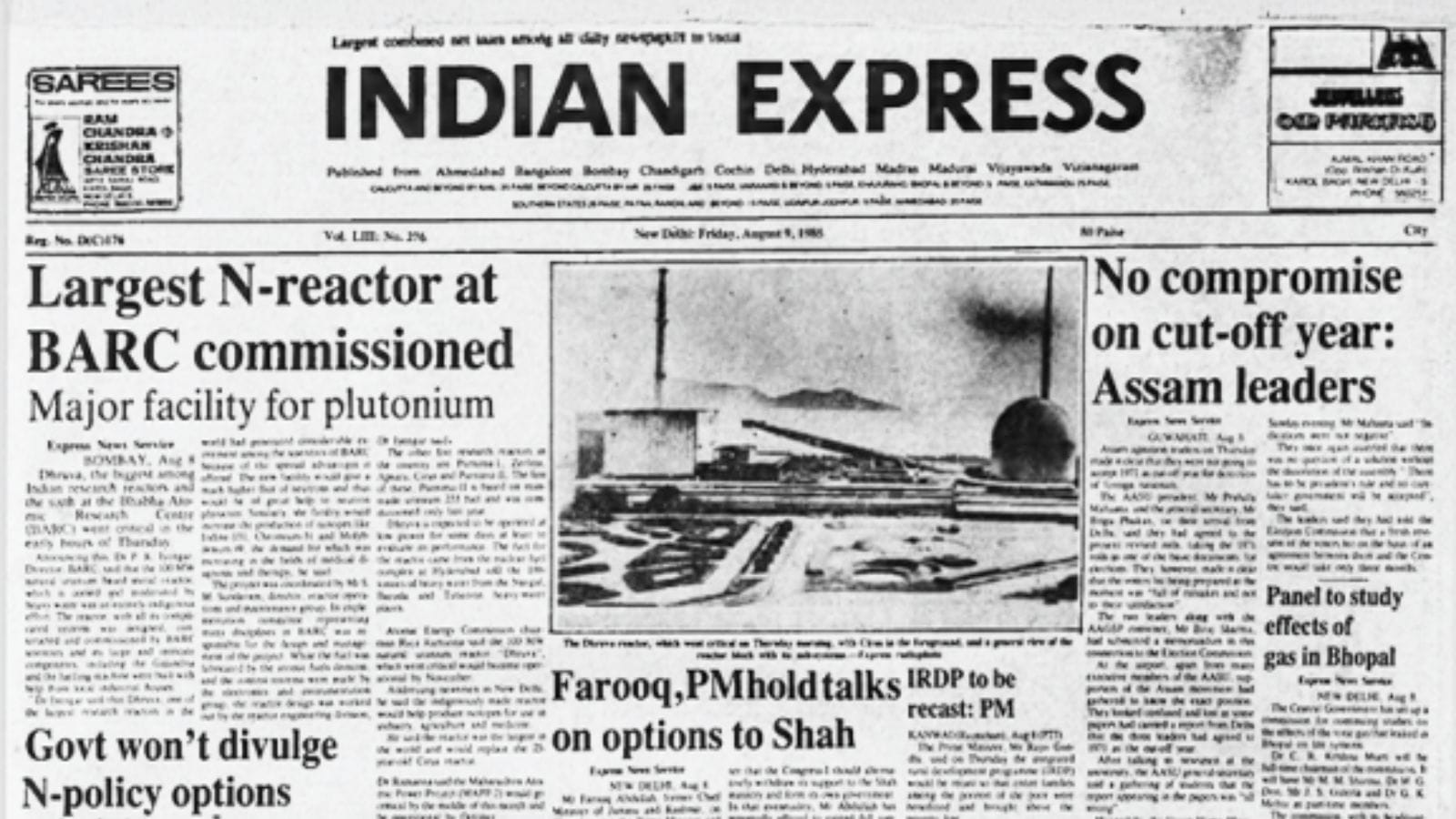
In 1985, India achieved a major milestone in nuclear research.
The Dhruva research reactor, the largest in India, went live at the Bhabha Atomic Research Centre.
This was a significant accomplishment as the reactor, a 100 MW natural uranium-based reactor cooled by heavy water, was entirely built by Indian scientists.
Separately, Farooq Abdullah, a former chief minister, met with Prime Minister Rajiv Gandhi.
They talked about the political issues in Jammu and Kashmir, aiming to address the instability.

Dhruva, India's largest research reactor, went critical at Bhabha Atomic Research Centre (BARC).
The reactor is a 100 MW, natural uranium-based metal reactor cooled and moderated by heavy water.
The project was entirely indigenous.
Director of BARC, P. K. Iyengar, announced the achievement.
Farooq Abdullah met with Prime Minister Rajiv Gandhi to discuss political instability in Jammu and Kashmir.
- Who
- P. K. Iyengar, director of BARC, Farooq Abdullah, and Prime Minister Rajiv Gandhi.
- What
- Dhruva reactor went critical and talks about Jammu and Kashmir political situation.
- When
- July 8, 1985
- Where
- Bhabha Atomic Research Centre (BARC) and meeting in New Delhi.
- Why
- To find ways to end political instability in Jammu and Kashmir and to celebrate the Dhruva reactor achievement.
Jammu and Kashmir Political Instability
No differing views presented
Political instability
Jammu and Kashmir Political Instability
The growing disillusionment of the Congress-I with the G M Shah ministry.
No differing views presented
Not explicitly stated in the context.
- Reactor Name
- Dhruva
- Reactor Type
- Research Reactor
- Power Output
- 100 MW
- Fuel Type
- Natural Uranium
- Coolant
- Heavy Water
- Location
- Bhabha Atomic Research Centre (BARC)
- Meeting Participants
- Farooq Abdullah and Rajiv Gandhi