

10 months ago
US and Philippines Bolster Defenses in Batanes Near Taiwan
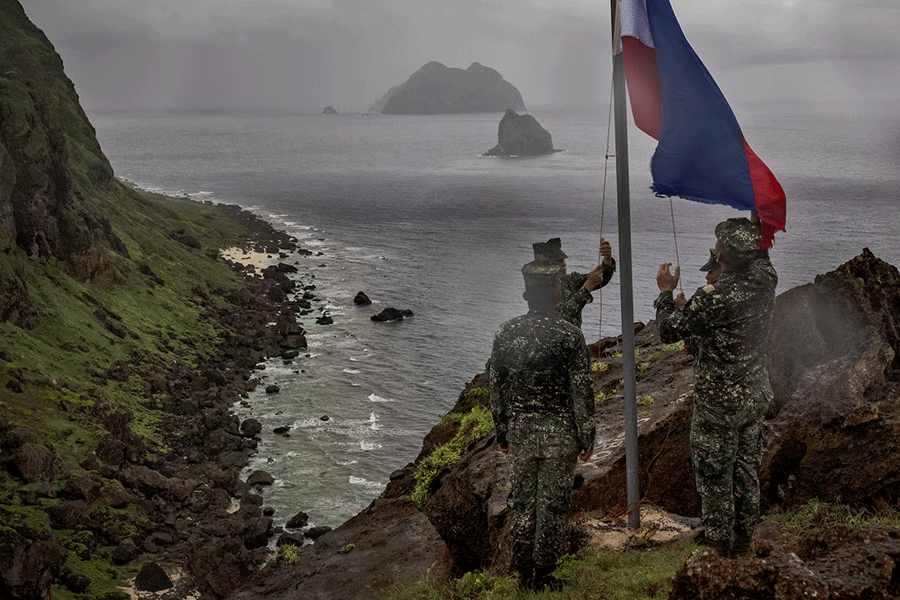
Imagine two neighbors, the US and the Philippines, are practicing how to block a very important water road near Taiwan called the Bashi Channel.
This road is important because it helps ships travel between the South China Sea and the big Pacific Ocean.
China wants to have control of this area.
The US and Philippines are doing this by practicing with special missile launchers that can hit ships from land.
They want to make sure that if there's a problem, China's navy can't easily use this water road.
People living on islands nearby, like in Batanes, are a bit worried because these practice drills feel like real preparations for a fight, and they fear getting caught in the middle if a conflict happens over Taiwan.
China says this is interfering in its business and making things tense.

The US and Philippines are conducting joint military exercises in Batanes province, strategically located near Taiwan, to counter China's growing naval power.
These exercises involve deploying ground-based anti-ship missile systems like NMESIS, designed to deny access to the Bashi Channel, a critical Pacific waterway.
Local residents in Batanes express anxiety over the increased military activity and the potential for conflict, with some preparing for supply disruptions.
China views these deployments and exercises as provocative, warning against external interference in its affairs concerning Taiwan.
The US strategy aims to leverage the Philippine archipelago's geography to contain Chinese forces within the 'First Island Chain'.
- Who
- United States and Philippine military forces, with local residents of Batanes, and the governments of China and Taiwan.
- What
- Joint military exercises, including the deployment of anti-ship missile systems, aimed at denying China access to key Pacific waterways and deterring aggression towards Taiwan. Local residents express concern about potential conflict.
- Where
- Batanes Province, Philippines, specifically near the Bashi Channel.
- When
- Recent joint exercises occurred from April to June, with ongoing military engagements and strategic planning for 2026.
- Why
- To counter China's naval expansion, deter potential aggression against Taiwan, and maintain strategic control of vital Pacific shipping lanes.
United States and Philippines
China
Purpose of Military Exercises
United States and Philippines
The exercises, including anti-ship missile deployments, are defensive measures to deter Chinese aggression, protect regional stability, and ensure freedom of navigation in vital waterways like the Bashi Channel.
China
These military drills and weapon deployments by the US and Philippines are provocative actions that undermine regional peace, increase tensions, and interfere in what China considers its internal affairs regarding Taiwan.
Control of the Bashi Channel
United States and Philippines
The Philippines, with US support, aims to deny China control of the Bashi Channel, viewing it as a critical chokepoint that could decide the outcome of a conflict in the region, particularly concerning Taiwan.
China
China asserts its strategic interests in the waters around Taiwan and the South China Sea, viewing any attempts by external forces to block key passages like the Bashi Channel as a threat to its national security and territorial claims.
US Military Presence in the Philippines
United States and Philippines
The enhanced US military presence and rotational force deployments in the Philippines are crucial for regional deterrence and are a result of the Philippines' strategic location and bilateral defense agreements.
China
China warns the Philippines against drawing in external forces and advises against actions that provoke confrontation, viewing the US military's increased engagement in the region as a destabilizing factor.
Key facts
- Location
- Batanes Province, Philippines
- Proximity to Taiwan
- Less than 90 miles
- Key Waterway
- Bashi Channel
- Military Exercises
- Joint US-Philippine amphibious warfare and anti-ship missile drills
- US Weaponry Deployed
- NMESIS ground-based anti-ship missile launchers, Typhon launchers (Luzon)
- Philippine Defense Systems
- BrahMos supersonic anti-ship cruise missiles
Quotes

Philippine Defense Ministry
The defense ministry of the Philippines.
“neither confirm nor deny whether these systems remain in the country or where they are currently located. This is a matter of operational security.”
 telegraphindia.com
“purely for training and deterrence and not directed at any specific country or intended to close any maritime passage such as the Bashi Channel.”
telegraphindia.com

China's Foreign Ministry
The foreign ministry of Beijing.
“frequent, highly targeted military exercises conducted by the United States and the Philippines in the region, alongside the deployment of strategic offensive weapons such as the Typhon.”
telegraphindia.com
“The Taiwan issue is China's internal affair. How to resolve it is solely China's own business and does not warrant interference from others.”
telegraphindia.com
Marilyn Hubalde
A 65-year-old resident and owner of a variety store in Basco, the provincial capital of Batanes.
“We were terrified. We thought China might attack when they learned there were military exercises in Batanes.”
telegraphindia.com
“She thought the war had already started.”
telegraphindia.com
Rommel Ong
Retired Rear Admiral and former vice-commander of the Philippine Navy.
“We should have the ability to deny the Chinese control of the Bashi Channel. In a conflict scenario, that decisive point will determine who wins or who loses.”
telegraphindia.com
“My personal rule of thumb is that if the Beijing Ministry of Foreign Affairs spokesman talks about it and they don’t like it, that means we’re doing it right.”
telegraphindia.com
Roy Trinidad
Philippine Navy spokesperson.
“By divine design, we have been put here, the archipelago has been put here. It just so happened that we are the toll gate between the South China Sea and the Pacific Ocean.”
telegraphindia.com
“is designed to close a strait.”
telegraphindia.com
Ronald “Jun” Aguto Jr.
Newly elected provincial governor of Batanes.
“One scenario in our contingency plan is to use Batanes as a launch pad to bring home OFWs from Taiwan. But, our islands are designed to support 20,000 people. We have to bring them back to the mainland where their sustainability will be more realistic.”
telegraphindia.com
“So, we had to educate them and tell them that, you know, this is just a military exercise.”
telegraphindia.com

Florencio Abad
Retired politician, former budget secretary, and a member of one of Batanes’ most prominent families.
“I was concerned that history will repeat itself.”
telegraphindia.com
“I’m not even thinking about livelihood. I’m just thinking about surviving a war that is so close to us. Even if we do not get directly involved, we may have to take precautions. What if it is not possible to travel by sea or travel by air? How do we feed ourselves?”
telegraphindia.com

Emmanuel Bautista
Retired General and former chief of staff of the Armed Forces of the Philippines.
“The invasion of Taiwan is almost impossible if you don’t control the northern Philippines.”
telegraphindia.com

Ferdinand Marcos Jr.
President of the Philippines.
“We do not want to go to war. But I think if there is a war over Taiwan, we will be drawn kicking and screaming, we will be drawn and dragged into that mess.”
telegraphindia.com
Edward Ike De Sagon
Commodore and former Philippine Navy commander for Northern Luzon.
“managing an influx of Filipino workers and “possibly refugees from Taiwan and other nationalities.”
telegraphindia.com
U.S. Military
The United States military.
“sea denial capability”
telegraphindia.com
Romeo Brawner
Philippine military chief.
“are here to train us because once we buy these capabilities we should be ready to use them.”
telegraphindia.com
