Archive · 7 Sep 2026
NSE, BSE Revise Pre-Open Rules, Restrict Market Orders After 9:05
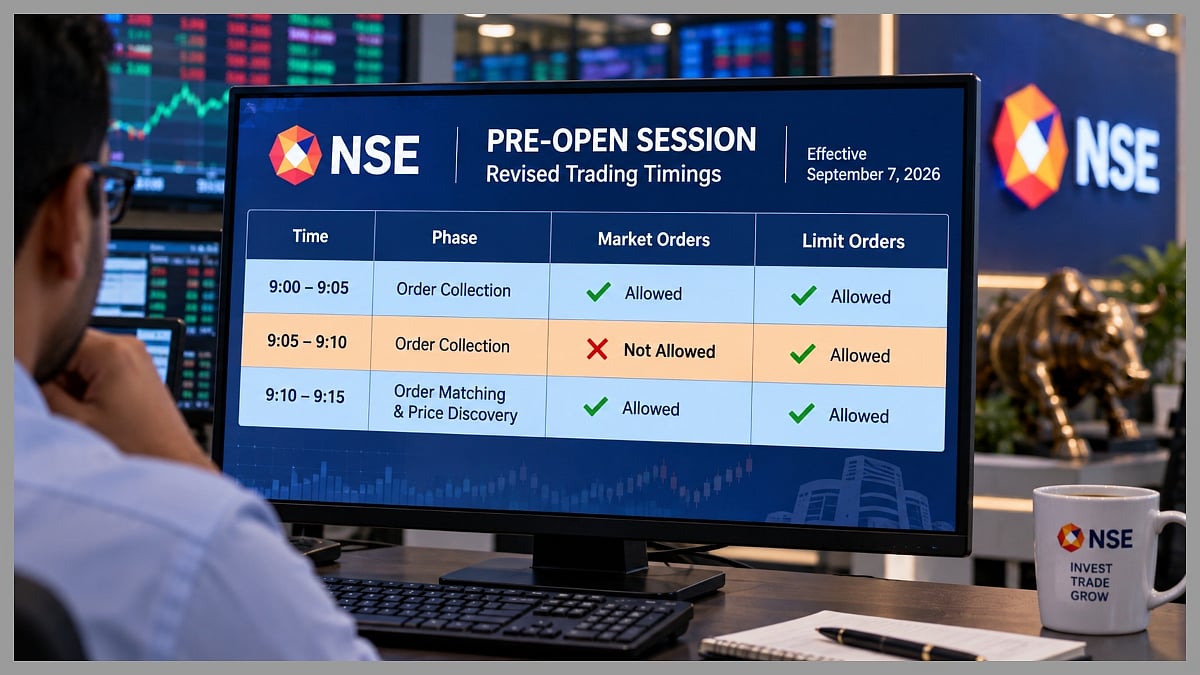
India’s stock exchanges are changing how trading begins each morning.
The pre-open session will still run from 9:00 AM to 9:15 AM.
During the first five minutes, investors can use both market orders and limit orders.
After 9:05 AM, only limit orders can be entered, changed, or cancelled.
This means investors using market orders must act during the first five minutes.
Orders will be matched and trades confirmed from 9:10 AM to 9:12 AM.
The last three minutes will help the market move into regular trading.
The exchanges say the changes are intended to make opening prices more orderly and align the process with the Closing Auction Session.
The rules cover several types of equity securities, not only futures and options-related stocks.

The NSE, and according to one report the BSE, revised the 9:00 AM–9:15 AM pre-open framework from Monday, September 7, 2026.
Investors can place, modify, or cancel market and limit orders only during the 9:00 AM–9:05 AM first phase.
From 9:05 AM to 9:10 AM, only limit orders can be placed, modified, or cancelled.
Order matching and trade confirmation now occur from 9:10 AM to 9:12 AM, followed by a three-minute buffer period.
The changes apply to eligible equity-market securities, including main-board and SME shares, partly paid-up shares, InvITs, and REITs.
- Who
- The National Stock Exchange and, according to one report, the Bombay Stock Exchange are changing pre-open trading procedures for market participants.
- What
- The exchanges are dividing the pre-open session into separate order-entry, order-matching, and buffer phases, while restricting market orders after 9:05 AM.
- When
- The revised framework began Monday, September 7, 2026, while the related Closing Auction Session was introduced on August 4.
- Where
- The changes apply to the equity cash-market pre-open sessions of the Indian stock exchanges.
- Why
- The stated aims are to align pre-open trading with the Closing Auction Session, improve price discovery, coordinate cash and derivatives operations, and support a smoother market transition.
Expected Benefits
Participant Concerns
Opening-price stability
Expected Benefits
Restricting market orders after 9:05 AM may limit late-stage price swings and reduce the possibility of large orders being placed and cancelled shortly before matching.
Participant Concerns
Traders responding to overnight news or global market gaps have only the first five minutes to place, modify, or cancel market orders.
Execution versus price control
Expected Benefits
Market-order priority may improve execution for orders placed early, while later limit orders can provide liquidity and respond to the initial order flow.
Participant Concerns
Price-sensitive traders have less flexibility after 9:05 AM because they cannot use, modify, or cancel market orders during the second phase.
- Pre-open session
- 9:00 AM to 9:15 AM
- Phase 1
- 9:00 AM to 9:05 AM; market and limit orders may be entered, modified, or cancelled.
- Phase 2
- 9:05 AM to 9:10 AM; only limit orders may be entered, modified, or cancelled.
- Matching period
- 9:10 AM to 9:12 AM; opening prices are established and eligible orders are matched.
- Buffer period
- 9:12 AM to 9:15 AM, before regular continuous trading begins.
- Order priority
- Market orders receive priority over limit orders during price determination, according to the reports.
- Covered securities
- Main-board shares, SME shares, partly paid-up shares, Infrastructure Investment Trusts, and Real Estate Investment Trusts.
- Related mechanism
- The revised framework is aligned with the Closing Auction Session introduced in the equity cash market on August 4.