

Archive · 13 Nov 2025
Scientists Observe First Moments of Dying Star Transforming into Supernova
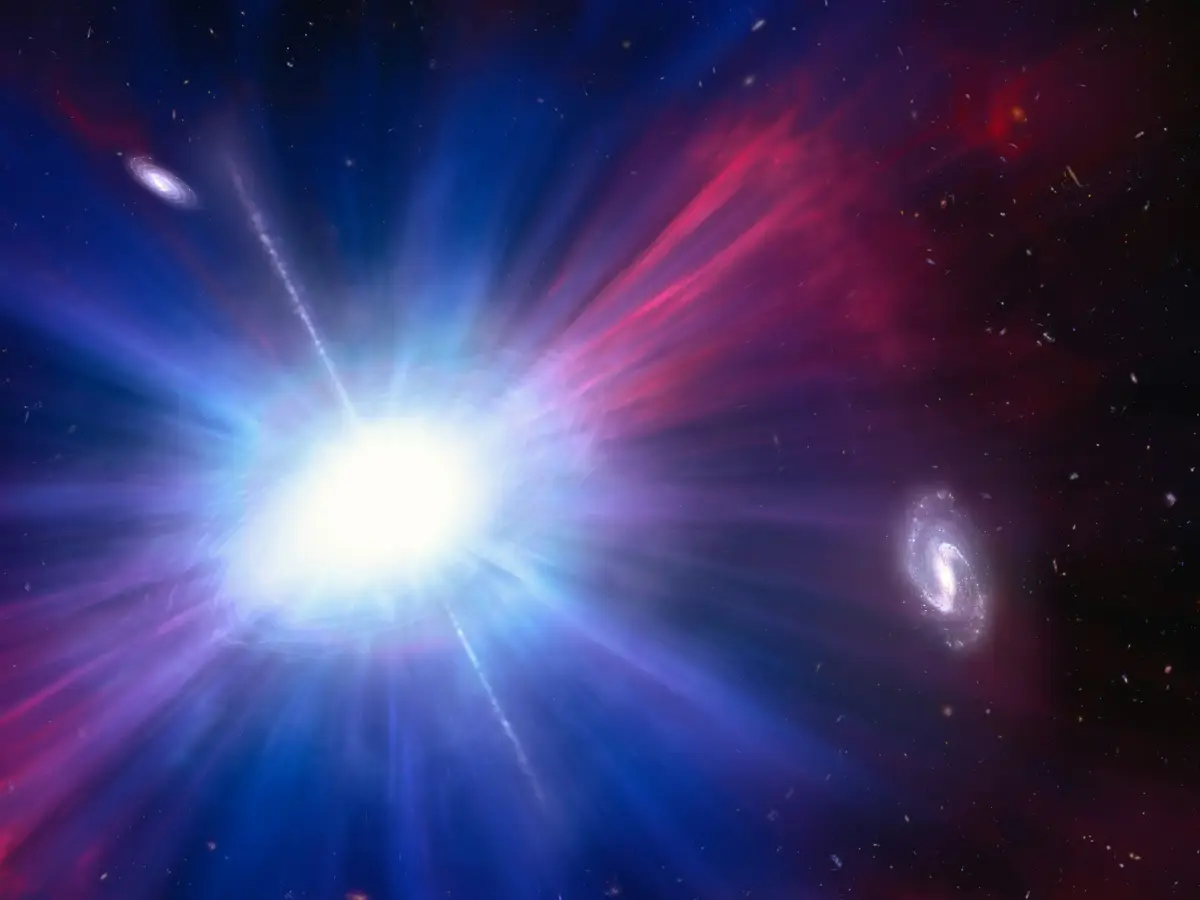
Imagine a giant star that's lived a long life and is now running out of energy.
When this happens, the star's center collapses, and then it bursts outwards in a huge explosion called a supernova.
Scientists used a powerful telescope in Chile to look at a specific star, SN 2024ggi, right as it was starting to explode.
They couldn't see colors at first, but by studying how the light scattered, they could figure out the star's shape.
At the very beginning, the explosion looked like an olive.
As the star's material spread out, it became flatter, but still kept its main shape.
This event happened in a galaxy far away called NGC 3621.
By watching this, scientists are learning more about how stars like this one, which are much bigger than our sun, live and die.

Scientists observed the initial moments of supernova SN 2024ggi in April 2024 using the Very Large Telescope.
The supernova, located 22 million light-years away in the galaxy NGC 3621, was formed from a red supergiant star 12-15 times the mass of the Sun.
The study reconstructed the supernova's geometry from the polarization of its light, revealing an initial olive shape that later flattened.
Supernovas occur when massive stars exhaust their fuel, causing their core to collapse and then rebound outwards in a powerful explosion.
The findings, published in Science Advances, aim to provide fundamental information on stellar evolution and explosion processes.
- Who
- Scientists at the European Southern Observatory (ESO) and Tsinghua University
- What
- Observed the first moments of a dying star transforming into a supernova (SN 2024ggi)
- When
- April 2024
- Where
- The galaxy NGC 3621, 22 million light-years away
- Why
- To study stellar evolution and the physical processes of supernova explosions by observing the geometry of the initial blast.
- Event
- Supernova SN 2024ggi
- Location
- Galaxy NGC 3621
- Distance
- 22 million light-years
- Observatory
- Very Large Telescope (VLT) in Chile
- Date of Observation
- April 2024
- Publication
- Science Advances
- Date of Publication
- November 12